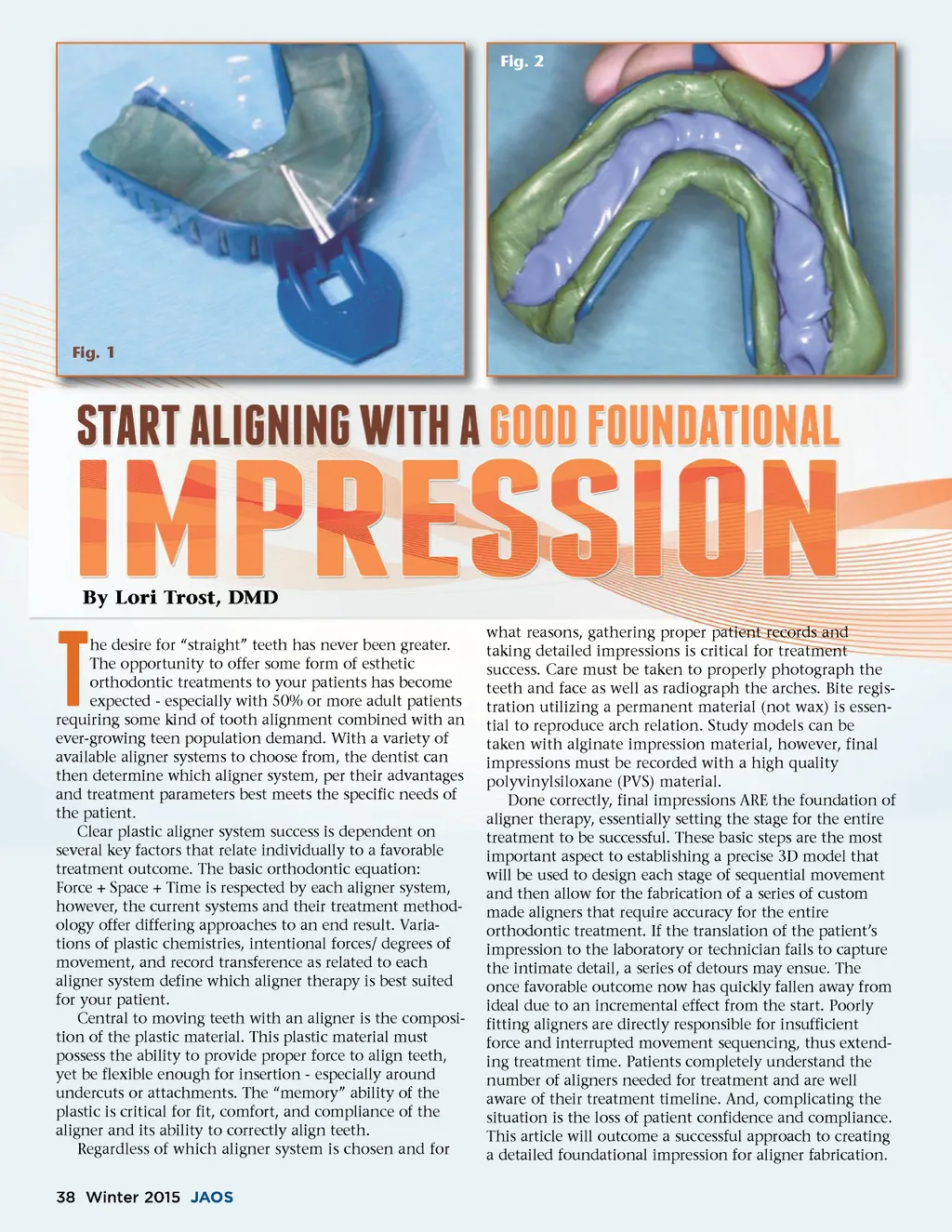
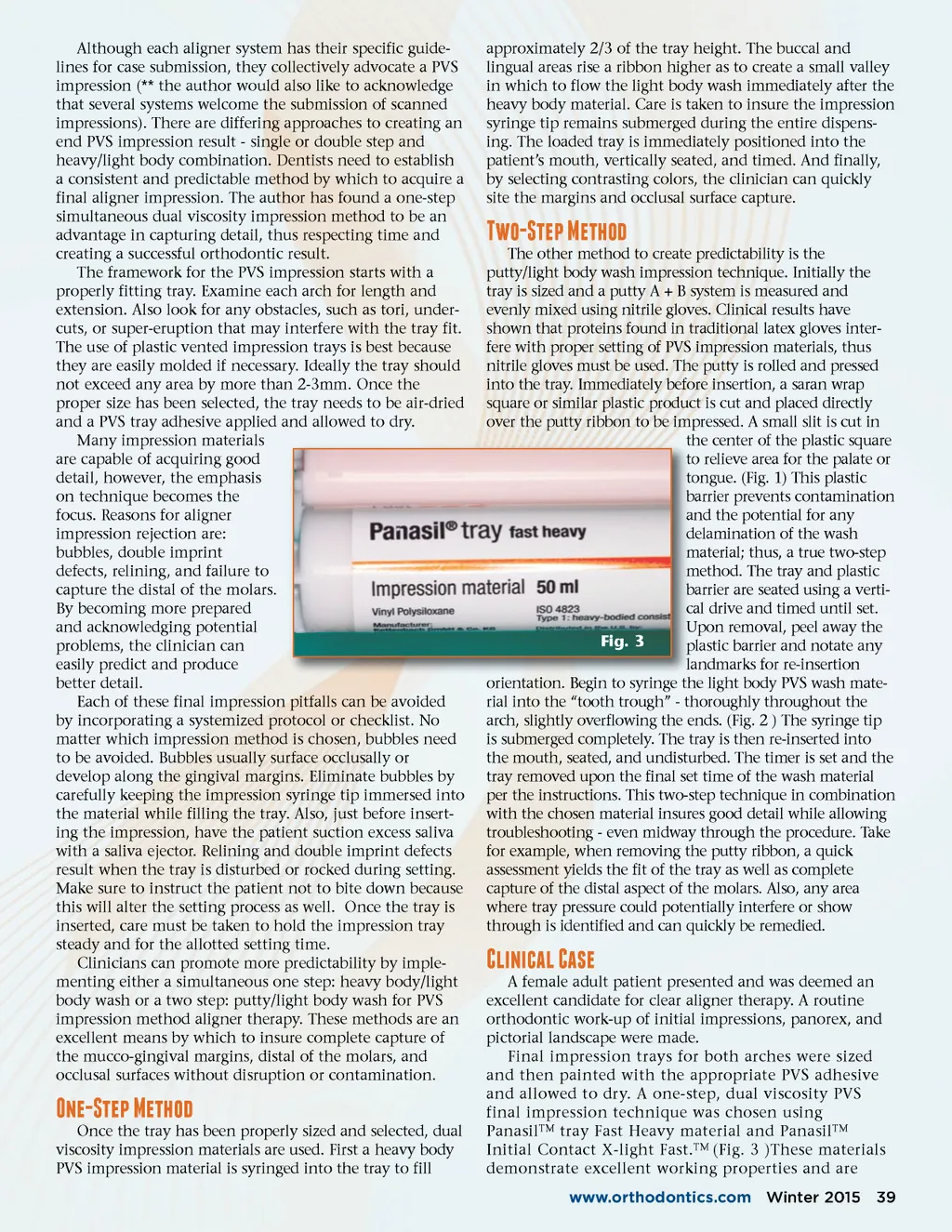
Fig. 2 Fig. 1 By Lori Trost, DMD  he desire for “straight” teeth has never been greater. The opportunity to offer some form of esthetic orthodontic treatments to your patients has become expected -especially with 50% or more adult patients requiring some kind of tooth alignment combined with an ever-growing teen population demand. With a variety of available aligner systems to choose from, the dentist can then determine which aligner system, per their advantages and treatment parameters best meets the specific needs of the patient. Clear plastic aligner system success is dependent on several key factors that relate individually to a favorable treatment outcome. The basic orthodontic equation: Force + Space + Time is respected by each aligner system, however, the current systems and their treatment method-ology offer differing approaches to an end result. Varia-tions of plastic chemistries, intentional forces/ degrees of movement, and record transference as related to each aligner system define which aligner therapy is best suited for your patient. Central to moving teeth with an aligner is the composi-tion of the plastic material. This plastic material must possess the ability to provide proper force to align teeth, yet be flexible enough for insertion -especially around undercuts or attachments. The “memory” ability of the plastic is critical for fit, comfort, and compliance of the aligner and its ability to correctly align teeth. Regardless of which aligner system is chosen and for what reasons, gathering proper patient records and taking detailed impressions is critical for treatment success. Care must be taken to properly photograph the teeth and face as well as radiograph the arches. Bite regis-tration utilizing a permanent material (not wax) is essen-tial to reproduce arch relation. Study models can be taken with alginate impression material, however, final impressions must be recorded with a high quality polyvinylsiloxane (PVS) material. Done correctly, final impressions ARE the foundation of aligner therapy, essentially setting the stage for the entire treatment to be successful. These basic steps are the most important aspect to establishing a precise 3D model that will be used to design each stage of sequential movement and then allow for the fabrication of a series of custom made aligners that require accuracy for the entire orthodontic treatment. If the translation of the patient’s impression to the laboratory or technician fails to capture the intimate detail, a series of detours may ensue. The once favorable outcome now has quickly fallen away from ideal due to an incremental effect from the start. Poorly fitting aligners are directly responsible for insufficient force and interrupted movement sequencing, thus extend-ing treatment time. Patients completely understand the number of aligners needed for treatment and are well aware of their treatment timeline. And, complicating the situation is the loss of patient confidence and compliance. This article will outcome a successful approach to creating a detailed foundational impression for aligner fabrication. 38 Winter 2015 JAOS
Journal of the American Orthodontic Society Winter 2015: Page 38