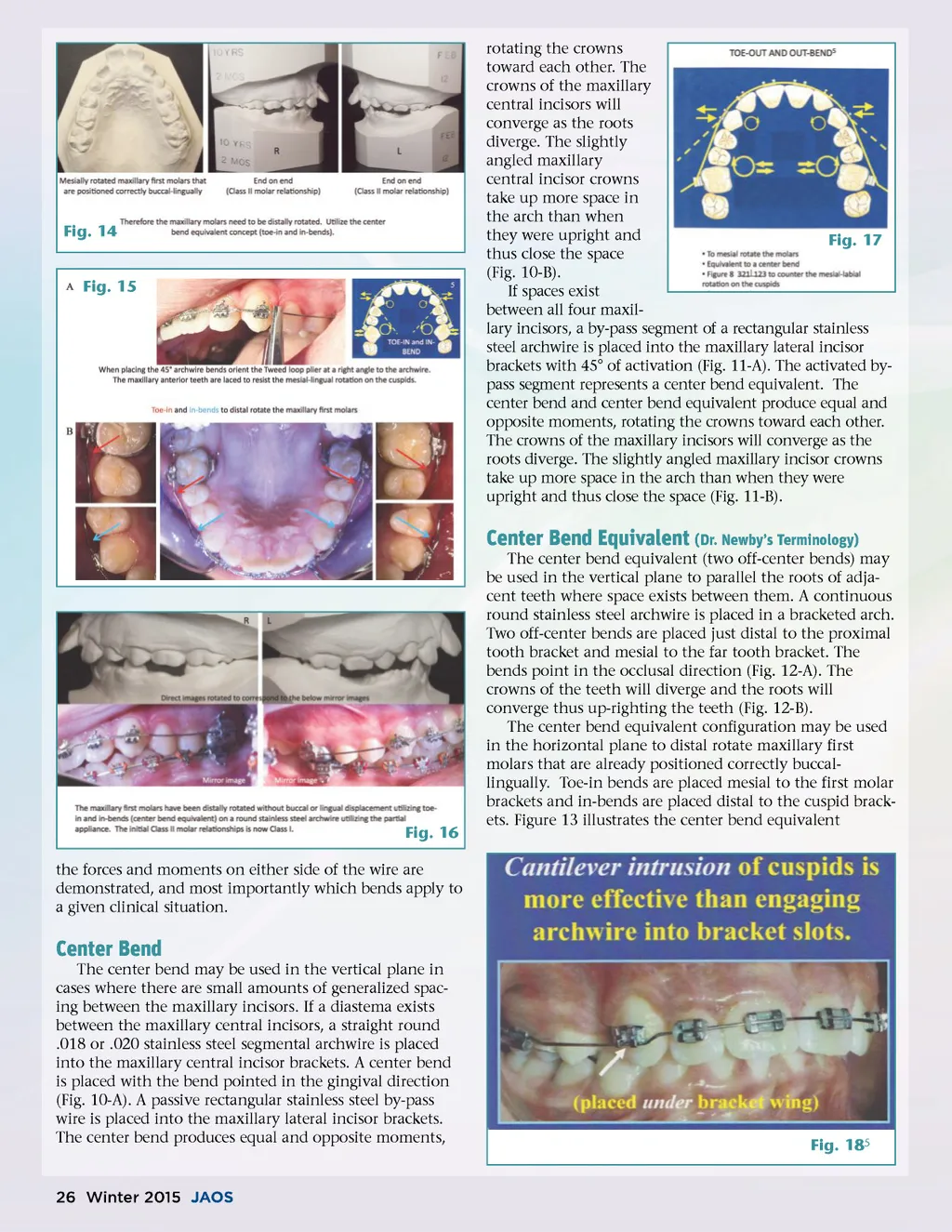
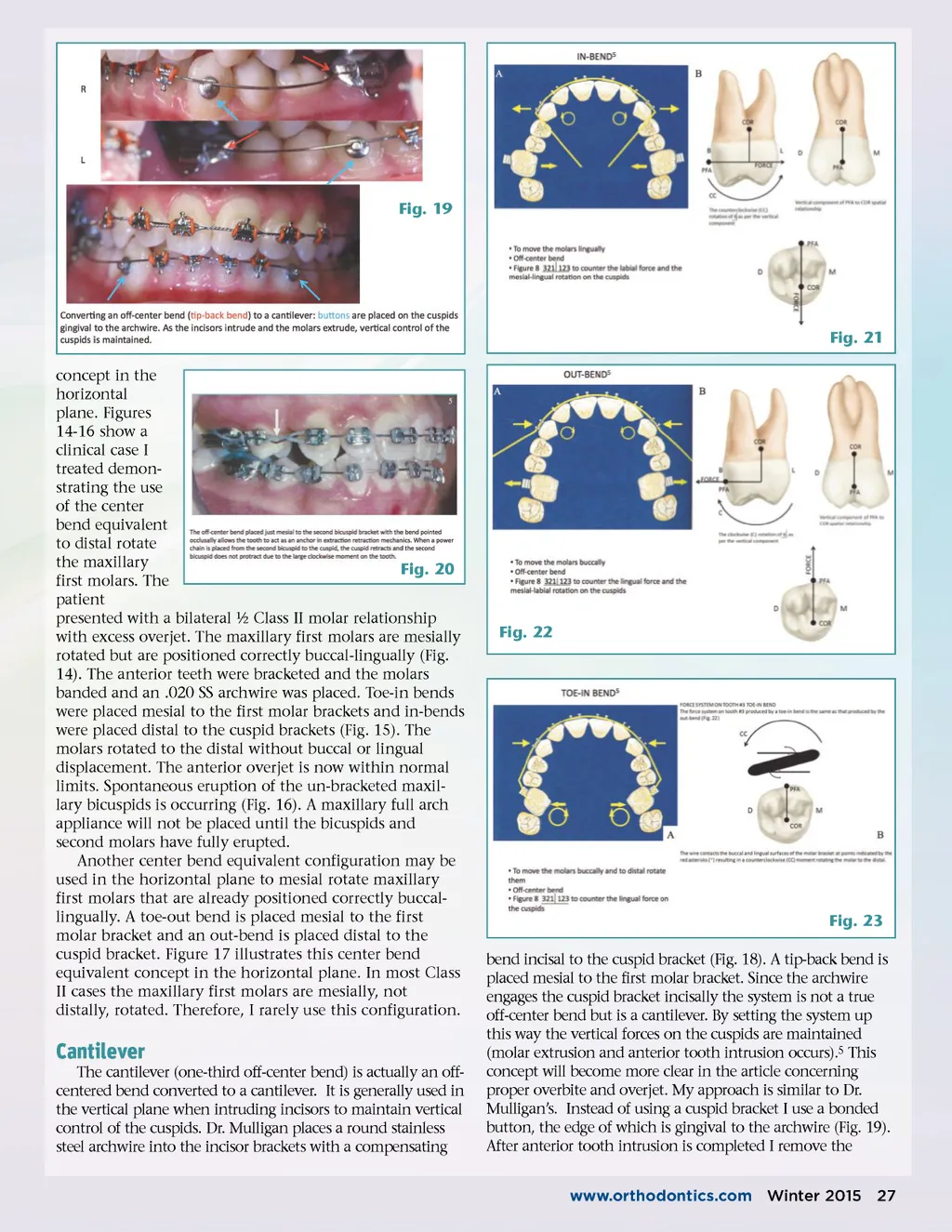
Fig. 19 Fig. 21 concept in the horizontal plane. Figures 14-16 show a clinical case I treated demon-strating the use of the center bend equivalent to distal rotate the maxillary Fig. 20 first molars. The patient presented with a bilateral ½ Class II molar relationship with excess overjet. The maxillary first molars are mesially rotated but are positioned correctly buccal-lingually (Fig. 14). The anterior teeth were bracketed and the molars banded and an .020 SS archwire was placed. Toe-in bends were placed mesial to the first molar brackets and in-bends were placed distal to the cuspid brackets (Fig. 15). The molars rotated to the distal without buccal or lingual displacement. The anterior overjet is now within normal limits. Spontaneous eruption of the un-bracketed maxil-lary bicuspids is occurring (Fig. 16). A maxillary full arch appliance will not be placed until the bicuspids and second molars have fully erupted. Another center bend equivalent configuration may be used in the horizontal plane to mesial rotate maxillary first molars that are already positioned correctly buccal-lingually. A toe-out bend is placed mesial to the first molar bracket and an out-bend is placed distal to the cuspid bracket. Figure 17 illustrates this center bend equivalent concept in the horizontal plane. In most Class II cases the maxillary first molars are mesially, not distally, rotated. Therefore, I rarely use this configuration. Fig. 22 Fig. 23 bend incisal to the cuspid bracket (Fig. 18). A tip-back bend is placed mesial to the first molar bracket. Since the archwire engages the cuspid bracket incisally the system is not a true off-center bend but is a cantilever. By setting the system up this way the vertical forces on the cuspids are maintained (molar extrusion and anterior tooth intrusion occurs). 5 This concept will become more clear in the article concerning proper overbite and overjet. My approach is similar to Dr. Mulligan’s. Instead of using a cuspid bracket I use a bonded button, the edge of which is gingival to the archwire (Fig. 19). After anterior tooth intrusion is completed I remove the www.orthodontics.com Winter 2015 27 Cantilever The cantilever (one-third off-center bend) is actually an off-centered bend converted to a cantilever. It is generally used in the vertical plane when intruding incisors to maintain vertical control of the cuspids. Dr. Mulligan places a round stainless steel archwire into the incisor brackets with a compensating
Journal of the American Orthodontic Society Winter 2015: Page 27