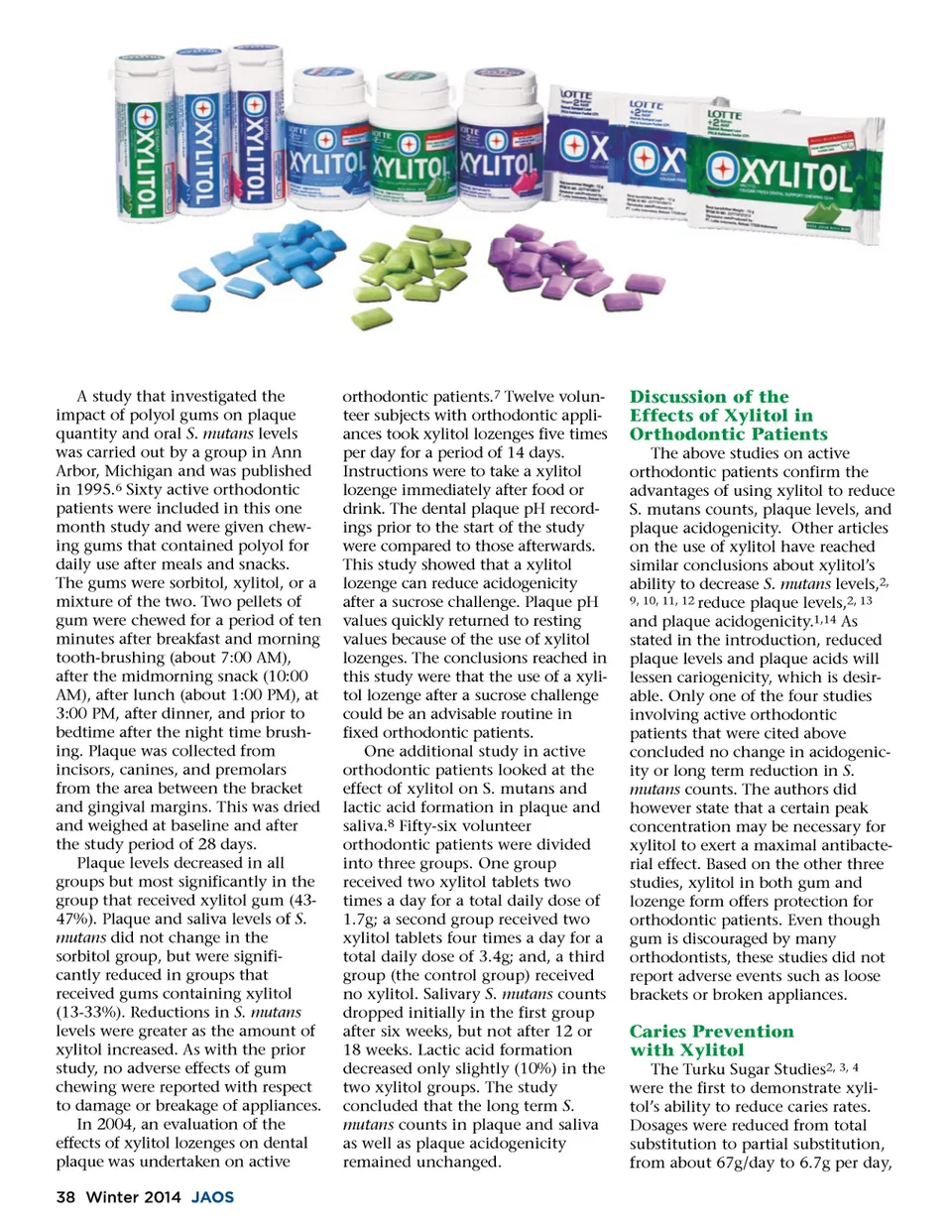
with little difference in caries preventive rates. 2, 3, 4 Others have concurred that partial substitution by xylitol is useful. 15,16 A more recent study has recommended 6g to 7g of xylitol per day in 3-5 divided doses to obtain positive clinical results. 13 Additional studies have showed a plateau effect between 6.9g -10.3g per day. 10 Thus, it is now generally recom-mended that xylitol be used at a dose between 6-10g per day after meals and after snacks at a frequency of 6-8 exposures a day to give optimal therapeutic effects. Data support the regimen of chew-ing xylitol-sweetened gum 3-5 times per day for a minimum of five minutes after meals to inhibit plaque accumulation and enamel demineralization, enhance reminer-alization of early lesions, and reduce S. mutans counts. 17 Confusion in the terminology of xylitol and other polyols with respect to cariogenicity has been reported. 18,19 A clarification of the various terms is in order. Cariostatic means a substance is capable of reducing the incidence of caries. All polyols fall into this category. Non-cariogenic means that a substance can not be broken into acids that can demineralize the enamel of the teeth. Xylitol is not fermented by cariogenic bacteria into acids and is, therefore, non-cariogenic. Other polyols such as sorbitol, mannitol, and maltitol can be fermented into acids. Although these polyols are considered cario-static, they can not be labeled as non-cariogenic. In addition, these other polyols support the growth of plaque and S. mutans, which xylitol does not. 13 Anti-cariogenic is a ther-apeutic claim that refers to a substance that may actually promote the reversal of an early carious lesion. Much has been writ-ten about the non-cariogenicity of xylitol. 17,18, 19, 20, 21, 22, 23, 24, 25 Habitual use of xylitol can be associated with significant reduc-tion in the incidence of dental caries and with remineralization of both enamel and dentin caries lesions. 13,17 However, not all studies show the positive effects of xylitol. When this occurs, it is most likely due to insufficient quantity or frequency of xylitol. 13 According to Ashpole, the dosage and frequency is crucial. 26 Kandelman also reported a dose relationship response with xylitol. 27 “A preventive strategy that incorporates the habitual use of xylitol makes sense. This is especially true for our orthodontic patients who are at high risk for demineralization, white spots, and caries.” Xylitol is available in various forms. Gums appear to be the most common, but xylitol is also avail-able in mints, candies, gummy bears, lozenges, toothpastes, tooth gels, mouth rinses, and nasal sprays. In one of the original four studies that utilized xylitol in orthodontic patients, 7 it was stated that xylitol lozenges would be an advisable practice for use in orthodontic patients to prevent future dental caries. Other studies have confirmed the efficacy of non-gum xylitol products as well. 28,29 In the United States most gums are based with sorbitol as the first ingredient. Although sorbitol is better than sugar, xylitol has been shown to be superior to sorbitol. 30, 31, 32, 33, 34, 35, 36 Xylitol is also reported to have long term beneficial effects that last well beyond the immediate or short term effect. Several studies have indi-cated a long-term preventive effect by reducing caries risk for several years after habitual xylitol use has ended. 20, 23, 37, 38 Long term effects were most evident on teeth that erupted after xylitol gum-chewing had started. Thus, for maximum benefits, it is advisable to start a xyli-tol program prior to the eruption of permanent teeth and preferably in the primary dentition in high risk children. Please note, however, that gum chewing in children less than four years of age is not advised as this presents a choking hazard. Other forms of xylitol, such as candies, mints, tooth gels, and pastes can be used in younger children. Xylitol has an additive effect when used with fluorides. 13, 35, 39, 40, 41, 42, 43, 44 In addition, xylitol was able to maintain S. mutans suppres-sion after the use of an antimicro-bial rinse. 13, 45 These strategies may prove useful for our patients that are already in braces. We can intro-duce xylitol with little modification of the current dietary or homecare routine. Reducing S. mutans counts with an antimicrobial rinse for 1-2 weeks followed by xylitol gums, mints, or candies on a habitual basis will add another useful tool to our preventive programs. Xylitol’s role in reducing plaque has been reported else where as well. 25, 46, 47, 48 The optimal time to initiate habitual xylitol gum-chewing for long term caries protection is one year prior to the eruption of the permanent teeth. 37 This recom-mendation has been applied to orthodontic patients as well. 49 The best time to start xylitol is one year prior to the start of braces. Starting xylitol at the time orthodontic treatment is initiated is also recom-mended if it has not been started earlier. A preventive strategy that incorporates the habitual use of xylitol makes sense. This is espe-cially true for our orthodontic patients who are at high risk for demineralization, white spots, and caries. Xylitol is an adjunct to any preventive program. 50,51 The benefits of xylitol in caries control and reduction has been well established over the past several decades. Nevertheless, the professional dental community in the United States has yet to adopt the use of xylitol on a routine basis. Xylitol is a sweetener that reduces caries risk, so we can recommend it with confidence. It is sweet, it tastes good, and it is good for us. www.orthodontics.com Winter 2014 39
Journal of the American Orthodontic Society Winter 2014: Page 39