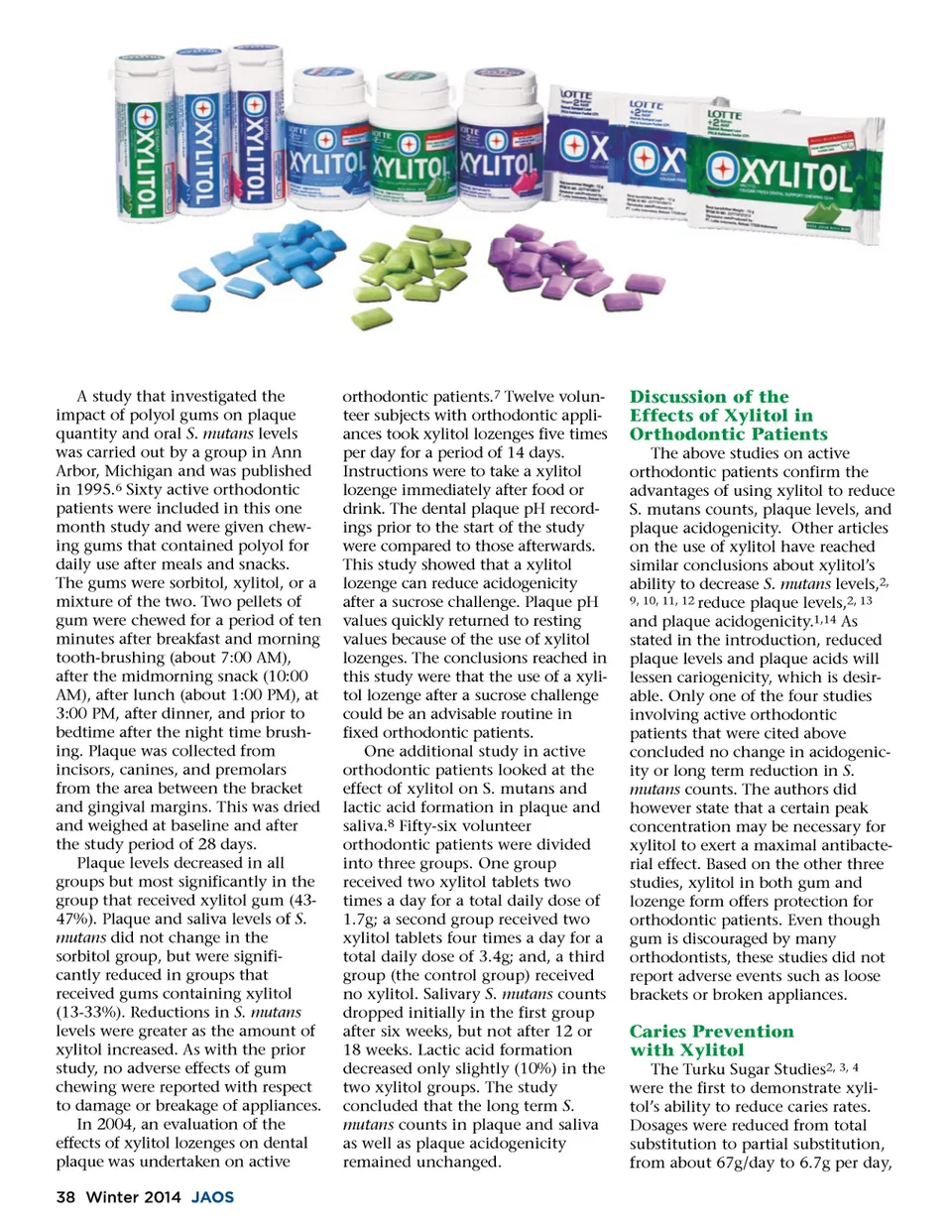
A study that investigated the impact of polyol gums on plaque quantity and oral S. mutans levels was carried out by a group in Ann Arbor, Michigan and was published in 1995. 6 Sixty active orthodontic patients were included in this one month study and were given chew-ing gums that contained polyol for daily use after meals and snacks. The gums were sorbitol, xylitol, or a mixture of the two. Two pellets of gum were chewed for a period of ten minutes after breakfast and morning tooth-brushing (about 7:00 AM), after the midmorning snack (10:00 AM), after lunch (about 1:00 PM), at 3:00 PM, after dinner, and prior to bedtime after the night time brush-ing. Plaque was collected from incisors, canines, and premolars from the area between the bracket and gingival margins. This was dried and weighed at baseline and after the study period of 28 days. Plaque levels decreased in all groups but most significantly in the group that received xylitol gum (43-47%). Plaque and saliva levels of S. mutans did not change in the sorbitol group, but were signifi-cantly reduced in groups that received gums containing xylitol (13-33%). Reductions in S. mutans levels were greater as the amount of xylitol increased. As with the prior study, no adverse effects of gum chewing were reported with respect to damage or breakage of appliances. In 2004, an evaluation of the effects of xylitol lozenges on dental plaque was undertaken on active 38 Winter 2014 JAOS orthodontic patients. 7 Twelve volun-teer subjects with orthodontic appli-ances took xylitol lozenges five times per day for a period of 14 days. Instructions were to take a xylitol lozenge immediately after food or drink. The dental plaque pH record-ings prior to the start of the study were compared to those afterwards. This study showed that a xylitol lozenge can reduce acidogenicity after a sucrose challenge. Plaque pH values quickly returned to resting values because of the use of xylitol lozenges. The conclusions reached in this study were that the use of a xyli-tol lozenge after a sucrose challenge could be an advisable routine in fixed orthodontic patients. One additional study in active orthodontic patients looked at the effect of xylitol on S. mutans and lactic acid formation in plaque and saliva. 8 Fifty-six volunteer orthodontic patients were divided into three groups. One group received two xylitol tablets two times a day for a total daily dose of 1.7g; a second group received two xylitol tablets four times a day for a total daily dose of 3.4g; and, a third group (the control group) received no xylitol. Salivary S. mutans counts dropped initially in the first group after six weeks, but not after 12 or 18 weeks. Lactic acid formation decreased only slightly (10%) in the two xylitol groups. The study concluded that the long term S. mutans counts in plaque and saliva as well as plaque acidogenicity remained unchanged. Discussion of the Effects of Xylitol in Orthodontic Patients The above studies on active orthodontic patients confirm the advantages of using xylitol to reduce S. mutans counts, plaque levels, and plaque acidogenicity. Other articles on the use of xylitol have reached similar conclusions about xylitol’s ability to decrease S. mutans levels, 2, 9, 10, 11, 12 reduce plaque levels, 2, 13 and plaque acidogenicity. 1,14 As stated in the introduction, reduced plaque levels and plaque acids will lessen cariogenicity, which is desir-able. Only one of the four studies involving active orthodontic patients that were cited above concluded no change in acidogenic-ity or long term reduction in S. mutans counts. The authors did however state that a certain peak concentration may be necessary for xylitol to exert a maximal antibacte-rial effect. Based on the other three studies, xylitol in both gum and lozenge form offers protection for orthodontic patients. Even though gum is discouraged by many orthodontists, these studies did not report adverse events such as loose brackets or broken appliances. Caries Prevention with Xylitol The Turku Sugar Studies 2, 3, 4 were the first to demonstrate xyli-tol’s ability to reduce caries rates. Dosages were reduced from total substitution to partial substitution, from about 67g/day to 6.7g per day,
Journal of the American Orthodontic Society Winter 2014: Page 38