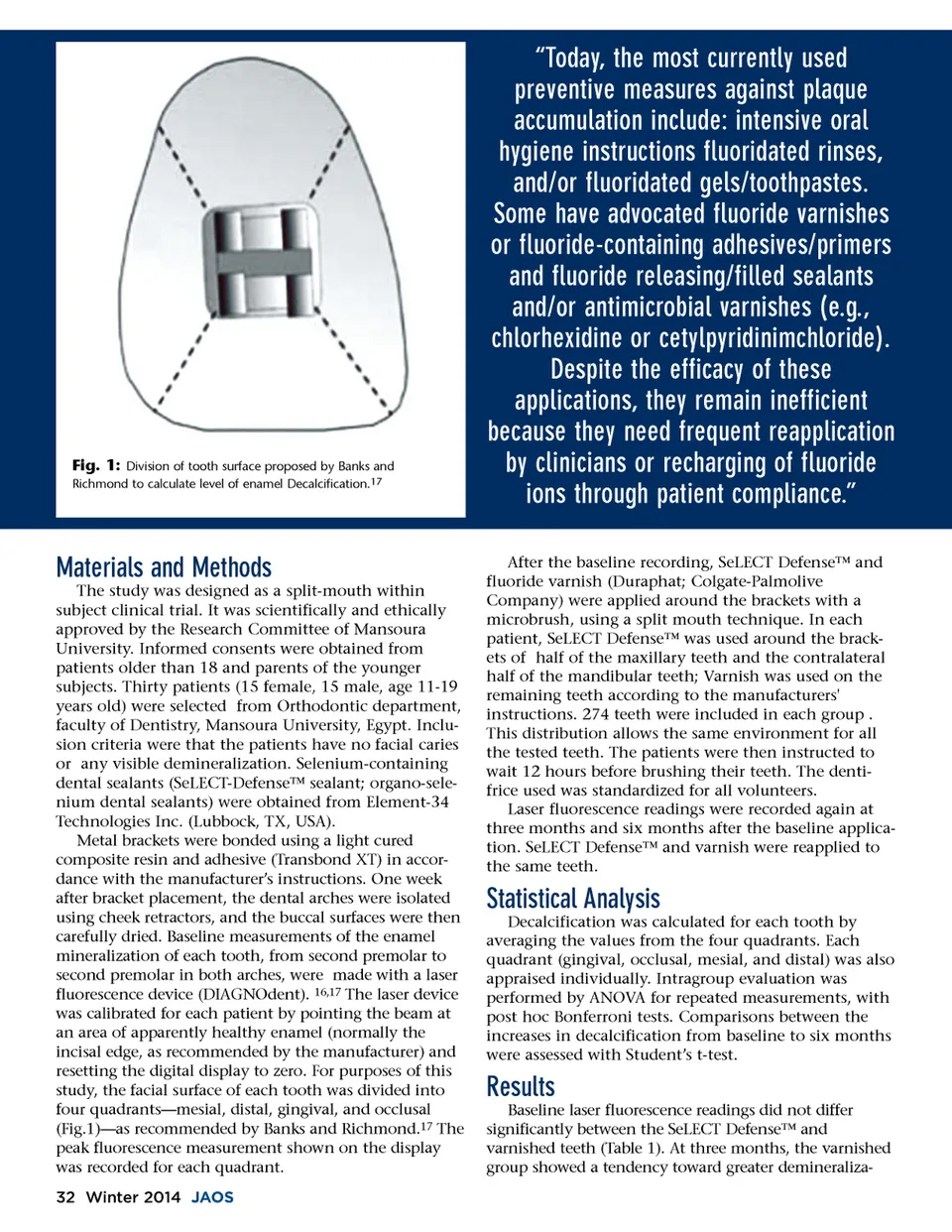
Fig. 1: Division of tooth surface proposed by Banks and Richmond to calculate level of enamel Decalcification. 17 “Today, the most currently used preventive measures against plaque accumulation include: intensive oral hygiene instructions fluoridated rinses, and/or fluoridated gels/toothpastes. Some have advocated fluoride varnishes or fluoride-containing adhesives/primers and fluoride releasing/filled sealants and/or antimicrobial varnishes (e.g., chlorhexidine or cetylpyridinimchloride). Despite the efficacy of these applications, they remain inefficient because they need frequent reapplication by clinicians or recharging of fluoride ions through patient compliance.” After the baseline recording, SeLECT Defense™ and fluoride varnish (Duraphat; Colgate-Palmolive Company) were applied around the brackets with a microbrush, using a split mouth technique. In each patient, SeLECT Defense™ was used around the brack-ets of half of the maxillary teeth and the contralateral half of the mandibular teeth; Varnish was used on the remaining teeth according to the manufacturers' instructions. 274 teeth were included in each group . This distribution allows the same environment for all the tested teeth. The patients were then instructed to wait 12 hours before brushing their teeth. The denti-frice used was standardized for all volunteers. Laser fluorescence readings were recorded again at three months and six months after the baseline applica-tion. SeLECT Defense™ and varnish were reapplied to the same teeth. Materials and Methods The study was designed as a split-mouth within subject clinical trial. It was scientifically and ethically approved by the Research Committee of Mansoura University. Informed consents were obtained from patients older than 18 and parents of the younger subjects. Thirty patients (15 female, 15 male, age 11-19 years old) were selected from Orthodontic department, faculty of Dentistry, Mansoura University, Egypt. Inclu-sion criteria were that the patients have no facial caries or any visible demineralization. Selenium-containing dental sealants (SeLECT-Defense™ sealant; organo-sele-nium dental sealants) were obtained from Element-34 Technologies Inc. (Lubbock, TX, USA). Metal brackets were bonded using a light cured composite resin and adhesive (Transbond XT) in accor-dance with the manufacturer’s instructions. One week after bracket placement, the dental arches were isolated using cheek retractors, and the buccal surfaces were then carefully dried. Baseline measurements of the enamel mineralization of each tooth, from second premolar to second premolar in both arches, were made with a laser fluorescence device (DIAGNOdent). 16,17 The laser device was calibrated for each patient by pointing the beam at an area of apparently healthy enamel (normally the incisal edge, as recommended by the manufacturer) and resetting the digital display to zero. For purposes of this study, the facial surface of each tooth was divided into four quadrants—mesial, distal, gingival, and occlusal (Fig.1)—as recommended by Banks and Richmond. 17 The peak fluorescence measurement shown on the display was recorded for each quadrant. 32 Winter 2014 JAOS Statistical Analysis Decalcification was calculated for each tooth by averaging the values from the four quadrants. Each quadrant (gingival, occlusal, mesial, and distal) was also appraised individually. Intragroup evaluation was performed by ANOVA for repeated measurements, with post hoc Bonferroni tests. Comparisons between the increases in decalcification from baseline to six months were assessed with Student’s t-test. Results Baseline laser fluorescence readings did not differ significantly between the SeLECT Defense™ and varnished teeth (Table 1). At three months, the varnished group showed a tendency toward greater demineraliza-
Journal of the American Orthodontic Society Winter 2014: Page 32