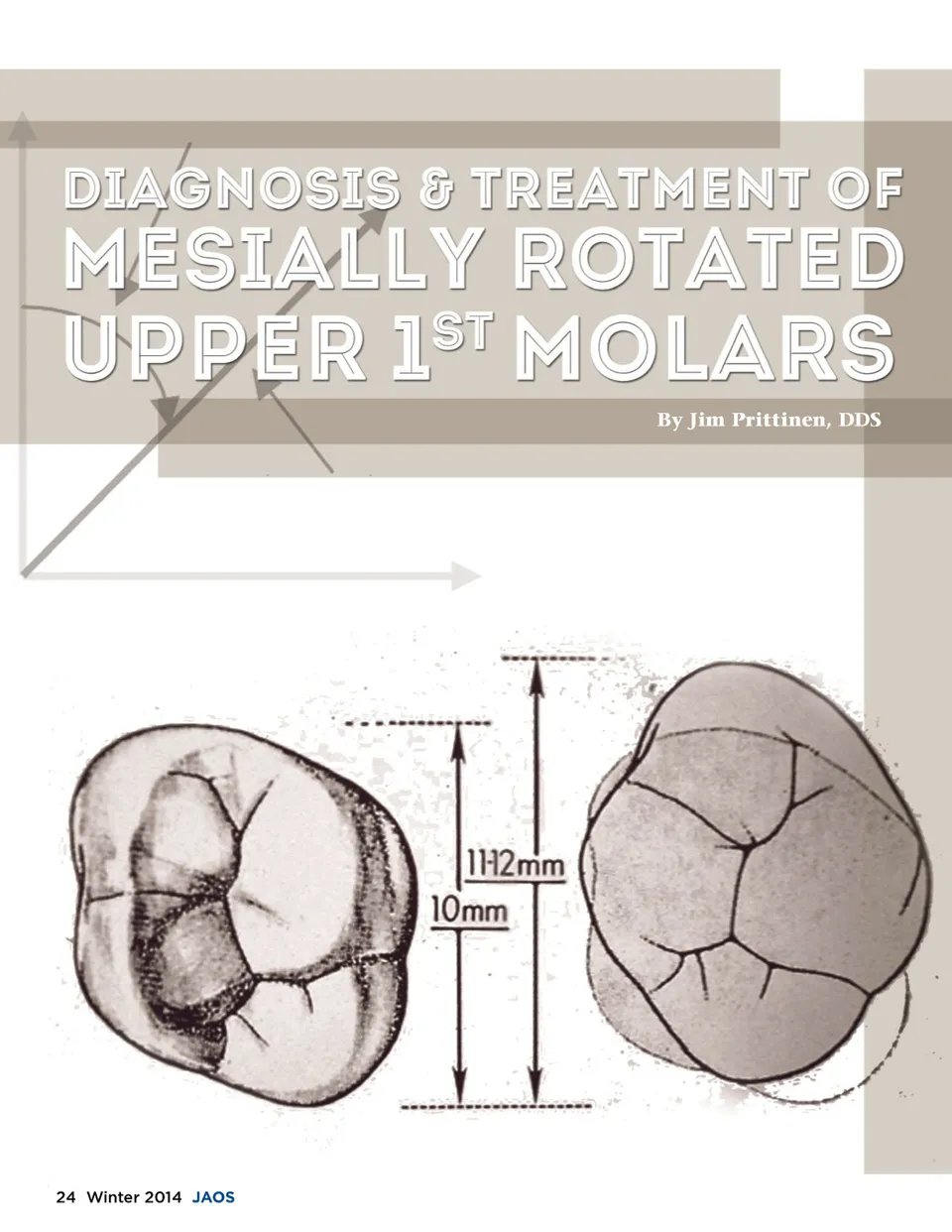
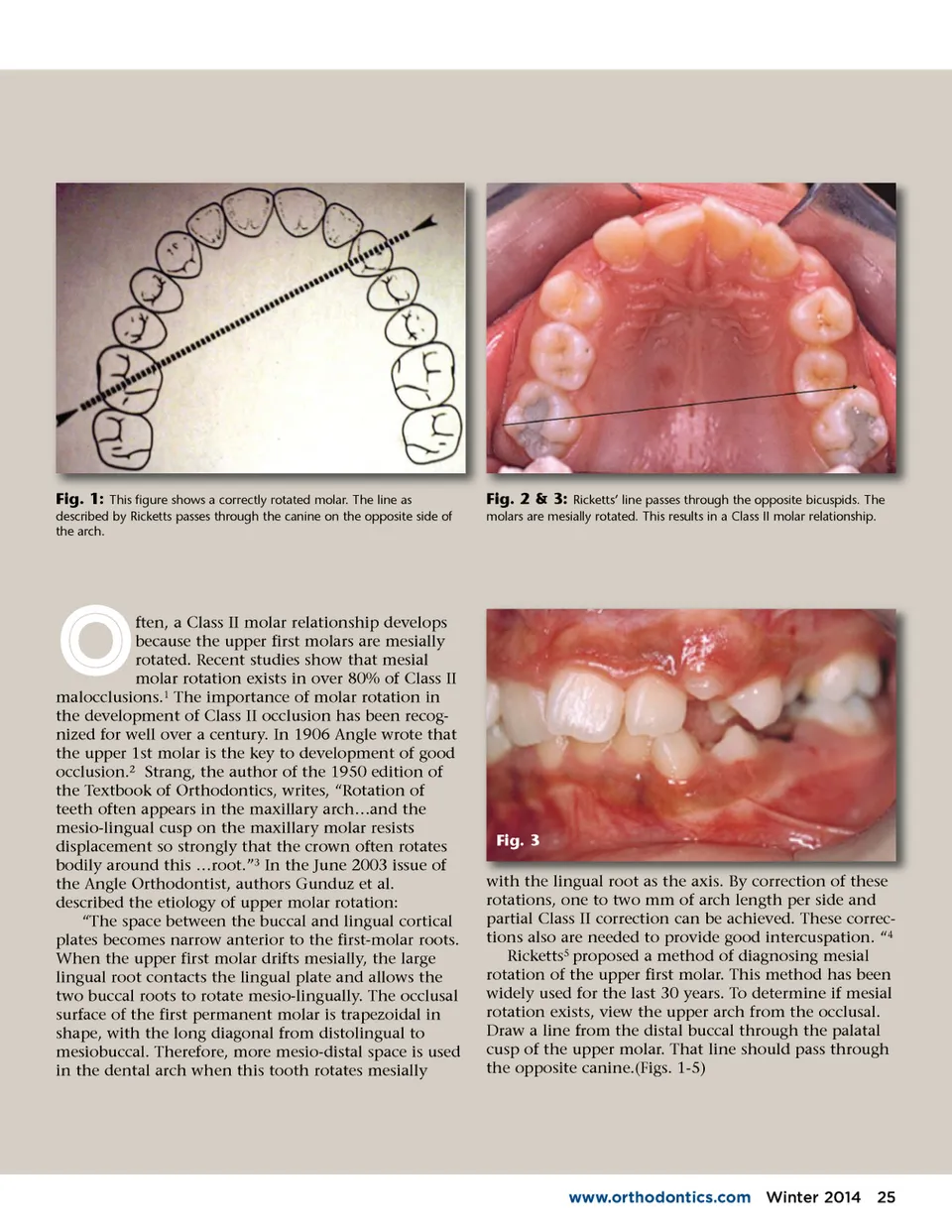
Fig. 1: This figure shows a correctly rotated molar. The line as described by Ricketts passes through the canine on the opposite side of the arch. Fig. 2 & 3: Ricketts’ line passes through the opposite bicuspids. The molars are mesially rotated. This results in a Class II molar relationship. O ften, a Class II molar relationship develops because the upper first molars are mesially rotated. Recent studies show that mesial molar rotation exists in over 80% of Class II malocclusions. 1 The importance of molar rotation in the development of Class II occlusion has been recog-nized for well over a century. In 1906 Angle wrote that the upper 1st molar is the key to development of good occlusion. 2 Strang, the author of the 1950 edition of the Textbook of Orthodontics, writes, “Rotation of teeth often appears in the maxillary arch…and the mesio-lingual cusp on the maxillary molar resists displacement so strongly that the crown often rotates bodily around this …root.” 3 In the June 2003 issue of the Angle Orthodontist, authors Gunduz et al. described the etiology of upper molar rotation: “The space between the buccal and lingual cortical plates becomes narrow anterior to the first-molar roots. When the upper first molar drifts mesially, the large lingual root contacts the lingual plate and allows the two buccal roots to rotate mesio-lingually. The occlusal surface of the first permanent molar is trapezoidal in shape, with the long diagonal from distolingual to mesiobuccal. Therefore, more mesio-distal space is used in the dental arch when this tooth rotates mesially Fig. 3 axis. By correction of these with the lingual root as the axis rotations, one to two mm of arch length per side and partial Class II correction can be achieved. These correc-tions also are needed to provide good intercuspation. “ 4 Ricketts 5 proposed a method of diagnosing mesial rotation of the upper first molar. This method has been widely used for the last 30 years. To determine if mesial rotation exists, view the upper arch from the occlusal. Draw a line from the distal buccal through the palatal cusp of the upper molar. That line should pass through the opposite canine.(Figs. 1-5) www.orthodontics.com Winter 2014 25
Journal of the American Orthodontic Society Winter 2014: Page 25