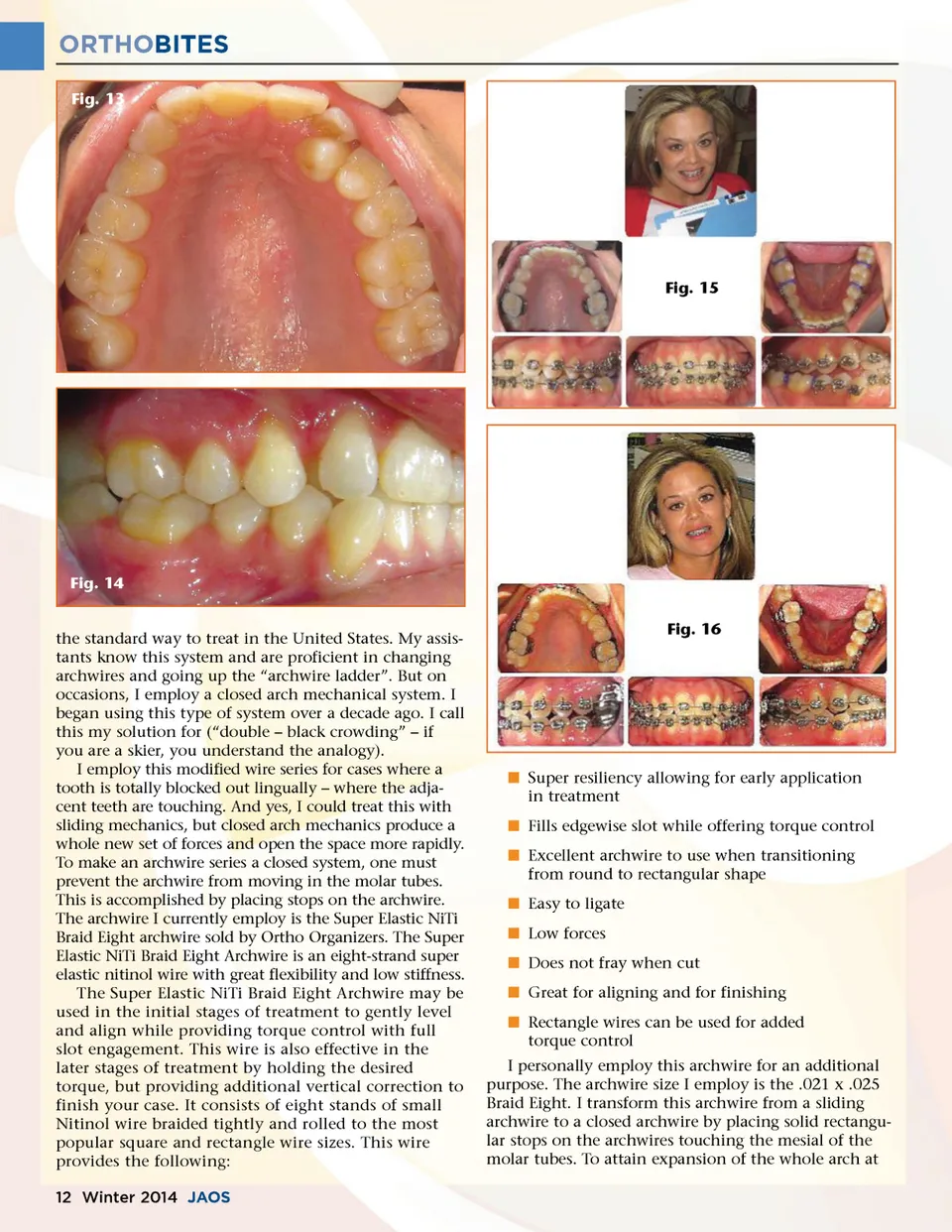
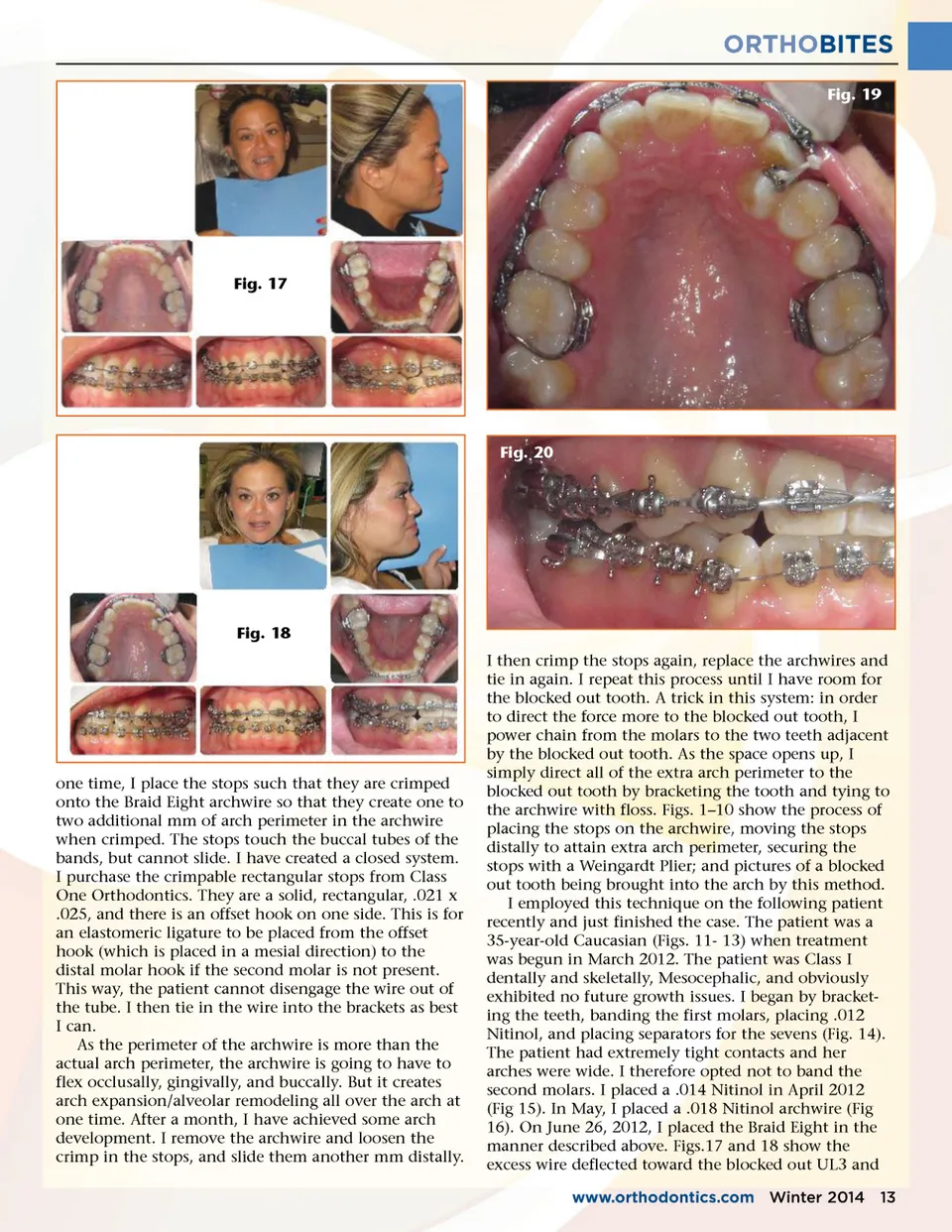
ORTHOBITES Fig. 13 Fig. 15 Fig. 14 Fig. 16 the standard way to treat in the United States. My assis-tants know this system and are proficient in changing archwires and going up the “archwire ladder”. But on occasions, I employ a closed arch mechanical system. I began using this type of system over a decade ago. I call this my solution for (“double – black crowding” – if you are a skier, you understand the analogy). I employ this modified wire series for cases where a tooth is totally blocked out lingually – where the adja-cent teeth are touching. And yes, I could treat this with sliding mechanics, but closed arch mechanics produce a whole new set of forces and open the space more rapidly. To make an archwire series a closed system, one must prevent the archwire from moving in the molar tubes. This is accomplished by placing stops on the archwire. The archwire I currently employ is the Super Elastic NiTi Braid Eight archwire sold by Ortho Organizers. The Super Elastic NiTi Braid Eight Archwire is an eight-strand super elastic nitinol wire with great flexibility and low stiffness. The Super Elastic NiTi Braid Eight Archwire may be used in the initial stages of treatment to gently level and align while providing torque control with full slot engagement. This wire is also effective in the later stages of treatment by holding the desired torque, but providing additional vertical correction to finish your case. It consists of eight stands of small Nitinol wire braided tightly and rolled to the most popular square and rectangle wire sizes. This wire provides the following: 12 Winter 2014 JAOS í Super resiliency allowing for early application in treatment í Fills edgewise slot while offering torque control í Excellent archwire to use when transitioning from round to rectangular shape í Easy to ligate í Low forces í Does not fray when cut í Great for aligning and for finishing í Rectangle wires can be used for added torque control I personally employ this archwire for an additional purpose. The archwire size I employ is the .021 x .025 Braid Eight. I transform this archwire from a sliding archwire to a closed archwire by placing solid rectangu-lar stops on the archwires touching the mesial of the molar tubes. To attain expansion of the whole arch at
Journal of the American Orthodontic Society Winter 2014: Page 12