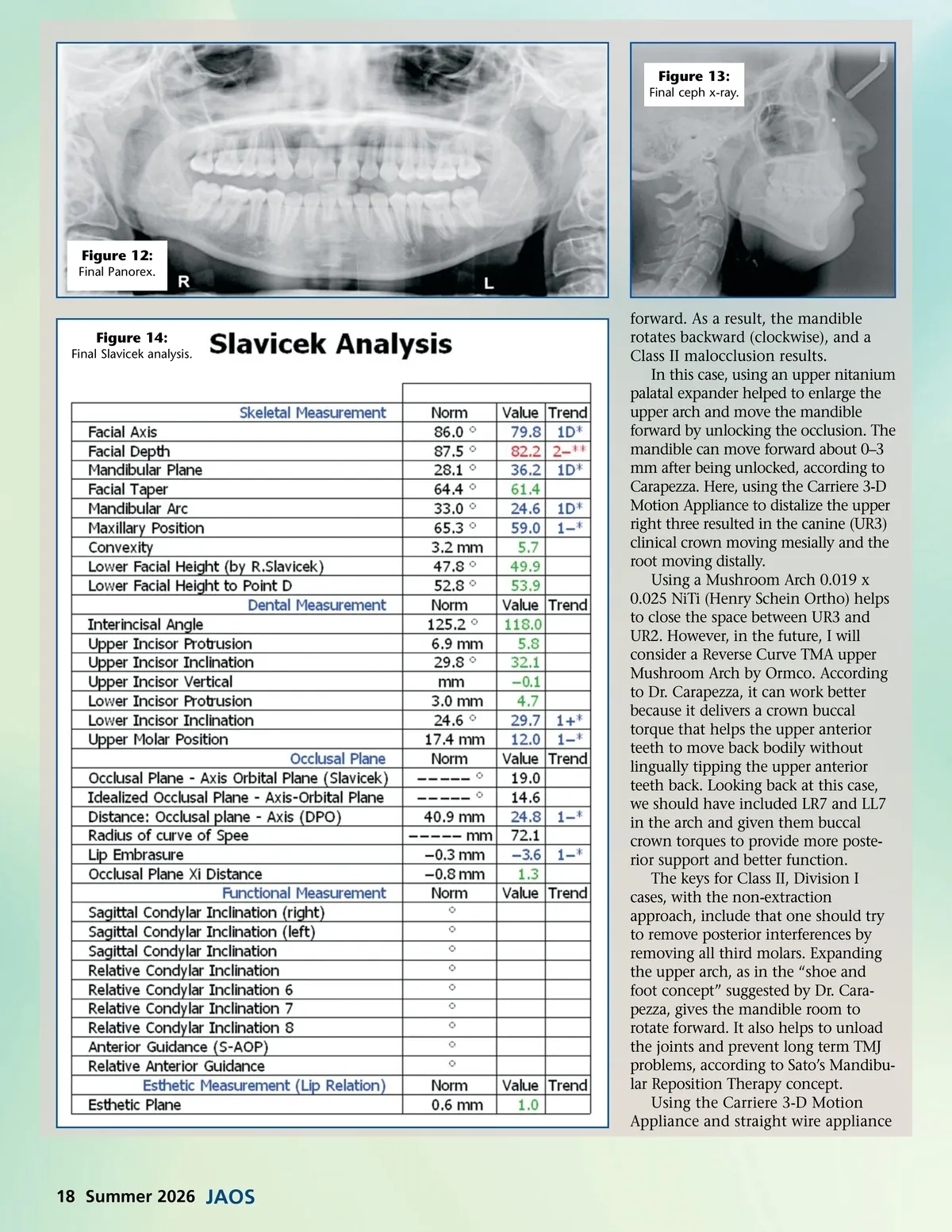
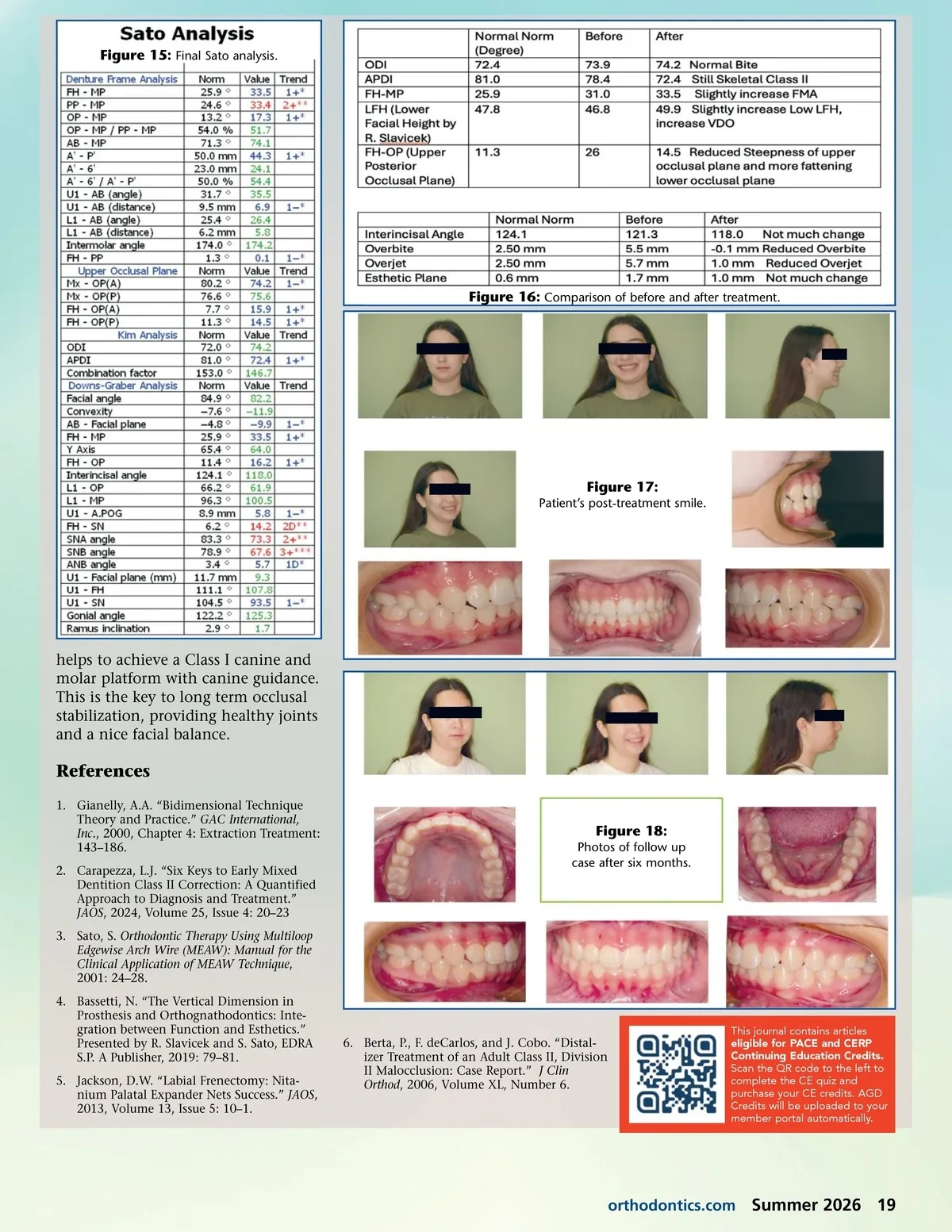
Figure 15: Final Sato analysis. Figure 16: Comparison of before and after treatment. Figure 17: Patient’s post-treatment smile. helps to achieve a Class I canine and molar platform with canine guidance. This is the key to long term occlusal stabilization, providing healthy joints and a nice facial balance. References 1. Gianelly, A.A. “Bidimensional Technique Theory and Practice.” GAC International, Inc. , 2000, Chapter 4: Extraction Treatment: 143–186. 2. Carapezza, L.J. “Six Keys to Early Mixed Dentition Class II Correction: A Quantified Approach to Diagnosis and Treatment.” JAOS , 2024, Volume 25, Issue 4: 20–23 3. Sato, S. Orthodontic Therapy Using Multiloop Edgewise Arch Wire (MEAW): Manual for the Clinical Application of MEAW Technique , 2001: 24–28. 4. Bassetti, N. “The Vertical Dimension in Prosthesis and Orthognathodontics: Inte-gration between Function and Esthetics.” Presented by R. Slavicek and S. Sato, EDRA S.P. A Publisher, 2019: 79–81. 5. Jackson, D.W. “Labial Frenectomy: Nita-nium Palatal Expander Nets Success.” JAOS , 2013, Volume 13, Issue 5: 10–1. Figure 18: Photos of follow up case after six months. 6. Berta, P., F. deCarlos, and J. Cobo. “Distal-izer Treatment of an Adult Class II, Division II Malocclusion: Case Report.” J Clin Orthod , 2006, Volume XL, Number 6. This journal contains articles eligible for PACE and CERP Continuing Education Credits. Scan the QR code to the left to complete the CE quiz and purchase your CE credits. AGD Credits will be uploaded to your member portal automatically. orthodontics.com Summer 2026 19
Journal of the American Orthodontic Society Summer 2026: Page 19