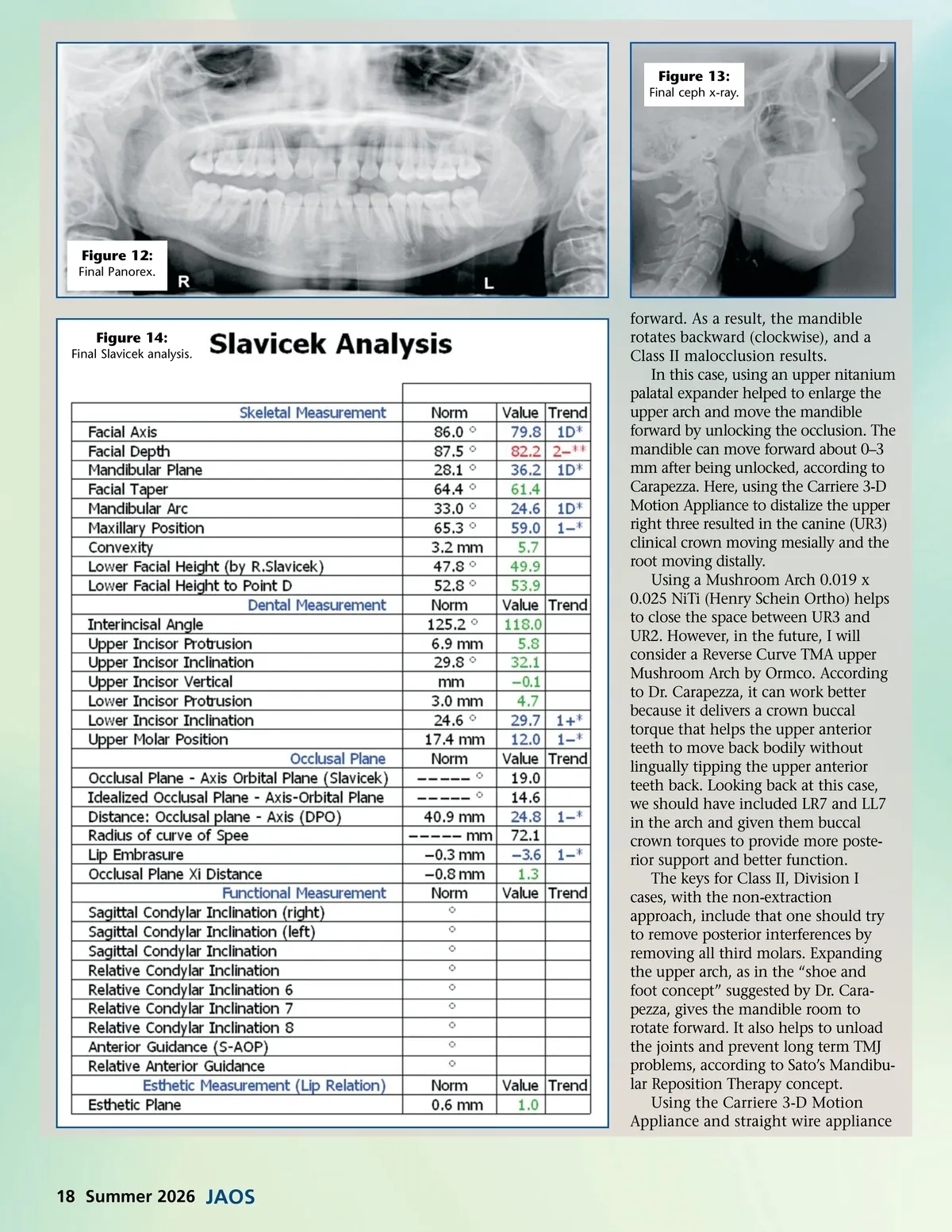
Figure 13: Final ceph x-ray. Figure 12: Final Panorex. Figure 14: Final Slavicek analysis. forward. As a result, the mandible rotates backward (clockwise), and a Class II malocclusion results. In this case, using an upper nitanium palatal expander helped to enlarge the upper arch and move the mandible forward by unlocking the occlusion. The mandible can move forward about 0–3 mm after being unlocked, according to Carapezza. Here, using the Carriere 3-D Motion Appliance to distalize the upper right three resulted in the canine (UR3) clinical crown moving mesially and the root moving distally. Using a Mushroom Arch 0.019 x 0.025 NiTi (Henry Schein Ortho) helps to close the space between UR3 and UR2. However, in the future, I will consider a Reverse Curve TMA upper Mushroom Arch by Ormco. According to Dr. Carapezza, it can work better because it delivers a crown buccal torque that helps the upper anterior teeth to move back bodily without lingually tipping the upper anterior teeth back. Looking back at this case, we should have included LR7 and LL7 in the arch and given them buccal crown torques to provide more poste-rior support and better function. The keys for Class II, Division I cases, with the non-extraction approach, include that one should try to remove posterior interferences by removing all third molars. Expanding the upper arch, as in the “shoe and foot concept” suggested by Dr. Cara-pezza, gives the mandible room to rotate forward. It also helps to unload the joints and prevent long term TMJ problems, according to Sato’s Mandibu-lar Reposition Therapy concept. Using the Carriere 3-D Motion Appliance and straight wire appliance 18 Summer 2026 JAOS
Journal of the American Orthodontic Society Summer 2026: Page 18