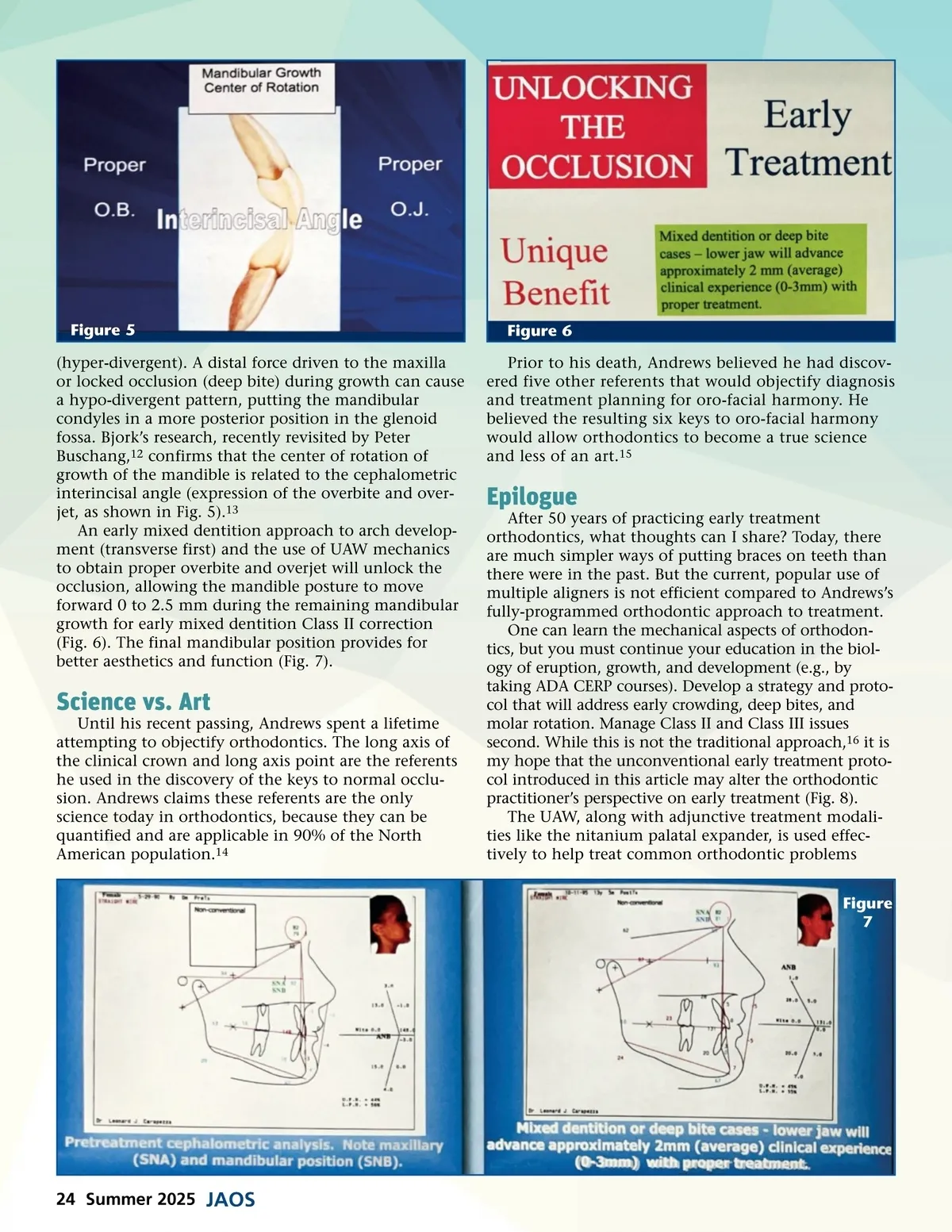
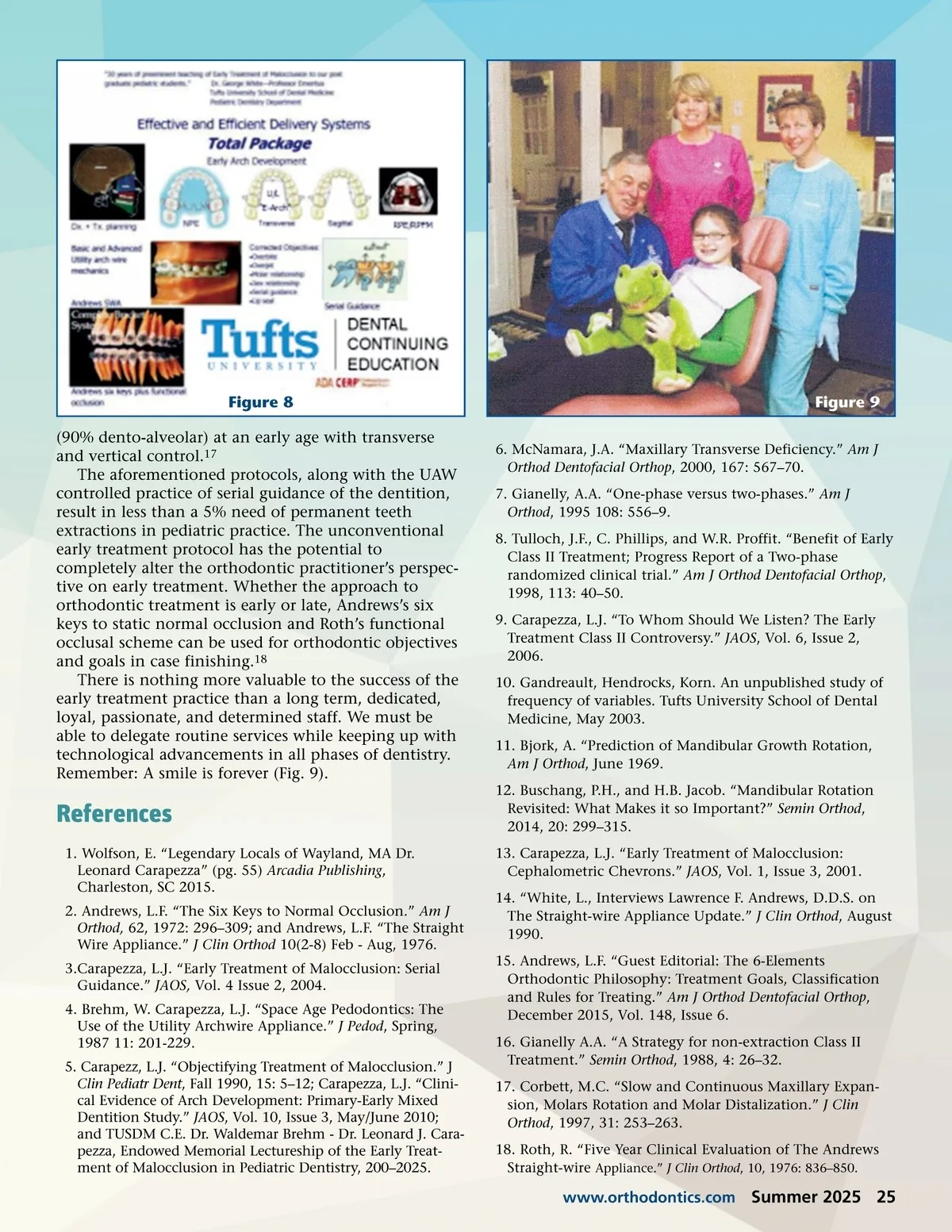
Figure 5 (hyper-divergent). A distal force driven to the maxilla or locked occlusion (deep bite) during growth can cause a hypo-divergent pattern, putting the mandibular condyles in a more posterior position in the glenoid fossa. Bjork’s research, recently revisited by Peter Buschang, 12 confirms that the center of rotation of growth of the mandible is related to the cephalometric interincisal angle (expression of the overbite and over-jet, as shown in Fig. 5). 13 An early mixed dentition approach to arch develop-ment (transverse first) and the use of UAW mechanics to obtain proper overbite and overjet will unlock the occlusion, allowing the mandible posture to move forward 0 to 2.5 mm during the remaining mandibular growth for early mixed dentition Class II correction (Fig. 6). The final mandibular position provides for better aesthetics and function (Fig. 7). Figure 6 Prior to his death, Andrews believed he had discov-ered five other referents that would objectify diagnosis and treatment planning for oro-facial harmony. He believed the resulting six keys to oro-facial harmony would allow orthodontics to become a true science and less of an art. 15 Epilogue After 50 years of practicing early treatment orthodontics, what thoughts can I share? Today, there are much simpler ways of putting braces on teeth than there were in the past. But the current, popular use of multiple aligners is not efficient compared to Andrews’s fully-programmed orthodontic approach to treatment. One can learn the mechanical aspects of orthodon-tics, but you must continue your education in the biol-ogy of eruption, growth, and development (e.g., by taking ADA CERP courses). Develop a strategy and proto-col that will address early crowding, deep bites, and molar rotation. Manage Class II and Class III issues second. While this is not the traditional approach, 16 it is my hope that the unconventional early treatment proto-col introduced in this article may alter the orthodontic practitioner’s perspective on early treatment (Fig. 8). The UAW, along with adjunctive treatment modali-ties like the nitanium palatal expander, is used effec-tively to help treat common orthodontic problems Figure 7 Science vs. Art Until his recent passing, Andrews spent a lifetime attempting to objectify orthodontics. The long axis of the clinical crown and long axis point are the referents he used in the discovery of the keys to normal occlu-sion. Andrews claims these referents are the only science today in orthodontics, because they can be quantified and are applicable in 90% of the North American population. 14 24 Summer 2025 JAOS
Journal of the American Orthodontic Society Summer 2025: Page 24