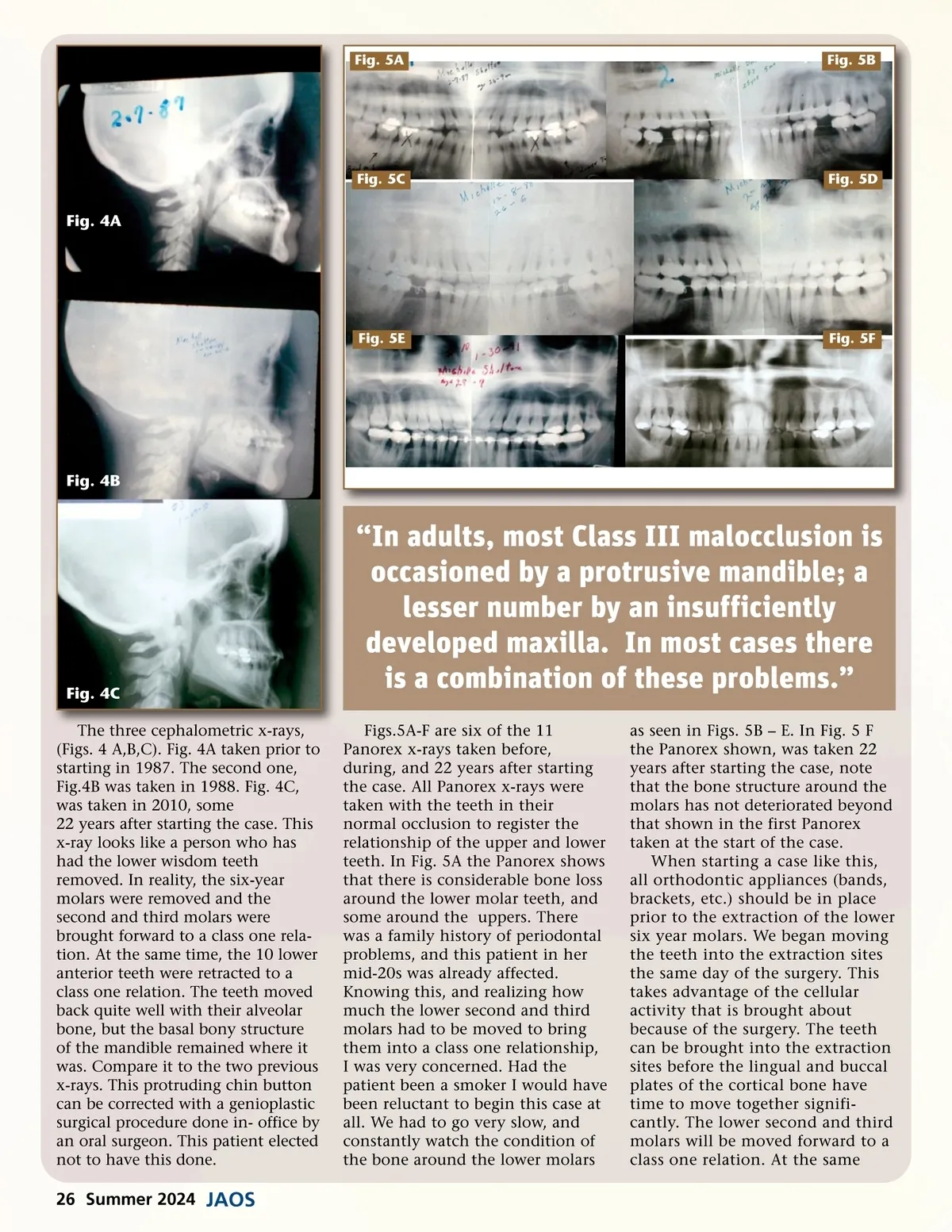
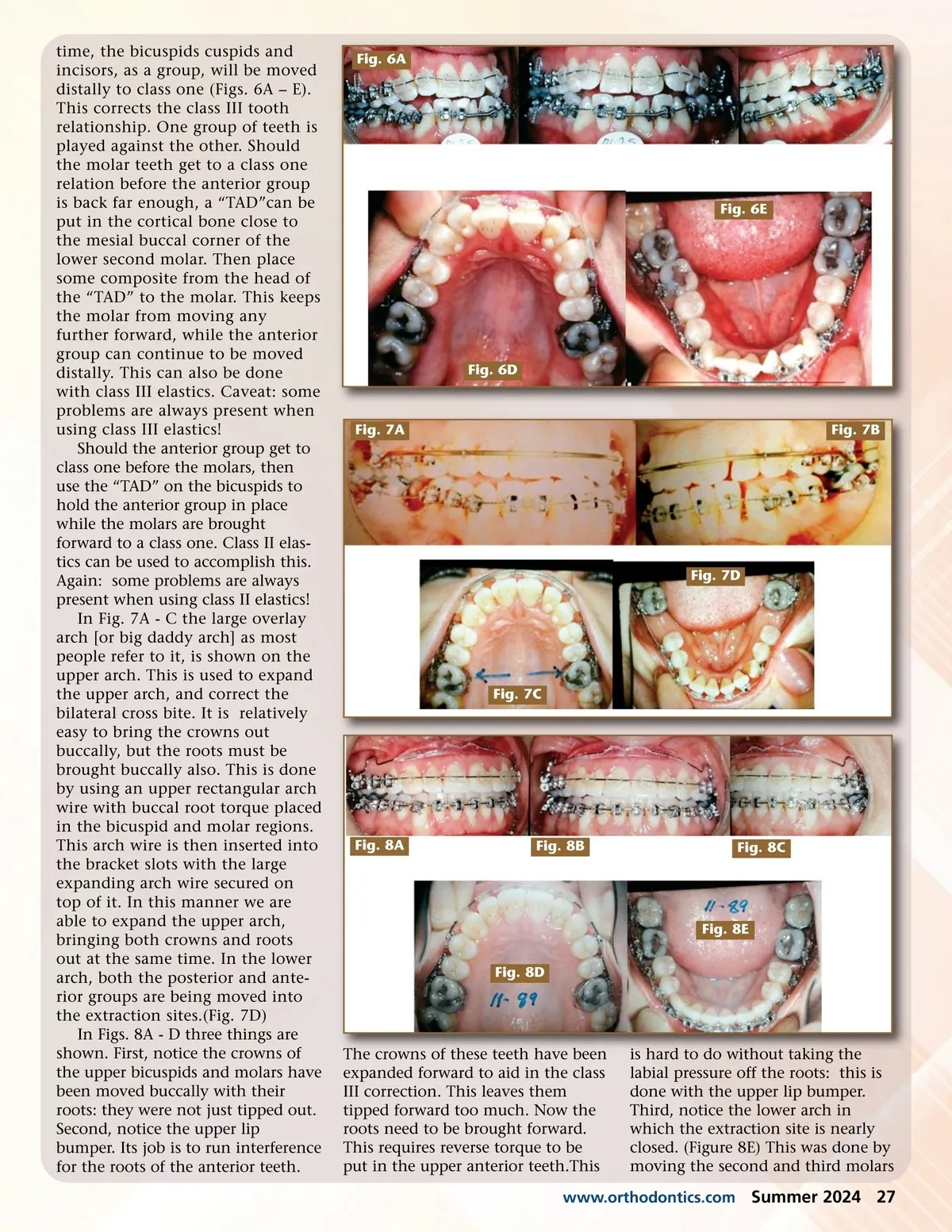
time, the bicuspids cuspids and incisors, as a group, will be moved distally to class one (Figs. 6A – E). This corrects the class III tooth relationship. One group of teeth is played against the other. Should the molar teeth get to a class one relation before the anterior group is back far enough, a “TAD”can be put in the cortical bone close to the mesial buccal corner of the lower second molar. Then place some composite from the head of the “TAD” to the molar. This keeps the molar from moving any further forward, while the anterior group can continue to be moved distally. This can also be done with class III elastics. Caveat: some problems are always present when using class III elastics! Should the anterior group get to class one before the molars, then use the “TAD” on the bicuspids to hold the anterior group in place while the molars are brought forward to a class one. Class II elas-tics can be used to accomplish this. Again: some problems are always present when using class II elastics! In Fig. 7A -C the large overlay arch [or big daddy arch] as most people refer to it, is shown on the upper arch. This is used to expand the upper arch, and correct the bilateral cross bite. It is relatively easy to bring the crowns out buccally, but the roots must be brought buccally also. This is done by using an upper rectangular arch wire with buccal root torque placed in the bicuspid and molar regions. This arch wire is then inserted into the bracket slots with the large expanding arch wire secured on top of it. In this manner we are able to expand the upper arch, bringing both crowns and roots out at the same time. In the lower arch, both the posterior and ante-rior groups are being moved into the extraction sites.(Fig. 7D) In Figs. 8A -D three things are shown. First, notice the crowns of the upper bicuspids and molars have been moved buccally with their roots: they were not just tipped out. Second, notice the upper lip bumper. Its job is to run interference for the roots of the anterior teeth. Fig. 6A Fig. 6E Fig. 6D Fig. 7A Fig. 7B Fig. 7D Fig. 7C Fig. 8A Fig. 8B Fig. 8C Fig. 8E Fig. 8D The crowns of these teeth have been expanded forward to aid in the class III correction. This leaves them tipped forward too much. Now the roots need to be brought forward. This requires reverse torque to be put in the upper anterior teeth.This is hard to do without taking the labial pressure off the roots: this is done with the upper lip bumper. Third, notice the lower arch in which the extraction site is nearly closed. (Figure 8E) This was done by moving the second and third molars www.orthodontics.com Summer 2024 27
Journal of the American Orthodontic Society Summer 2024: Page 27