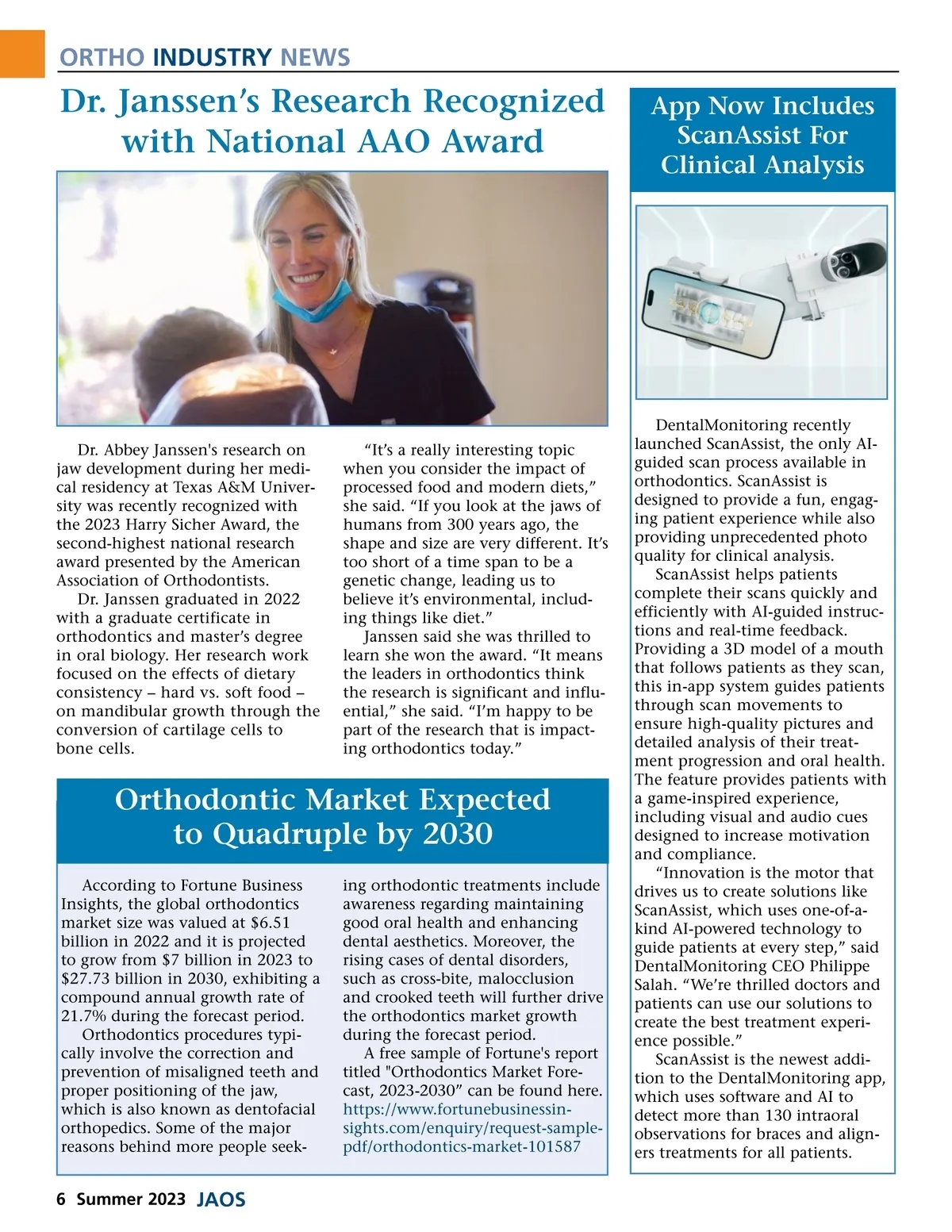
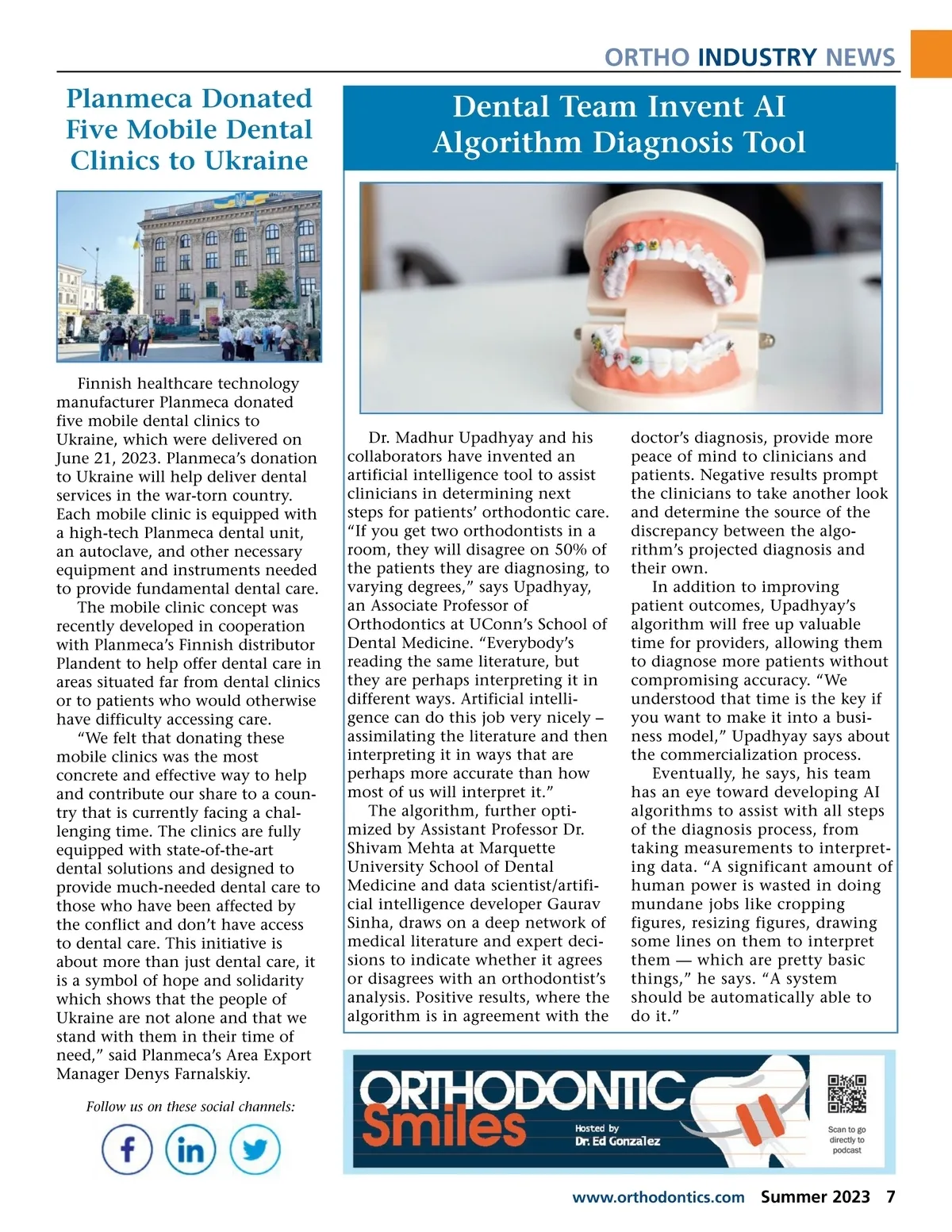
ORTHO INDUSTRY NEWS Planmeca Donated Five Mobile Dental Clinics to Ukraine Dental Team Invent AI Algorithm Diagnosis Tool Finnish healthcare technology manufacturer Planmeca donated five mobile dental clinics to Ukraine, which were delivered on June 21, 2023. Planmeca’s donation to Ukraine will help deliver dental services in the war-torn country. Each mobile clinic is equipped with a high-tech Planmeca dental unit, an autoclave, and other necessary equipment and instruments needed to provide fundamental dental care. The mobile clinic concept was recently developed in cooperation with Planmeca’s Finnish distributor Plandent to help offer dental care in areas situated far from dental clinics or to patients who would otherwise have difficulty accessing care. “We felt that donating these mobile clinics was the most concrete and effective way to help and contribute our share to a coun-try that is currently facing a chal-lenging time. The clinics are fully equipped with state-of-the-art dental solutions and designed to provide much-needed dental care to those who have been affected by the conflict and don’t have access to dental care. This initiative is about more than just dental care, it is a symbol of hope and solidarity which shows that the people of Ukraine are not alone and that we stand with them in their time of need,” said Planmeca’s Area Export Manager Denys Farnalskiy. Follow us on these social channels: Dr. Madhur Upadhyay and his collaborators have invented an artificial intelligence tool to assist clinicians in determining next steps for patients’ orthodontic care. “If you get two orthodontists in a room, they will disagree on 50% of the patients they are diagnosing, to varying degrees,” says Upadhyay, an Associate Professor of Orthodontics at UConn’s School of Dental Medicine. “Everybody’s reading the same literature, but they are perhaps interpreting it in different ways. Artificial intelli-gence can do this job very nicely – assimilating the literature and then interpreting it in ways that are perhaps more accurate than how most of us will interpret it.” The algorithm, further opti-mized by Assistant Professor Dr. Shivam Mehta at Marquette University School of Dental Medicine and data scientist/artifi-cial intelligence developer Gaurav Sinha, draws on a deep network of medical literature and expert deci-sions to indicate whether it agrees or disagrees with an orthodontist’s analysis. Positive results, where the algorithm is in agreement with the doctor’s diagnosis, provide more peace of mind to clinicians and patients. Negative results prompt the clinicians to take another look and determine the source of the discrepancy between the algo-rithm’s projected diagnosis and their own. In addition to improving patient outcomes, Upadhyay’s algorithm will free up valuable time for providers, allowing them to diagnose more patients without compromising accuracy. “We understood that time is the key if you want to make it into a busi-ness model,” Upadhyay says about the commercialization process. Eventually, he says, his team has an eye toward developing AI algorithms to assist with all steps of the diagnosis process, from taking measurements to interpret-ing data. “A significant amount of human power is wasted in doing mundane jobs like cropping figures, resizing figures, drawing some lines on them to interpret them — which are pretty basic things,” he says. “A system should be automatically able to do it.” www.orthodontics.com Summer 2023 7
Journal of the American Orthodontic Society Summer 2023: Page 7