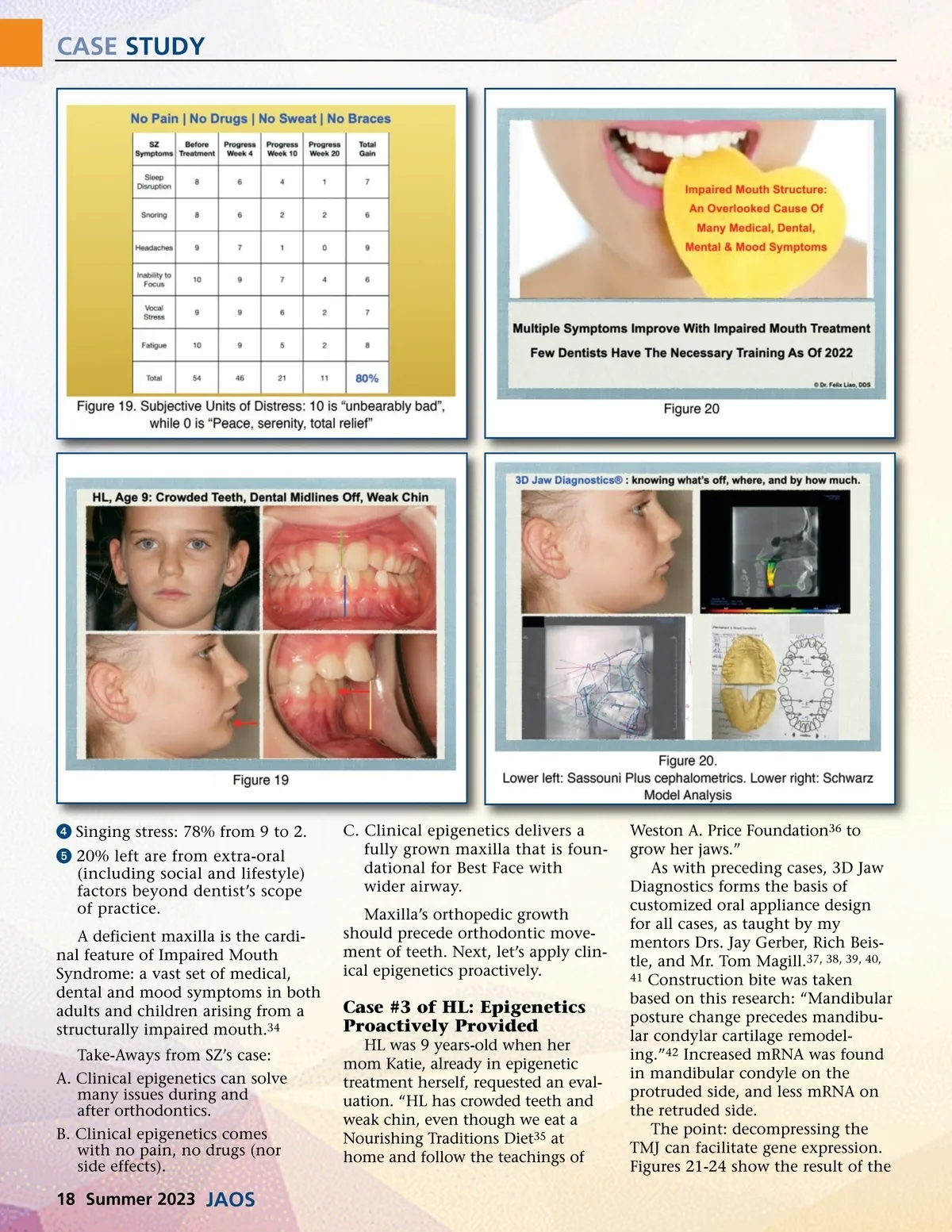
CASE STUDY clinical Epigenetics method as her adult teeth erupt. HL now has the orthopedic foun-dation for all her teeth and Best Face encoded in her genes. Phase II orthodontics consists of cranio-sacral therapy 43 in combination with clear aligners to balance palatal-facial asymmetry and align her midlines. Paradigm Shift: Orthodontic Mechanics to Clinical Epigenetics Traditional orthodontics relies heavily on wires and elastics to move teeth, while clinical epigenetics turns on HL’s gene expression toward her Best Face with room for all teeth. Sufficient jaw growth by the time adult teeth erupt is nature’s way to avoid crowded teeth and skeletal malocclusion. Clinical epigenetics facilitate jaw growth, which is a paradigm shift from arti-ficial imposition on periodontal ligaments in deficient jaws. Instead of one standardized wire series for all cases, clinical epigenetics uses physiological forces from lip seal and normal swallowing, plus inter-mittent weak stimulus from func-tional appliance as needed. In short, orthodontic practitioners need to become experts in Epigenetic growth. Just as sound nutrition can turn on gene expression, environmental toxins can turn off gene expression. “Disorder of oral-facial growth” can be impacted by basic environmental factors as follows: ᕡ Environmental pollutants even at low levels “may slow fetal growth.” 44 www.orthodontics.com Summer 2023 19
Journal of the American Orthodontic Society Summer 2023: Page 19