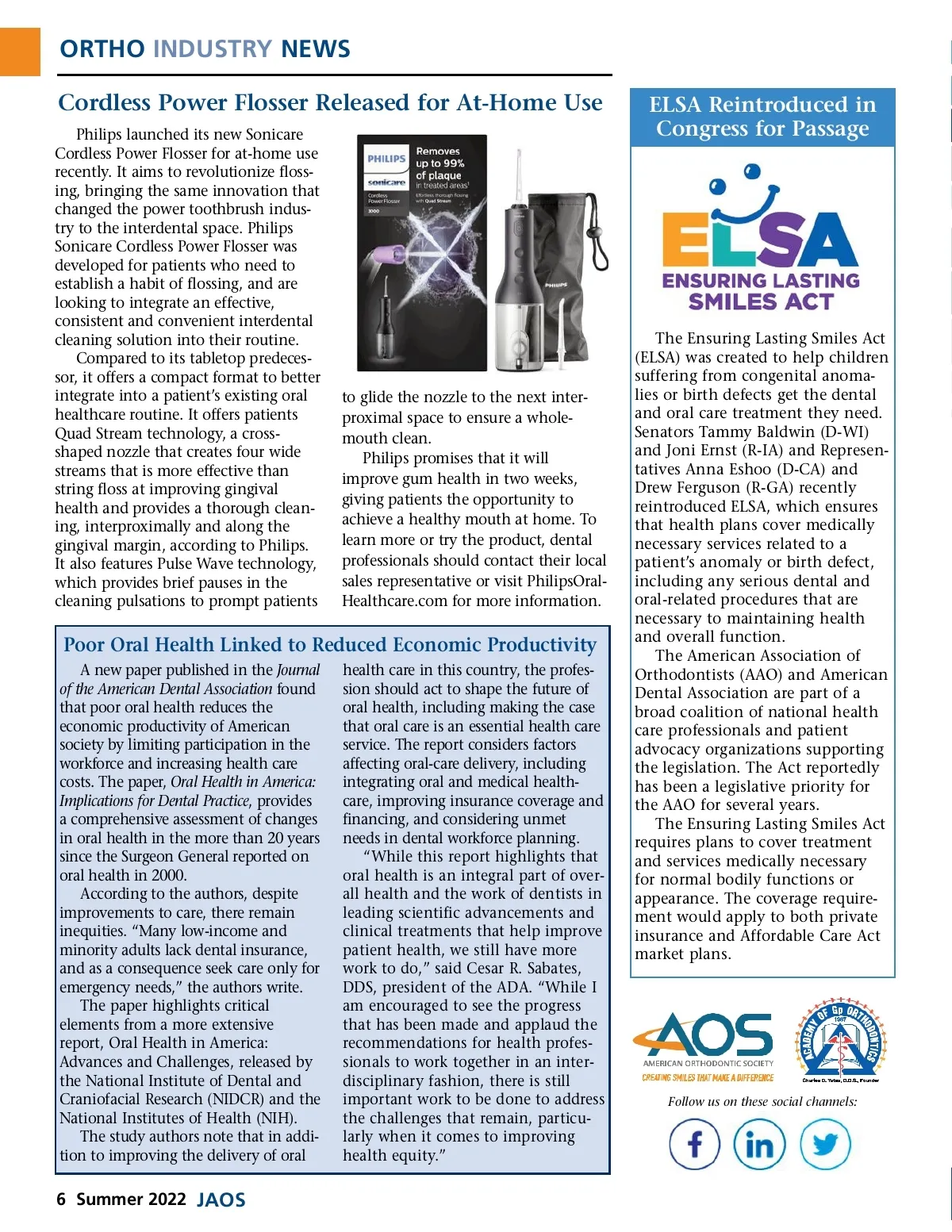
ORTHO INDUSTRY NEWS Cordless Power Flosser Released for At-Home Use Philips launched its new Sonicare Cordless Power Flosser for at-home use recently. It aims to revolutionize floss-ing, bringing the same innovation that changed the power toothbrush indus-try to the interdental space. Philips Sonicare Cordless Power Flosser was developed for patients who need to establish a habit of flossing, and are looking to integrate an effective, consistent and convenient interdental cleaning solution into their routine. Compared to its tabletop predeces-sor, it offers a compact format to better integrate into a patient’s existing oral healthcare routine. It offers patients Quad Stream technology, a cross-shaped nozzle that creates four wide streams that is more effective than string floss at improving gingival health and provides a thorough clean-ing, interproximally and along the gingival margin, according to Philips. It also features Pulse Wave technology, which provides brief pauses in the cleaning pulsations to prompt patients ELSA Reintroduced in Congress for Passage to glide the nozzle to the next inter-proximal space to ensure a whole-mouth clean. Philips promises that it will improve gum health in two weeks, giving patients the opportunity to achieve a healthy mouth at home. To learn more or try the product, dental professionals should contact their local sales representative or visit PhilipsOral-Healthcare.com for more information. Poor Oral Health Linked to Reduced Economic Productivity A new paper published in the Journal of the American Dental Association found that poor oral health reduces the economic productivity of American society by limiting participation in the workforce and increasing health care costs. The paper, Oral Health in America: Implications for Dental Practice , provides a comprehensive assessment of changes in oral health in the more than 20 years since the Surgeon General reported on oral health in 2000. According to the authors, despite improvements to care, there remain inequities. “Many low-income and minority adults lack dental insurance, and as a consequence seek care only for emergency needs,” the authors write. The paper highlights critical elements from a more extensive report, Oral Health in America: Advances and Challenges, released by the National Institute of Dental and Craniofacial Research (NIDCR) and the National Institutes of Health (NIH). The study authors note that in addi-tion to improving the delivery of oral health care in this country, the profes-sion should act to shape the future of oral health, including making the case that oral care is an essential health care service. The report considers factors affecting oral-care delivery, including integrating oral and medical health-care, improving insurance coverage and financing, and considering unmet needs in dental workforce planning. “While this report highlights that oral health is an integral part of over-all health and the work of dentists in leading scientific advancements and clinical treatments that help improve patient health, we still have more work to do,” said Cesar R. Sabates, DDS, president of the ADA. “While I am encouraged to see the progress that has been made and applaud the recommendations for health profes-sionals to work together in an inter-disciplinary fashion, there is still important work to be done to address the challenges that remain, particu-larly when it comes to improving health equity.” The Ensuring Lasting Smiles Act (ELSA) was created to help children suffering from congenital anoma-lies or birth defects get the dental and oral care treatment they need. Senators Tammy Baldwin (D-WI) and Joni Ernst (R-IA) and Represen-tatives Anna Eshoo (D-CA) and Drew Ferguson (R-GA) recently reintroduced ELSA, which ensures that health plans cover medically necessary services related to a patient’s anomaly or birth defect, including any serious dental and oral-related procedures that are necessary to maintaining health and overall function. The American Association of Orthodontists (AAO) and American Dental Association are part of a broad coalition of national health care professionals and patient advocacy organizations supporting the legislation. The Act reportedly has been a legislative priority for the AAO for several years. The Ensuring Lasting Smiles Act requires plans to cover treatment and services medically necessary for normal bodily functions or appearance. The coverage require-ment would apply to both private insurance and Affordable Care Act market plans. Follow us on these social channels: 6 Summer 2022 JAOS
Journal of the American Orthodontic Society Summer 2022: Page 6