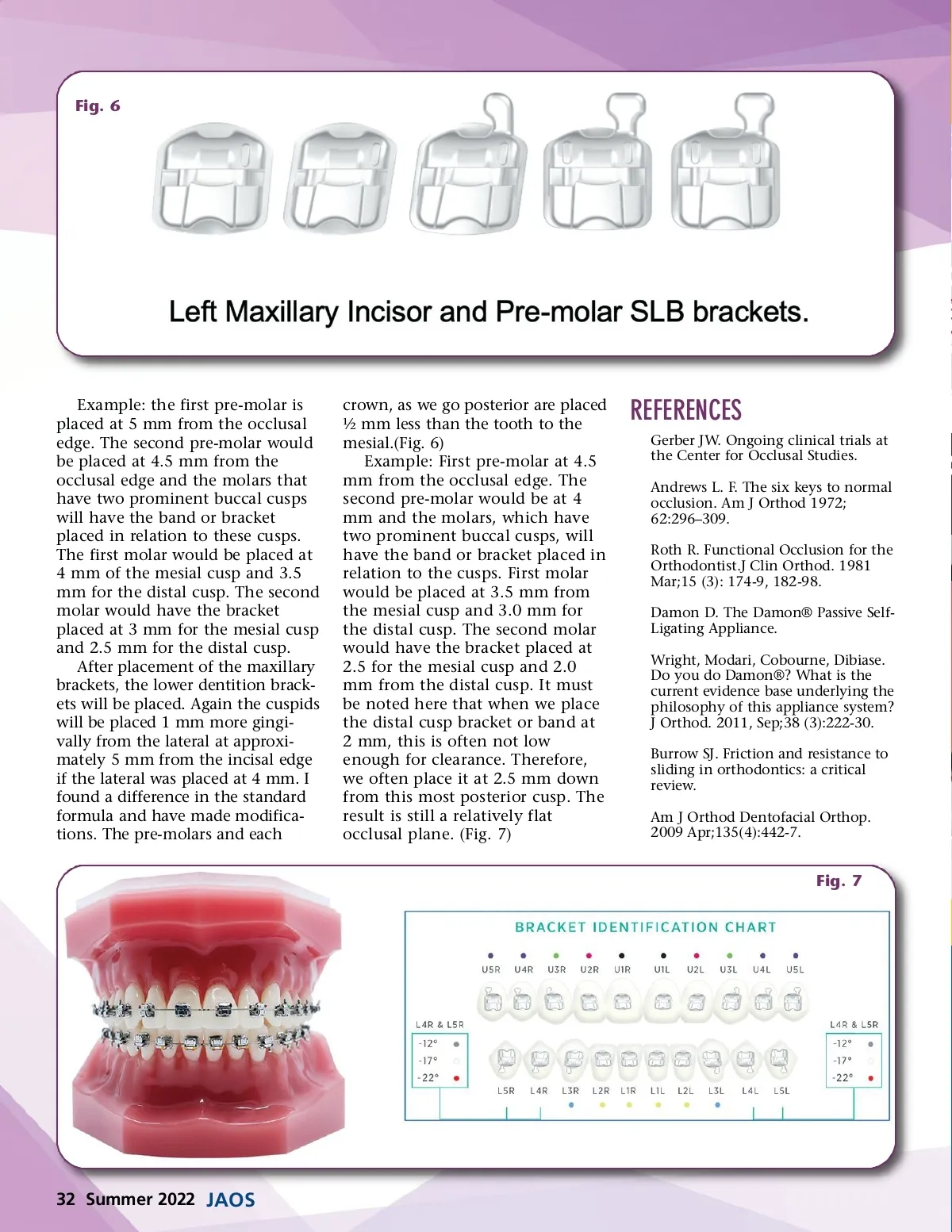
Fig. 6 Example: the first pre-molar is placed at 5 mm from the occlusal edge. The second pre-molar would be placed at 4.5 mm from the occlusal edge and the molars that have two prominent buccal cusps will have the band or bracket placed in relation to these cusps. The first molar would be placed at 4 mm of the mesial cusp and 3.5 mm for the distal cusp. The second molar would have the bracket placed at 3 mm for the mesial cusp and 2.5 mm for the distal cusp. After placement of the maxillary brackets, the lower dentition brack-ets will be placed. Again the cuspids will be placed 1 mm more gingi-vally from the lateral at approxi-mately 5 mm from the incisal edge if the lateral was placed at 4 mm. I found a difference in the standard formula and have made modifica-tions. The pre-molars and each crown, as we go posterior are placed ½ mm less than the tooth to the mesial.(Fig. 6) Example: First pre-molar at 4.5 mm from the occlusal edge. The second pre-molar would be at 4 mm and the molars, which have two prominent buccal cusps, will have the band or bracket placed in relation to the cusps. First molar would be placed at 3.5 mm from the mesial cusp and 3.0 mm for the distal cusp. The second molar would have the bracket placed at 2.5 for the mesial cusp and 2.0 mm from the distal cusp. It must be noted here that when we place the distal cusp bracket or band at 2 mm, this is often not low enough for clearance. Therefore, we often place it at 2.5 mm down from this most posterior cusp. The result is still a relatively flat occlusal plane. (Fig. 7) REFERENCES Gerber JW. Ongoing clinical trials at the Center for Occlusal Studies. Andrews L. F. The six keys to normal occlusion. Am J Orthod 1972; 62:296–309. Roth R. Functional Occlusion for the Orthodontist.J Clin Orthod. 1981 Mar;15 (3): 174-9, 182-98. Damon D. The Damon® Passive Self-Ligating Appliance. Wright, Modari, Cobourne, Dibiase. Do you do Damon®? What is the current evidence base underlying the philosophy of this appliance system? J Orthod. 2011, Sep;38 (3):222-30. Burrow SJ. Friction and resistance to sliding in orthodontics: a critical review. Am J Orthod Dentofacial Orthop. 2009 Apr;135(4):442-7. Fig. 7 32 Summer 2022 JAOS
Journal of the American Orthodontic Society Summer 2022: Page 32