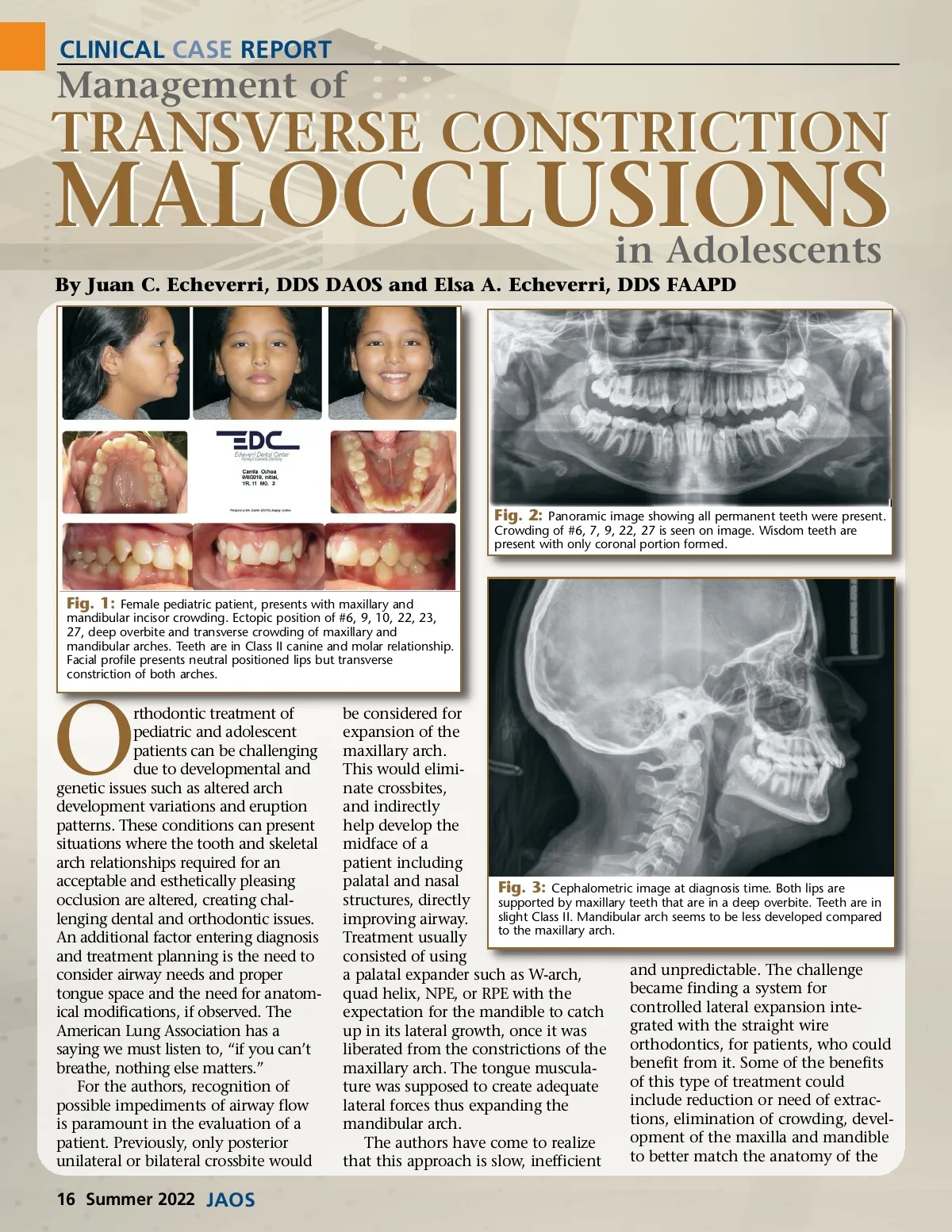
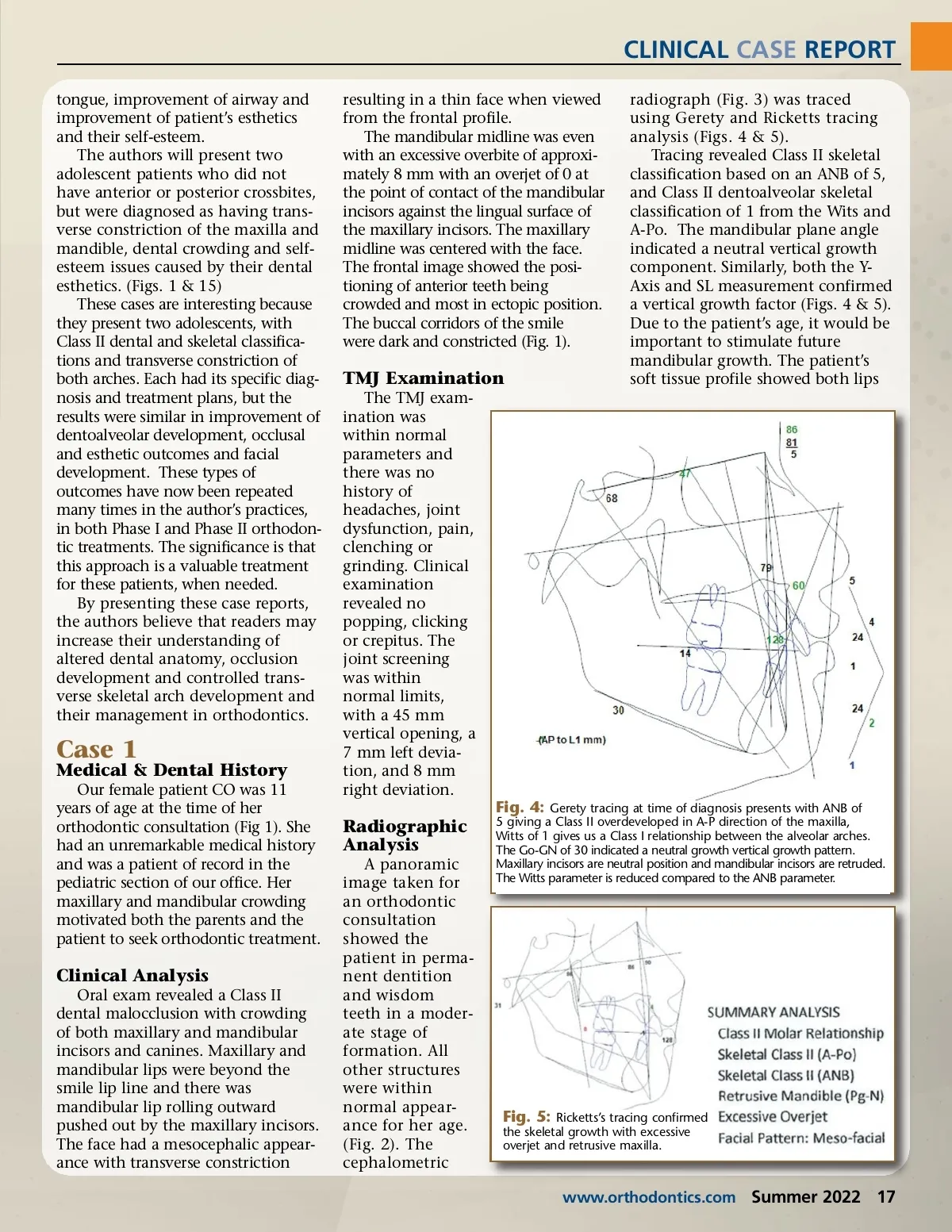
CLINICAL CASE REPORT Management of TRANSVERSE CONSTRICTION By Juan C. Echeverri, DDS DAOS and Elsa A. Echeverri, DDS FAAPD MALOCCLUSIONS in Adolescents Fig. 2: Panoramic image showing all permanent teeth were present. Crowding of #6, 7, 9, 22, 27 is seen on image. Wisdom teeth are present with only coronal portion formed. Fig. 1: Female pediatric patient, presents with maxillary and mandibular incisor crowding. Ectopic position of #6, 9, 10, 22, 23, 27, deep overbite and transverse crowding of maxillary and mandibular arches. Teeth are in Class II canine and molar relationship. Facial profile presents neutral positioned lips but transverse constriction of both arches. O rthodontic treatment of pediatric and adolescent patients can be challenging due to developmental and genetic issues such as altered arch development variations and eruption patterns. These conditions can present situations where the tooth and skeletal arch relationships required for an acceptable and esthetically pleasing occlusion are altered, creating chal-lenging dental and orthodontic issues. An additional factor entering diagnosis and treatment planning is the need to consider airway needs and proper tongue space and the need for anatom-ical modifications, if observed. The American Lung Association has a saying we must listen to, “if you can’t breathe, nothing else matters.” For the authors, recognition of possible impediments of airway flow is paramount in the evaluation of a patient. Previously, only posterior unilateral or bilateral crossbite would be considered for expansion of the maxillary arch. This would elimi-nate crossbites, and indirectly help develop the midface of a patient including palatal and nasal Fig. 3: Cephalometric image at diagnosis time. Both lips are structures, directly supported by maxillary teeth that are in a deep overbite. Teeth are in slight Class II. Mandibular arch seems to be less developed compared improving airway. to the maxillary arch. Treatment usually consisted of using and unpredictable. The challenge a palatal expander such as W-arch, became finding a system for quad helix, NPE, or RPE with the controlled lateral expansion inte-expectation for the mandible to catch grated with the straight wire up in its lateral growth, once it was orthodontics, for patients, who could liberated from the constrictions of the benefit from it. Some of the benefits maxillary arch. The tongue muscula-of this type of treatment could ture was supposed to create adequate include reduction or need of extrac-lateral forces thus expanding the tions, elimination of crowding, devel-mandibular arch. opment of the maxilla and mandible The authors have come to realize to better match the anatomy of the that this approach is slow, inefficient 16 Summer 2022 JAOS
Journal of the American Orthodontic Society Summer 2022: Page 16