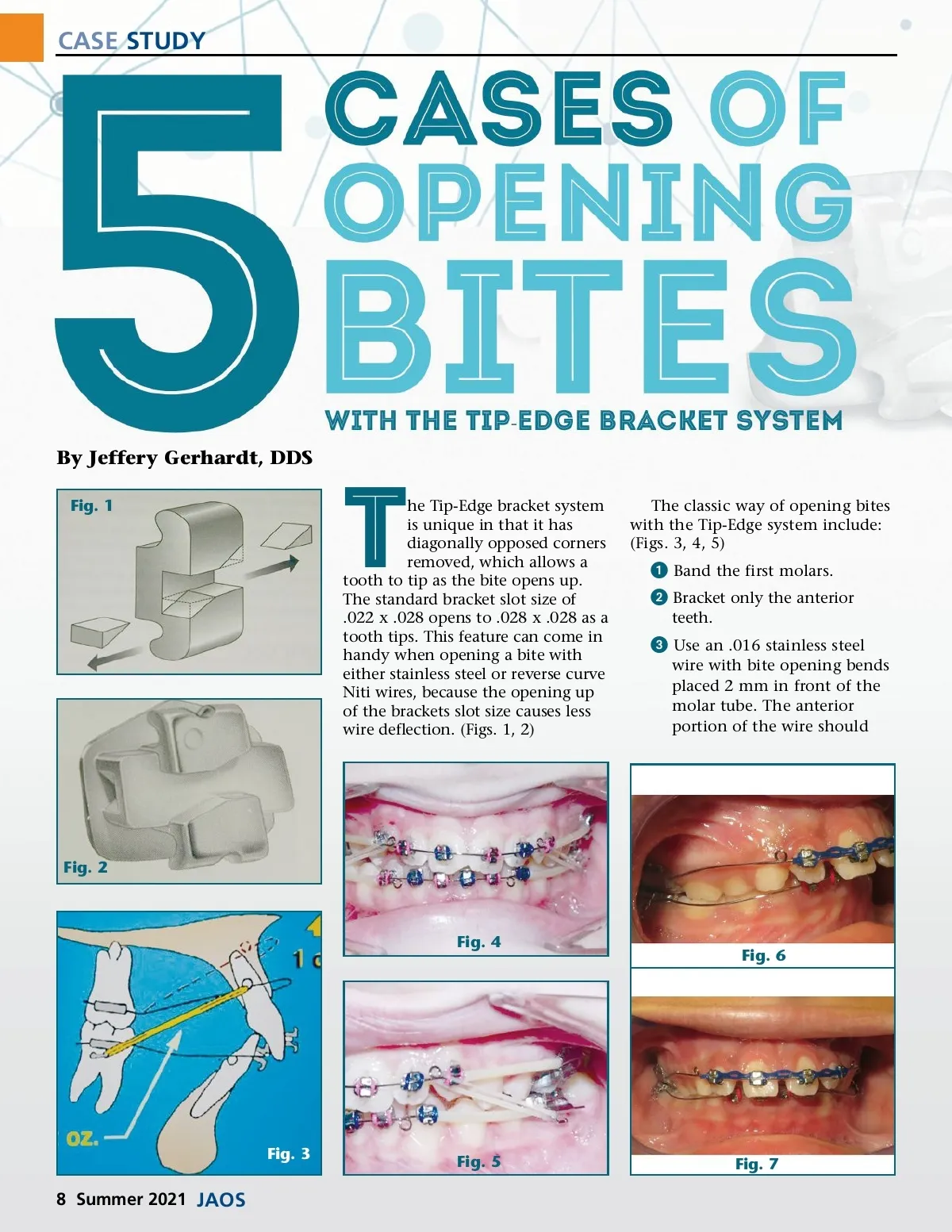
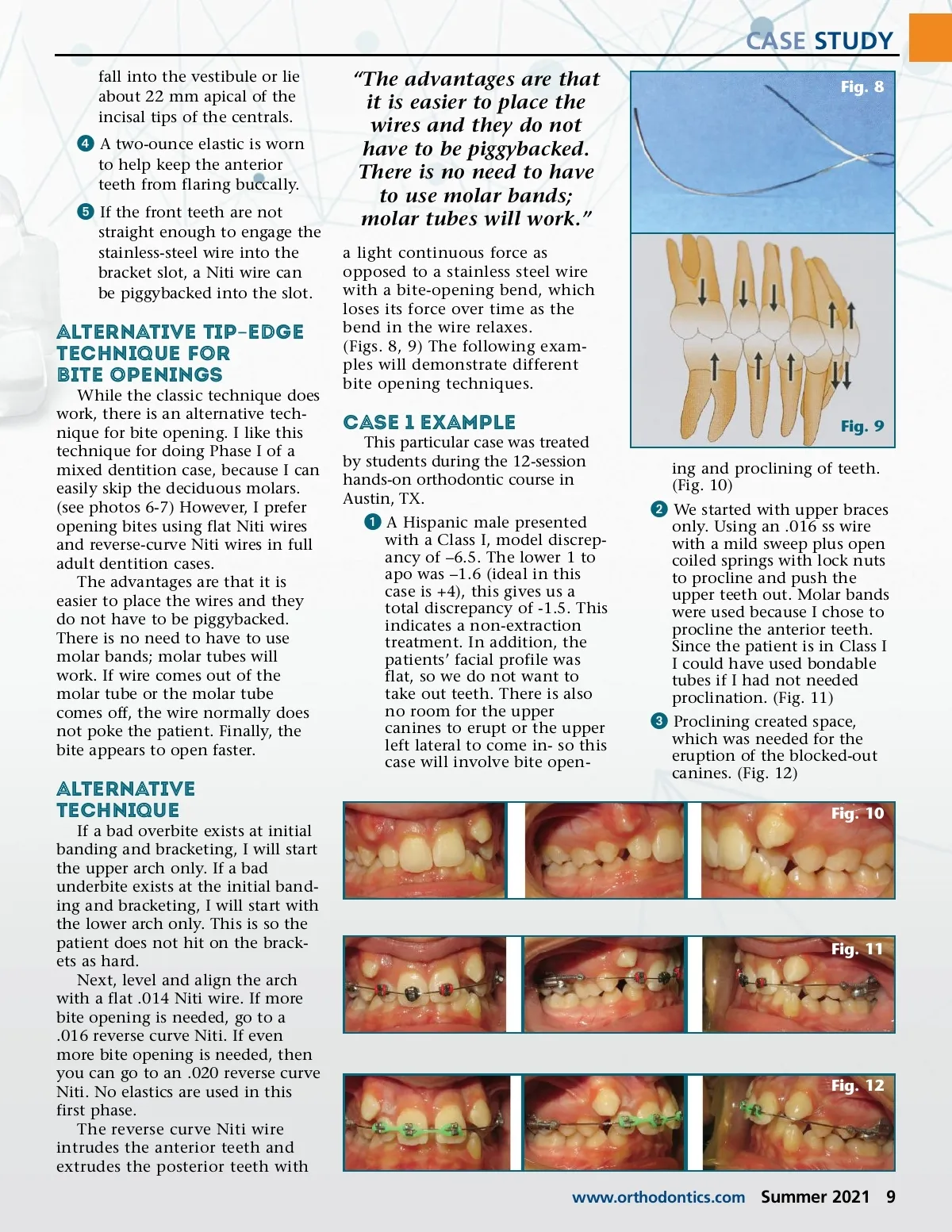
CASE STUDY fall into the vestibule or lie about 22 mm apical of the incisal tips of the centrals. ᕤ A two-ounce elastic is worn to help keep the anterior teeth from flaring buccally. ᕥ If the front teeth are not straight enough to engage the stainless-steel wire into the bracket slot, a Niti wire can be piggybacked into the slot. “The advantages are that it is easier to place the wires and they do not have to be piggybacked. There is no need to have to use molar bands; molar tubes will work.” a light continuous force as opposed to a stainless steel wire with a bite-opening bend, which loses its force over time as the bend in the wire relaxes. (Figs. 8, 9) The following exam-ples will demonstrate different bite opening techniques. Fig. 8 Alternative Tip – Edge Technique for Bite Openings While the classic technique does work, there is an alternative tech-nique for bite opening. I like this technique for doing Phase I of a mixed dentition case, because I can easily skip the deciduous molars. (see photos 6-7) However, I prefer opening bites using flat Niti wires and reverse-curve Niti wires in full adult dentition cases. The advantages are that it is easier to place the wires and they do not have to be piggybacked. There is no need to have to use molar bands; molar tubes will work. If wire comes out of the molar tube or the molar tube comes off, the wire normally does not poke the patient. Finally, the bite appears to open faster. Case 1 Example This particular case was treated by students during the 12-session hands-on orthodontic course in Austin, TX. Fig. 9 ing and proclining of teeth. (Fig. 10) ᕡ A Hispanic male presented with a Class I, model discrep-ancy of –6.5. The lower 1 to apo was –1.6 (ideal in this case is +4), this gives us a total discrepancy of -1.5. This indicates a non-extraction treatment. In addition, the patients’ facial profile was flat, so we do not want to take out teeth. There is also no room for the upper canines to erupt or the upper left lateral to come in-so this case will involve bite open-ᕢ We started with upper braces only. Using an .016 ss wire with a mild sweep plus open coiled springs with lock nuts to procline and push the upper teeth out. Molar bands were used because I chose to procline the anterior teeth. Since the patient is in Class I I could have used bondable tubes if I had not needed proclination. (Fig. 11) ᕣ Proclining created space, which was needed for the eruption of the blocked-out canines. (Fig. 12) Fig. 10 Alternative TECHNIQUE If a bad overbite exists at initial banding and bracketing, I will start the upper arch only. If a bad underbite exists at the initial band-ing and bracketing, I will start with the lower arch only. This is so the patient does not hit on the brack-ets as hard. Next, level and align the arch with a flat .014 Niti wire. If more bite opening is needed, go to a .016 reverse curve Niti. If even more bite opening is needed, then you can go to an .020 reverse curve Niti. No elastics are used in this first phase. The reverse curve Niti wire intrudes the anterior teeth and extrudes the posterior teeth with Fig. 11 Fig. 12 www.orthodontics.com Summer 2021 9
Journal of the American Orthodontic Society Summer 2021: Page 9