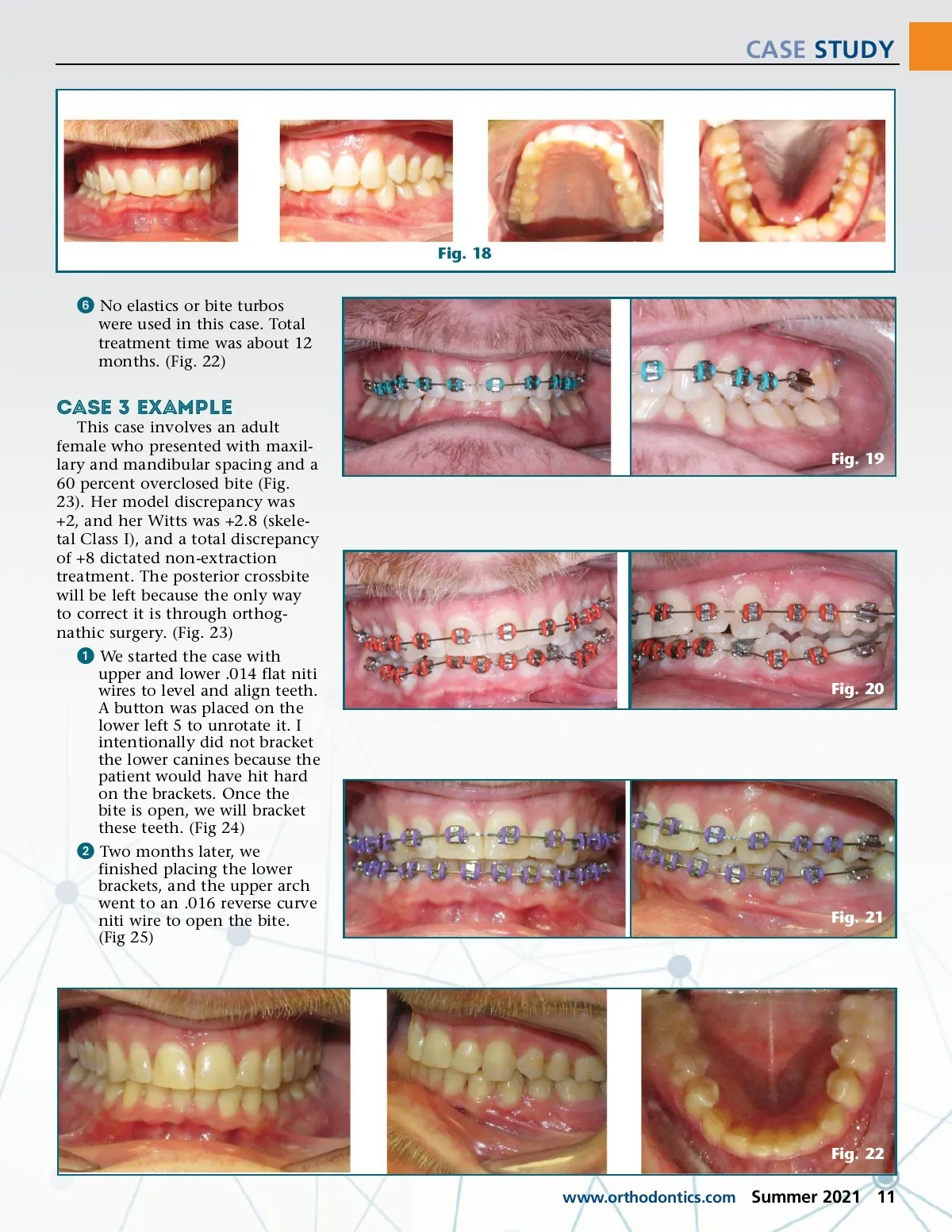
CASE STUDY Fig. 13 Fig. 14 Fig. 15 Fig. 16 “Now the lower teeth are out of the way and the bite is opened so we began engaging and pulling the Upper Left 2 into place using an .014 flat niti. We first bracketed the lateral with a button, and then went to a bracket.” ancy using the Tip-Edge diagnosis was +8 (indicating non-extraction) (Fig. 18) Fig. 17 ᕡ The case was started with upper-bracketed teeth only, and a flat .014 niti wire to level and align the upper arch. (Fig 19) ᕢ We then switched to an .016 ᕤ After space was created, we placed an .014 niti wire to bring the canines in to the arch. (Fig 13) finishing with .020 ss wires. (Fig. 16) ᕨ Braces were removed, but the torque of the laterals was still slightly off, so we later improved this with a spring aligner retainer. (Fig 17) then an .020 reverse curve niti wire in order to intrude the upper front teeth. ᕥ Once the upper canines were in the arch, we placed lower brackets and leveled and aligned the lower teeth with an .014 niti wire. (Fig 14) ᕣ After about three months more room had developed in the lower arch allowing us to place lower brackets with an .014 flat niti to level and align the lower teeth. (Fig. 20) ᕩ Post–op ceph shows that the lower 1 to APo is at a finished position of +3.3 (ideal +4). (Fig .18) ᕦ Now the lower teeth are out of the way and the bite is opened so we began engaging and pulling the Upper Left 2 into place using an .014 flat niti. We first bracketed the lateral with a button, and then went to a bracket. (Fig 15) ᕤ We then went to an .016 reverse curve niti wire in the lower arch to finishing open-ing the bite. Case 2 Example This case involved an adult male who presented with a 100 percent over-closed bite and lower anterior crowding. His model discrepancy was –4, and he had a witts of +6.1 (Class II skeletal). His total discrep-ᕥ The case was finished in an upper .021 x .028 braided wire and a lower .020 ss wire. (Fig. 21) ᕧ Once the lateral and canines were aligned, we went to 10 Summer 2021 JAOS
Journal of the American Orthodontic Society Summer 2021: Page 10