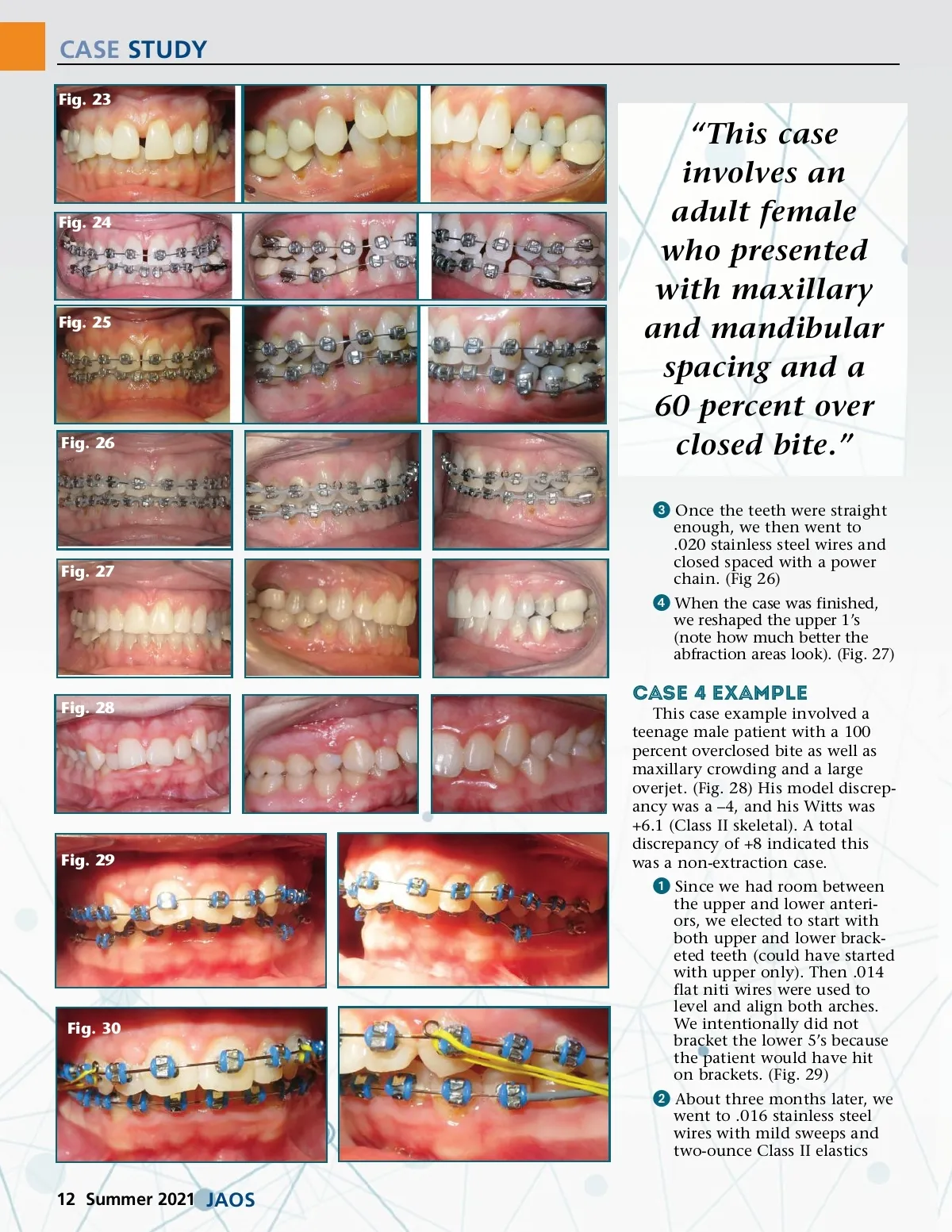
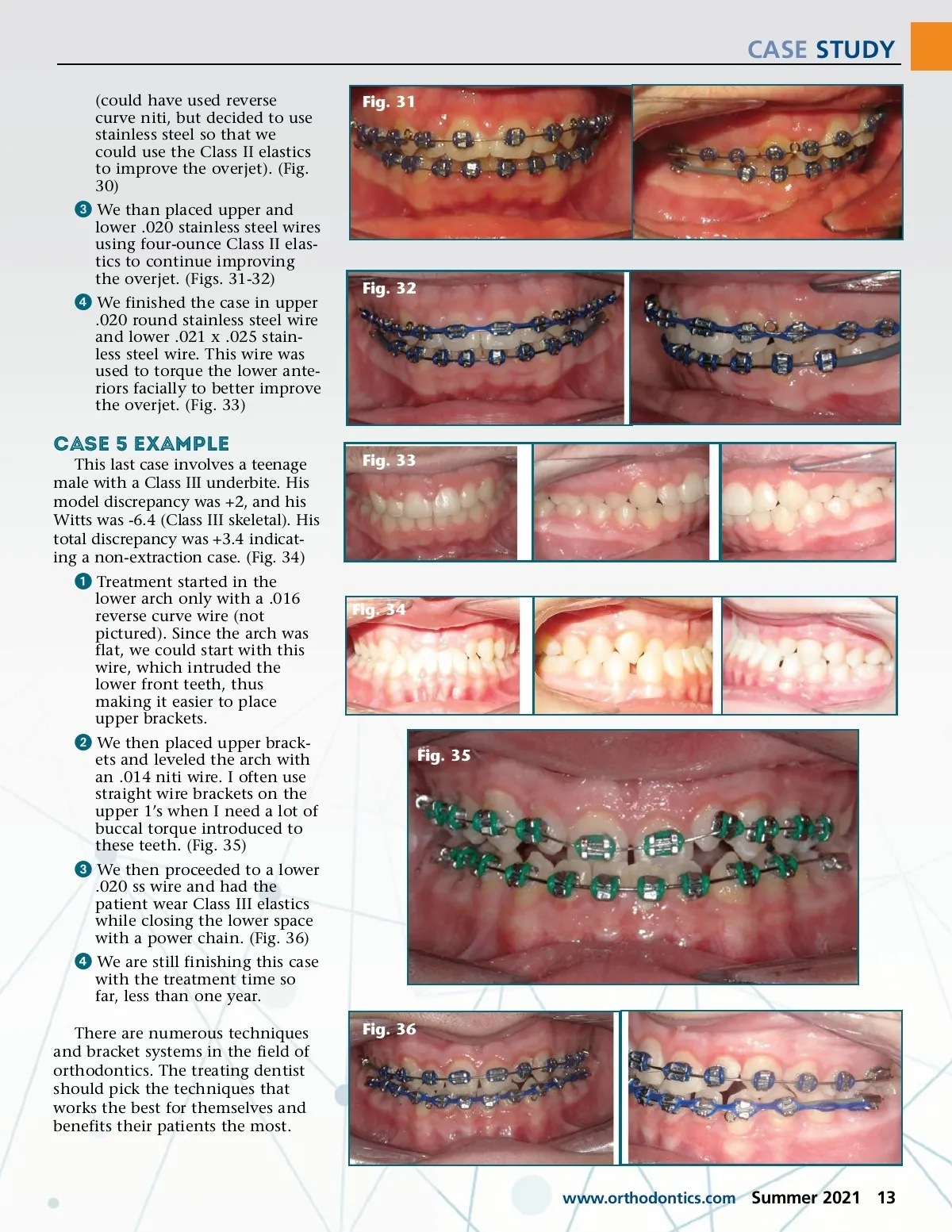
CASE STUDY (could have used reverse curve niti, but decided to use stainless steel so that we could use the Class II elastics to improve the overjet). (Fig. 30) Fig. 31 ᕣ We than placed upper and lower .020 stainless steel wires using four-ounce Class II elas-tics to continue improving the overjet. (Figs. 31-32) ᕤ We finished the case in upper .020 round stainless steel wire and lower .021 x .025 stain-less steel wire. This wire was used to torque the lower ante-riors facially to better improve the overjet. (Fig. 33) Fig. 32 Case 5 Example This last case involves a teenage male with a Class III underbite. His model discrepancy was +2, and his Witts was -6.4 (Class III skeletal). His total discrepancy was +3.4 indicat-ing a non-extraction case. (Fig. 34) Fig. 33 ᕡ Treatment started in the lower arch only with a .016 reverse curve wire (not pictured). Since the arch was flat, we could start with this wire, which intruded the lower front teeth, thus making it easier to place upper brackets. Fig. 34 ᕢ We then placed upper brack-ets and leveled the arch with an .014 niti wire. I often use straight wire brackets on the upper 1’s when I need a lot of buccal torque introduced to these teeth. (Fig. 35) Fig. 35 ᕣ We then proceeded to a lower .020 ss wire and had the patient wear Class III elastics while closing the lower space with a power chain. (Fig. 36) ᕤ We are still finishing this case with the treatment time so far, less than one year. There are numerous techniques and bracket systems in the field of orthodontics. The treating dentist should pick the techniques that works the best for themselves and benefits their patients the most. Fig. 36 www.orthodontics.com Summer 2021 13
Journal of the American Orthodontic Society Summer 2021: Page 13