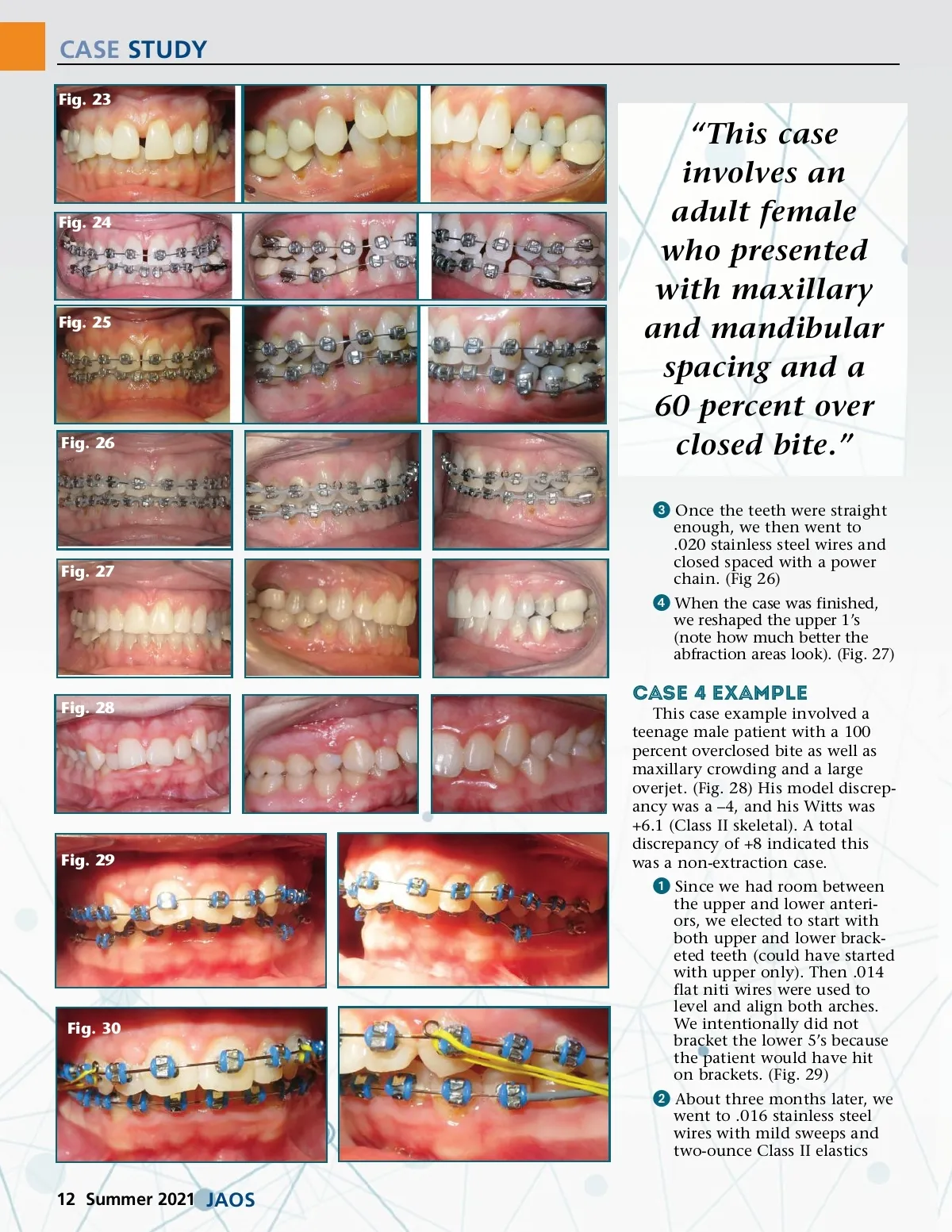
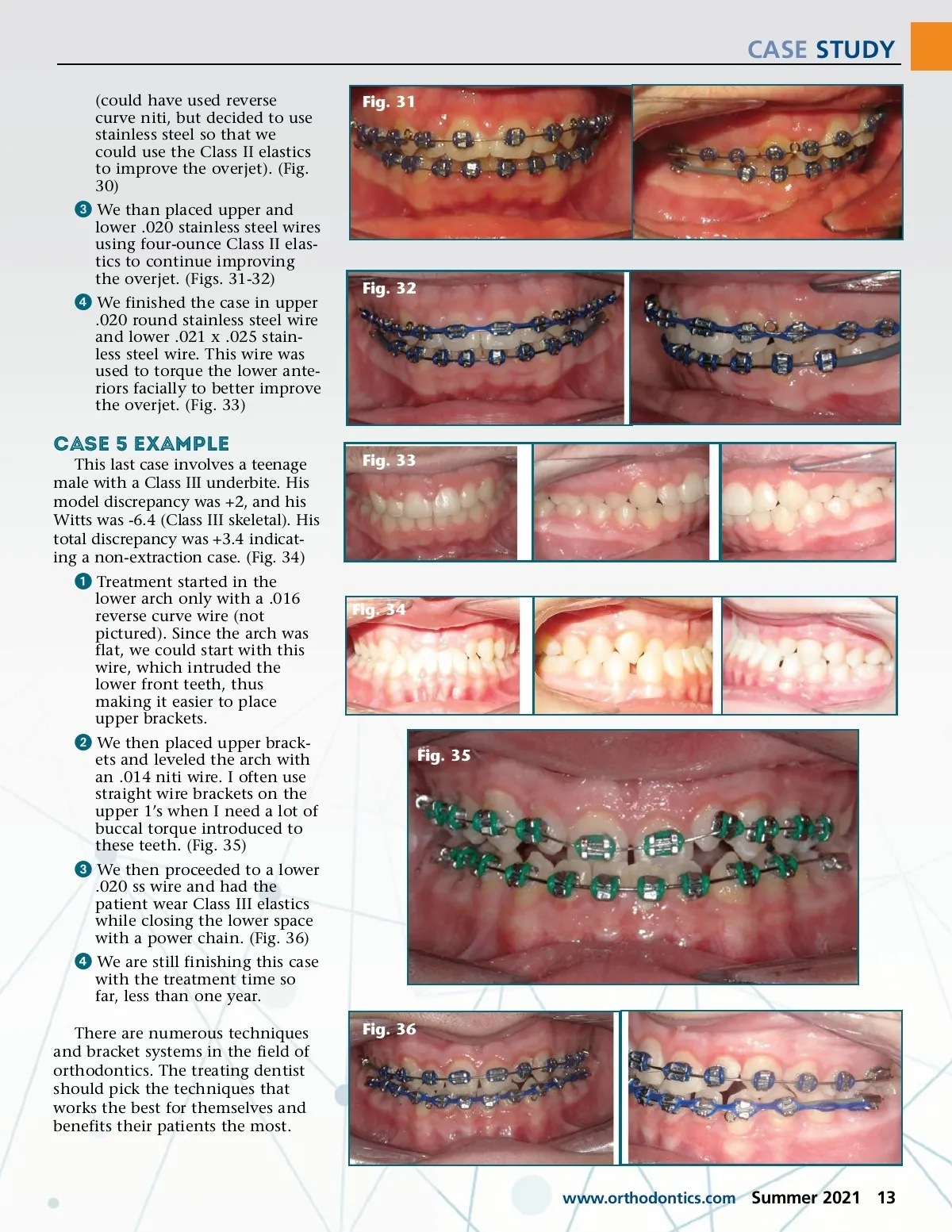
CASE STUDY Fig. 23 Fig. 24 Fig. 25 Fig. 26 “This case involves an adult female who presented with maxillary and mandibular spacing and a 60 percent over closed bite.” ᕣ Once the teeth were straight enough, we then went to .020 stainless steel wires and closed spaced with a power chain. (Fig 26) Fig. 27 ᕤ When the case was finished, we reshaped the upper 1’s (note how much better the abfraction areas look). (Fig. 27) Case 4 Example Fig. 28 This case example involved a teenage male patient with a 100 percent overclosed bite as well as maxillary crowding and a large overjet. (Fig. 28) His model discrep-ancy was a –4, and his Witts was +6.1 (Class II skeletal). A total discrepancy of +8 indicated this was a non-extraction case. Fig. 29 ᕡ Since we had room between the upper and lower anteri-ors, we elected to start with both upper and lower brack-eted teeth (could have started with upper only). Then .014 flat niti wires were used to level and align both arches. We intentionally did not bracket the lower 5’s because the patient would have hit on brackets. (Fig. 29) Fig. 30 ᕢ About three months later, we went to .016 stainless steel wires with mild sweeps and two-ounce Class II elastics 12 Summer 2021 JAOS
Journal of the American Orthodontic Society Summer 2021: Page 12