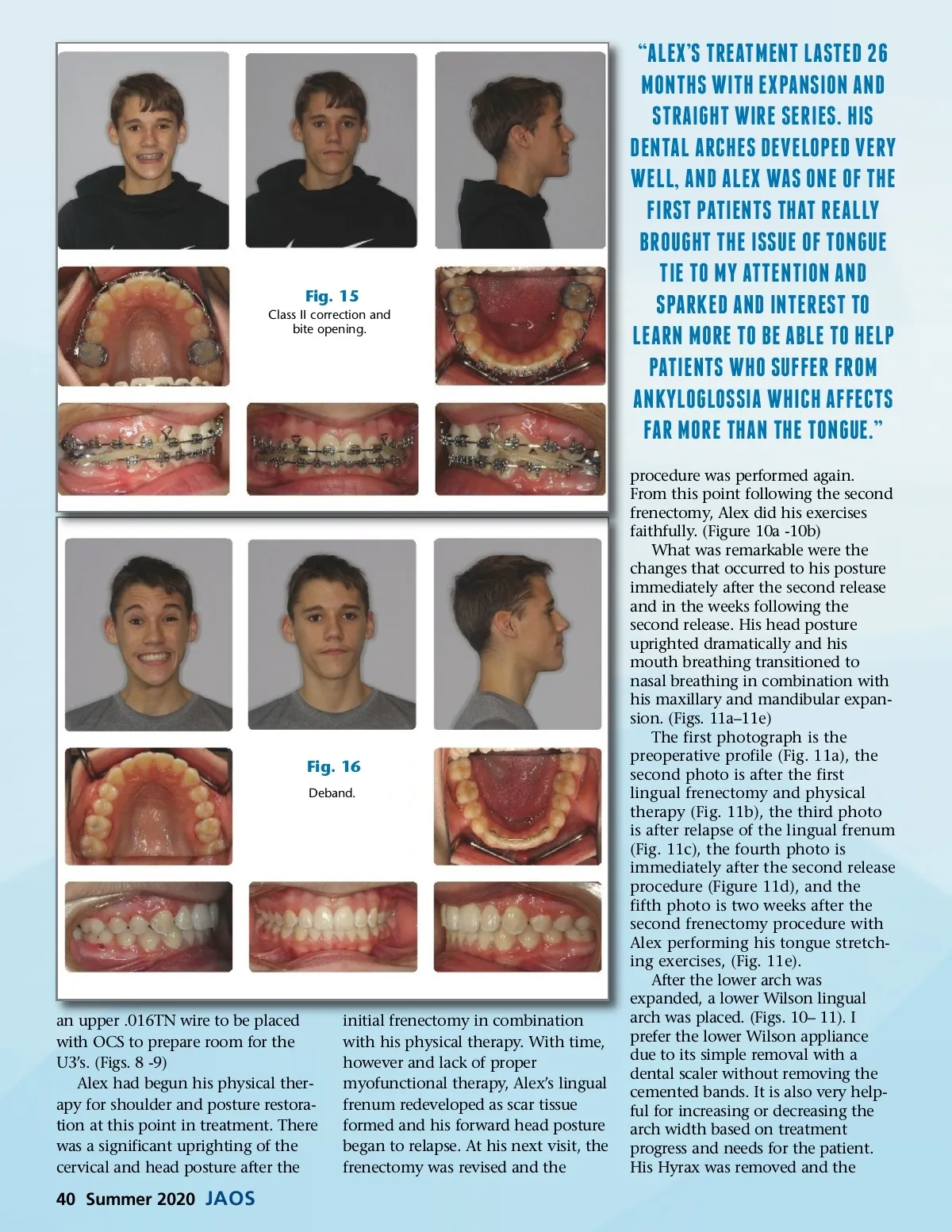
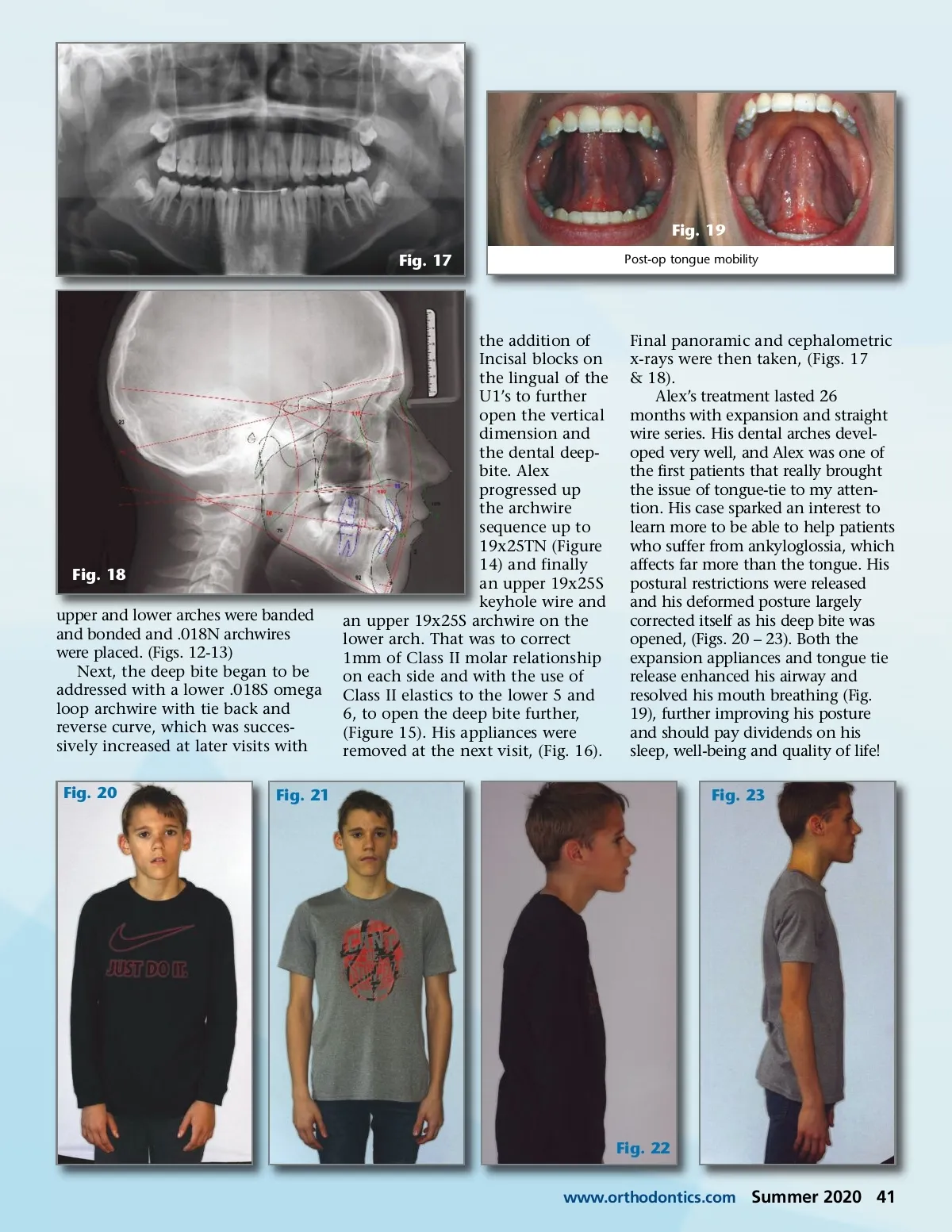
Fig. 19 Fig. 17 P ost-op tongue mobility Fig. 18 upper and lower arches were banded and bonded and .018N archwires were placed. (Figs. 12-13) Next, the deep bite began to be addressed with a lower .018S omega loop archwire with tie back and reverse curve, which was succes-sively increased at later visits with Fig. 20 Fig. 21 the addition of Incisal blocks on the lingual of the U1’s to further open the vertical dimension and the dental deep-bite. Alex progressed up the archwire sequence up to 19x25TN (Figure 14) and finally an upper 19x25S keyhole wire and an upper 19x25S archwire on the lower arch. That was to correct 1mm of Class II molar relationship on each side and with the use of Class II elastics to the lower 5 and 6, to open the deep bite further, (Figure 15). His appliances were removed at the next visit, (Fig. 16). Final panoramic and cephalometric x-rays were then taken, (Figs. 17 & 18). Alex’s treatment lasted 26 months with expansion and straight wire series. His dental arches devel-oped very well, and Alex was one of the first patients that really brought the issue of tongue-tie to my atten-tion. His case sparked an interest to learn more to be able to help patients who suffer from ankyloglossia, which affects far more than the tongue. His postural restrictions were released and his deformed posture largely corrected itself as his deep bite was opened, (Figs. 20 – 23). Both the expansion appliances and tongue tie release enhanced his airway and resolved his mouth breathing (Fig. 19), further improving his posture and should pay dividends on his sleep, well-being and quality of life! Fig. 23 Fig. 22 www.orthodontics.com Summer 2020 41
Journal of the American Orthodontic Society Summer 2020: Page 41