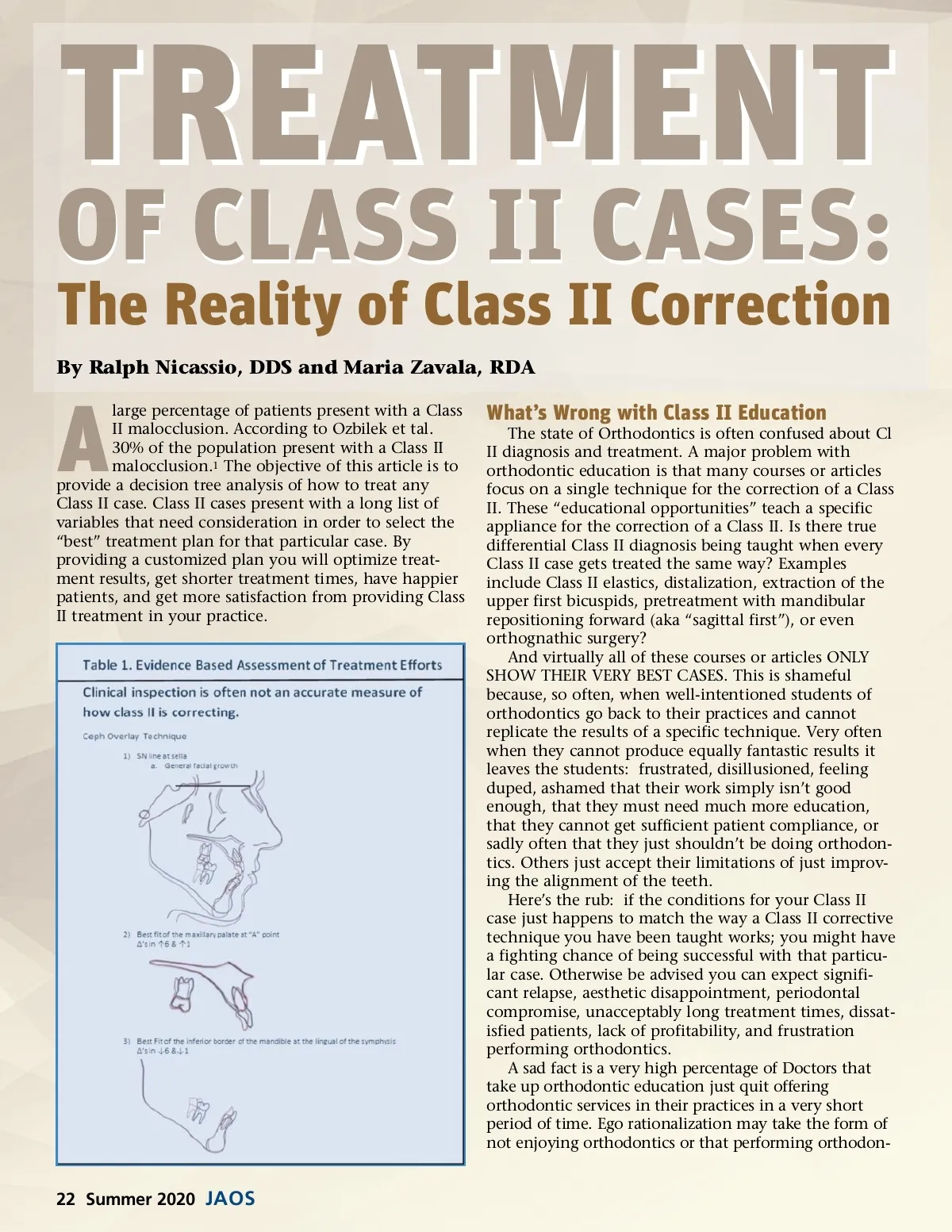
OF CLASS II CASES: The Reality of Class II Correction By Ralph Nicassio, DDS and Maria Zavala, RDA large percentage of patients present with a Class II malocclusion. According to Ozbilek et tal. 30% of the population present with a Class II malocclusion. 1 The objective of this article is to provide a decision tree analysis of how to treat any Class II case. Class II cases present with a long list of variables that need consideration in order to select the “best” treatment plan for that particular case. By providing a customized plan you will optimize treat-ment results, get shorter treatment times, have happier patients, and get more satisfaction from providing Class II treatment in your practice. TREATMENT What’s Wrong with Class II Education The state of Orthodontics is often confused about Cl II diagnosis and treatment. A major problem with orthodontic education is that many courses or articles focus on a single technique for the correction of a Class II. These “educational opportunities” teach a specific appliance for the correction of a Class II. Is there true differential Class II diagnosis being taught when every Class II case gets treated the same way? Examples include Class II elastics, distalization, extraction of the upper first bicuspids, pretreatment with mandibular repositioning forward (aka “sagittal first”), or even orthognathic surgery? And virtually all of these courses or articles ONLY SHOW THEIR VERY BEST CASES. This is shameful because, so often, when well-intentioned students of orthodontics go back to their practices and cannot replicate the results of a specific technique. Very often when they cannot produce equally fantastic results it leaves the students: frustrated, disillusioned, feeling duped, ashamed that their work simply isn’t good enough, that they must need much more education, that they cannot get sufficient patient compliance, or sadly often that they just shouldn’t be doing orthodon-tics. Others just accept their limitations of just improv-ing the alignment of the teeth. Here’s the rub: if the conditions for your Class II case just happens to match the way a Class II corrective technique you have been taught works; you might have a fighting chance of being successful with that particu-lar case. Otherwise be advised you can expect signifi-cant relapse, aesthetic disappointment, periodontal compromise, unacceptably long treatment times, dissat-isfied patients, lack of profitability, and frustration performing orthodontics. A sad fact is a very high percentage of Doctors that take up orthodontic education just quit offering orthodontic services in their practices in a very short period of time. Ego rationalization may take the form of not enjoying orthodontics or that performing orthodon-A 22 Summer 2020 JAOS
Journal of the American Orthodontic Society Summer 2020: Page 22