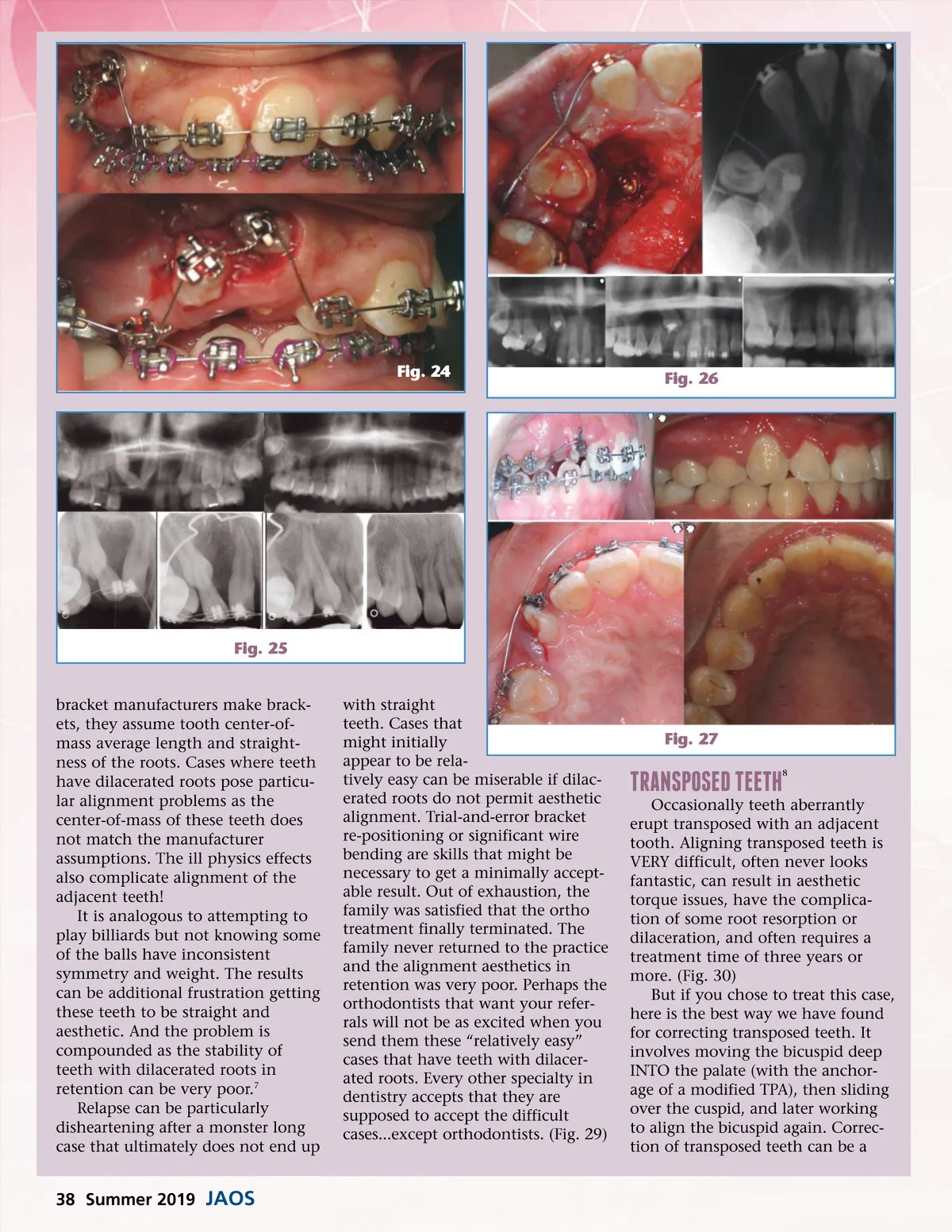
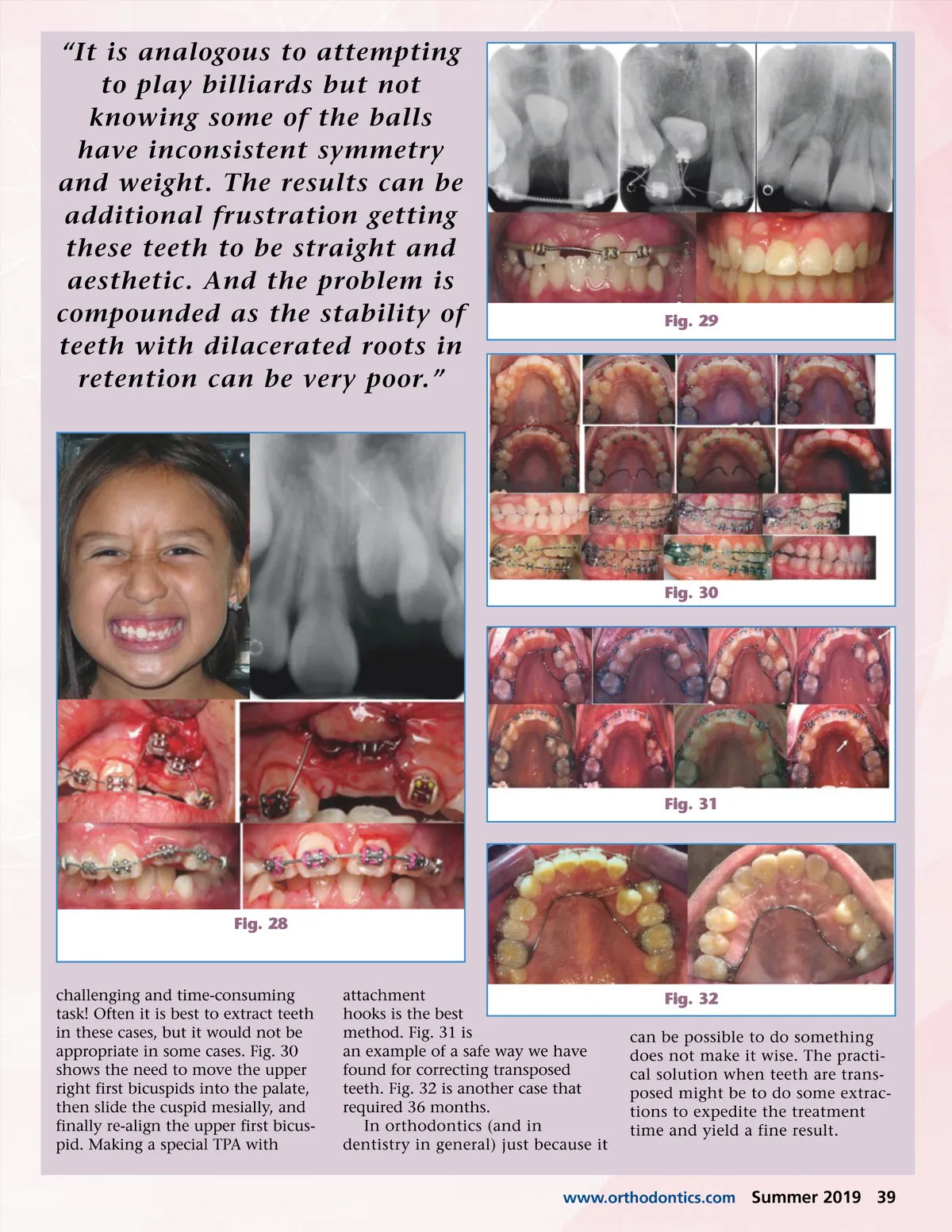
“It is analogous to attempting to play billiards but not knowing some of the balls have inconsistent symmetry and weight. The results can be additional frustration getting these teeth to be straight and aesthetic. And the problem is compounded as the stability of teeth with dilacerated roots in retention can be very poor.” Fig. 29 Fig. 30 Fig. 31 Fig. 28 challenging and time-consuming task! Often it is best to extract teeth in these cases, but it would not be appropriate in some cases. Fig. 30 shows the need to move the upper right first bicuspids into the palate, then slide the cuspid mesially, and finally re-align the upper first bicus-pid. Making a special TPA with attachment hooks is the best method. Fig. 31 is an example of a safe way we have found for correcting transposed teeth. Fig. 32 is another case that required 36 months. In orthodontics (and in dentistry in general) just because it Fig. 32 can be possible to do something does not make it wise. The practi-cal solution when teeth are trans-posed might be to do some extrac-tions to expedite the treatment time and yield a fine result. www.orthodontics.com Summer 2019 39
Journal of the American Orthodontic Society Summer 2019: Page 39