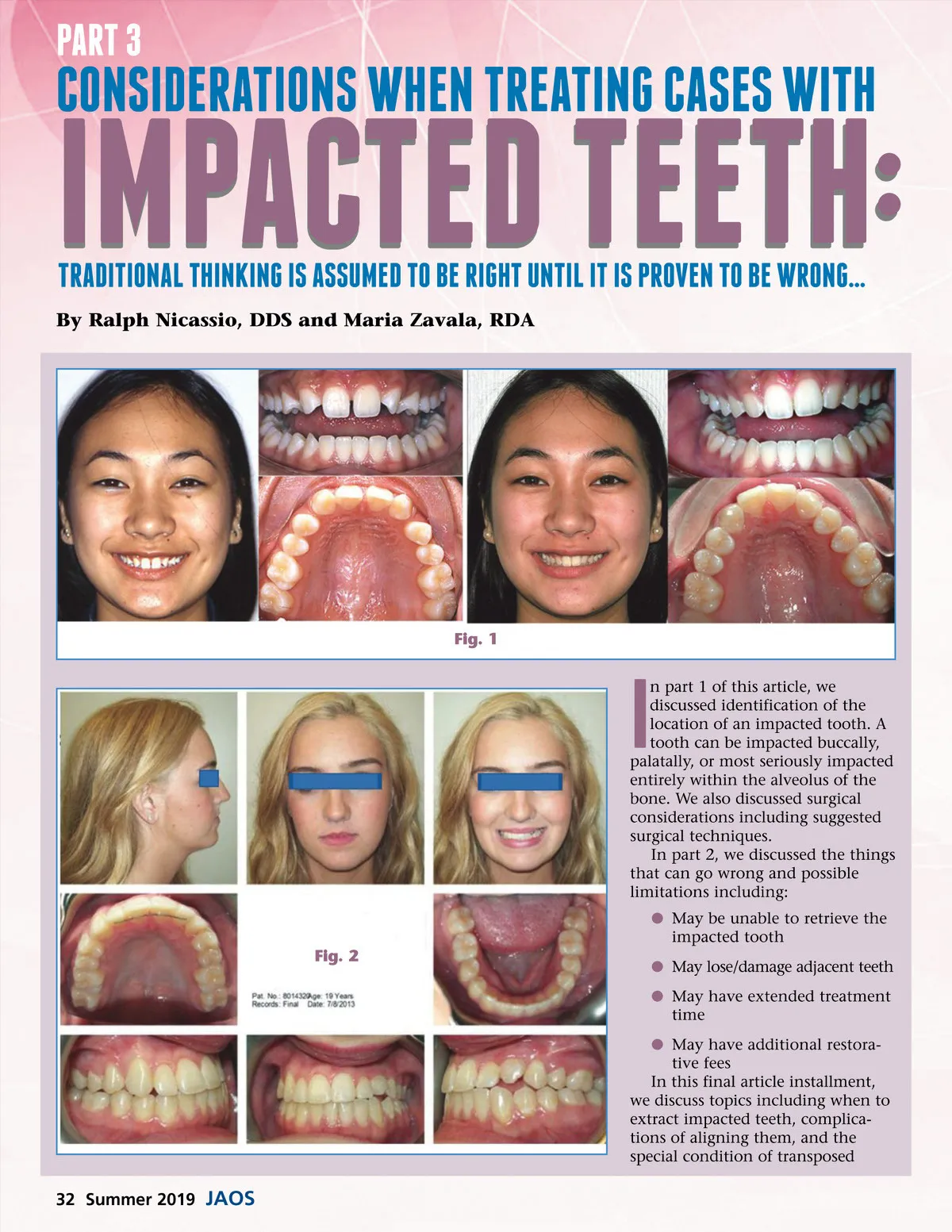
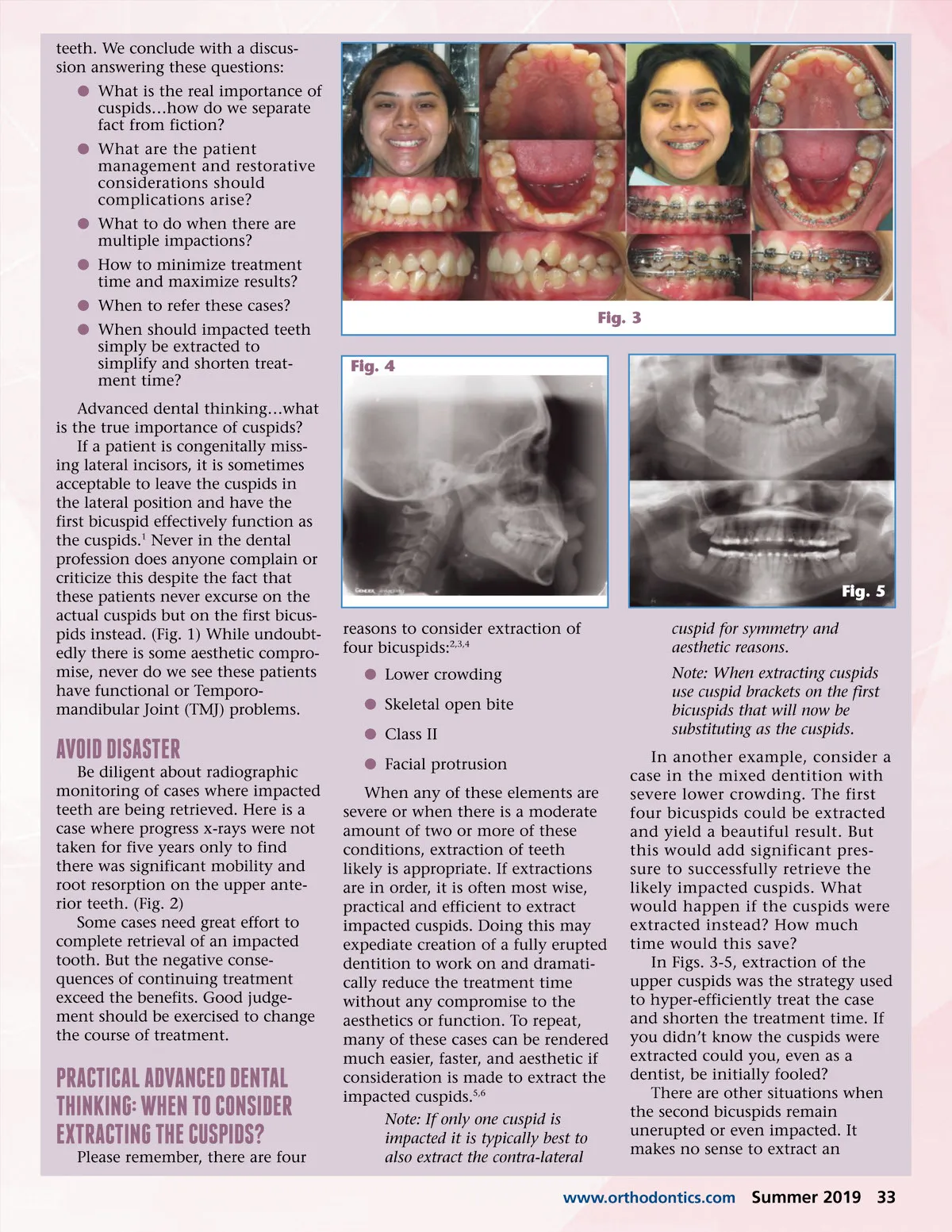
teeth. We conclude with a discus-sion answering these questions: b What is the real importance of cuspids…how do we separate fact from fiction? b What are the patient management and restorative considerations should complications arise? b What to do when there are multiple impactions? b How to minimize treatment time and maximize results? b When to refer these cases? b When should impacted teeth simply be extracted to simplify and shorten treat-ment time? Advanced dental thinking…what is the true importance of cuspids? If a patient is congenitally miss-ing lateral incisors, it is sometimes acceptable to leave the cuspids in the lateral position and have the first bicuspid effectively function as the cuspids. 1 Never in the dental profession does anyone complain or criticize this despite the fact that these patients never excurse on the actual cuspids but on the first bicus-pids instead. (Fig. 1) While undoubt-edly there is some aesthetic compro-mise, never do we see these patients have functional or Temporo-mandibular Joint (TMJ) problems. Fig. 3 Fig. 4 Fig. 5 reasons to consider extraction of four bicuspids: 2,3,4 b Lower crowding b Skeletal open bite b Class II b Facial protrusion When any of these elements are severe or when there is a moderate amount of two or more of these conditions, extraction of teeth likely is appropriate. If extractions are in order, it is often most wise, practical and efficient to extract impacted cuspids. Doing this may expediate creation of a fully erupted dentition to work on and dramati-cally reduce the treatment time without any compromise to the aesthetics or function. To repeat, many of these cases can be rendered much easier, faster, and aesthetic if consideration is made to extract the impacted cuspids. 5,6 Note: If only one cuspid is impacted it is typically best to also extract the contra-lateral cuspid for symmetry and aesthetic reasons. Note: When extracting cuspids use cuspid brackets on the first bicuspids that will now be substituting as the cuspids. In another example, consider a case in the mixed dentition with severe lower crowding. The first four bicuspids could be extracted and yield a beautiful result. But this would add significant pres-sure to successfully retrieve the likely impacted cuspids. What would happen if the cuspids were extracted instead? How much time would this save? In Figs. 3-5, extraction of the upper cuspids was the strategy used to hyper-efficiently treat the case and shorten the treatment time. If you didn’t know the cuspids were extracted could you, even as a dentist, be initially fooled? There are other situations when the second bicuspids remain unerupted or even impacted. It makes no sense to extract an avoId dIsaster Be diligent about radiographic monitoring of cases where impacted teeth are being retrieved. Here is a case where progress x-rays were not taken for five years only to find there was significant mobility and root resorption on the upper ante-rior teeth. (Fig. 2) Some cases need great effort to complete retrieval of an impacted tooth. But the negative conse-quences of continuing treatment exceed the benefits. Good judge-ment should be exercised to change the course of treatment. practIcal advanced dental thInkIng: When to consIder extractIng the cuspIds? Please remember, there are four www.orthodontics.com Summer 2019 33
Journal of the American Orthodontic Society Summer 2019: Page 33