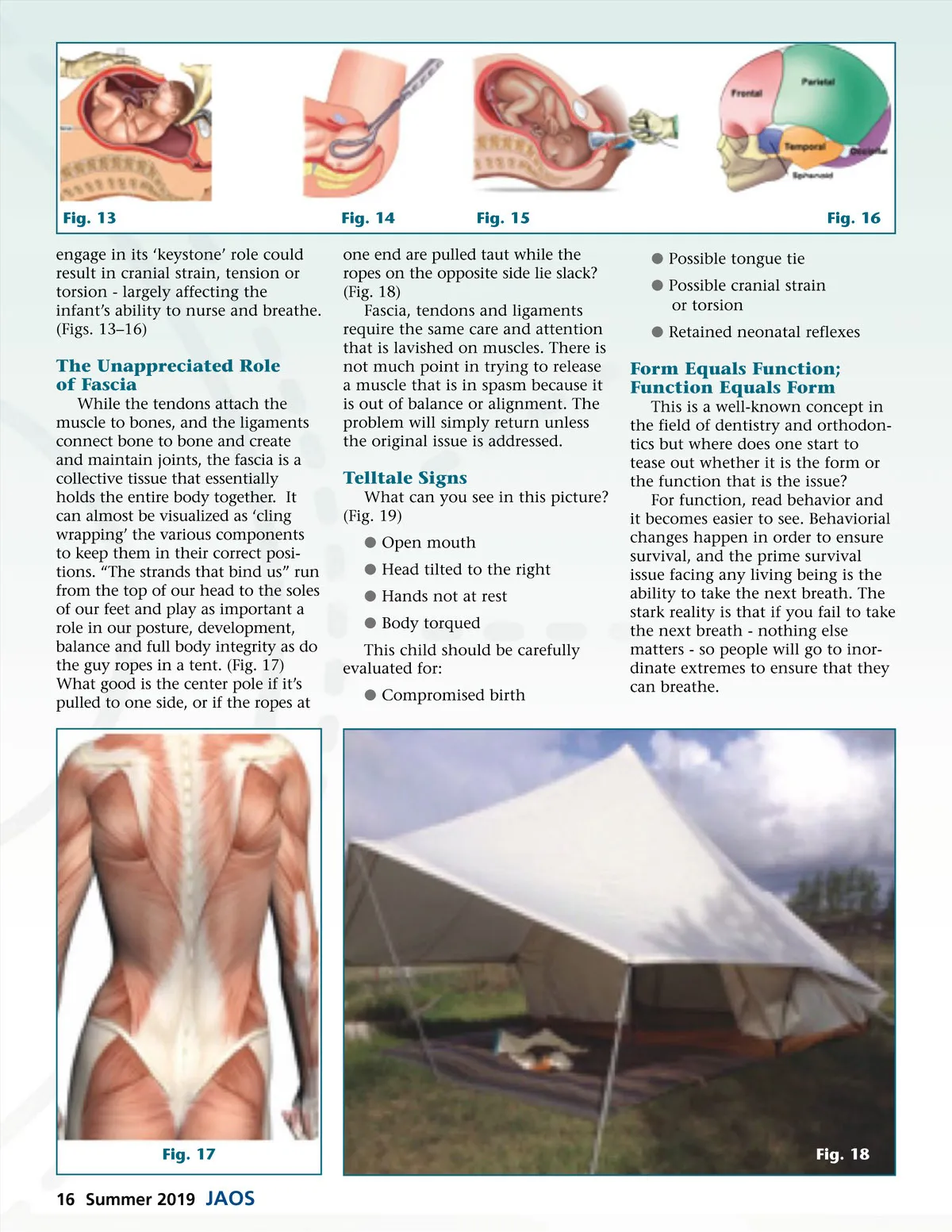
Some of these extremes do keep us breathing but they are responsi-ble for the onset and perpetuation of a raft of chronic health issues that will develop over time. There is no point in trying to treat these chronic issues through intervention, drug or surgical procedures, unless attention is also given to the initial cause. It is highly unlikely that anyone would be satisfied with a doctor who treated a broken arm by placing it in a splint or cast, and when asked when the cast could be removed replied “Never -it has to remain there or else the arm will break again.” This doctor will set the arm (acute intervention), apply a splint or cast (stabilization) and then refer to a therapist (rehabilitation). Why should craniofacial or dentofacial orthopedics be any different? Why should compromised breathing, the prime reason that people wake during the night, be any different? Fig. 19 Results & Outcomes Fall Short of Expectations Why should this be surprising? Why should everyone wonder why people fail to comply with CPAP or OAT? To me, the answer is quite simple. These breathing devices are prescribed, delivered, fitted, titrated and maintained by people who simply do not have the background education and experience in breath-ing. They are trained in sleep, and sleep isn’t actually the problem. There is little or no provision in medical or dental training that adequately covers breathing as a specialty. Breathing and respiration are two totally different things -yet the terms are constantly being interchanged as though they were the same. Breathing is a behavior and respi-ration is a chemical process. You cannot ‘breathe just fine’ during the day and have a ‘breathing problem’ at night. You are just more able to make compensations during the time you’re awake that you’re not able to make during the time you’re in bed. When you’re awake, you can always take a bigger breath, hold your breath, change your position, sigh, yawn, walk around etc. etc. When you’re asleep, you have two choices: you wake up or you don’t. Breathing Disordered Sleep No. This is not a typographical error -it is a far more accurate explanation about what is going on than the overused inaccurate term SLEEP DISORDERED BREATHING. Remove those cases which are of predominantly medical origin, neurological, neuromuscular, cardiac related and emotional disturbance, the people who find their way to the dental or orthodontic office with a ‘sleep issue’ do not wake up because they can’t ‘sleep’. They wake up because they can’t ‘breathe’. If you think that this is ‘drawing a long bow’ just take a moment to consider the two gold standards in sleep disorders: b CPAP is a breathing machine, not a sleep machine. b MAD is a breathing appliance, not a sleep appliance. Neither appliance does anything for sleep -both are 100% focused on keeping the person breathing. So, the problem is one of interrupted breathing, and it is addressed by using breathing intervention in the form of machines or devices? acquire skills, upskill regularly and would not dream of fitting an implant, applying brackets and wires, doing restorations etc. with-out adequate training and expertise. Why would this be any differ-ent? Why would you expect to become proficient in addressing issues that are more of a behavioral origin without the required train-ing, education and certification? If you truly want to “look after the person attached to the symp-toms” as professionally as you look after ‘the symptoms attached to the person’, you need to learn all about the posture, behavior, breathing and functioning of the body. This is not something that can be done in a couple of ‘Weekend Warrior’ programs because it is not the same as ‘resin and blue light’. Behavior is a human condition that has many layers but, once you see the benefits that accrue from being able to show someone how to change what they’re doing, and as a result, change what they’re getting ---it is all worthwhile. References 1. https://www.researchgate.net/publica-tion/327560802_Is_PostureScreenR_Mobil e_app_an_accurate_tool_for_dentists_to-evaluate_the_correlation_between_masloc clusion_and_posture 2. https://www.webmd.com/asthma/news/ 20120904/asthma-drug-shown-stunt-growth#1 Take Home Message As dentists and orthodontists, dental assistants and hygienists, you undertake training in the various activities and procedures you imple-ment daily. You attend courses, www.orthodontics.com Summer 2019 17
Journal of the American Orthodontic Society Summer 2019: Page 17