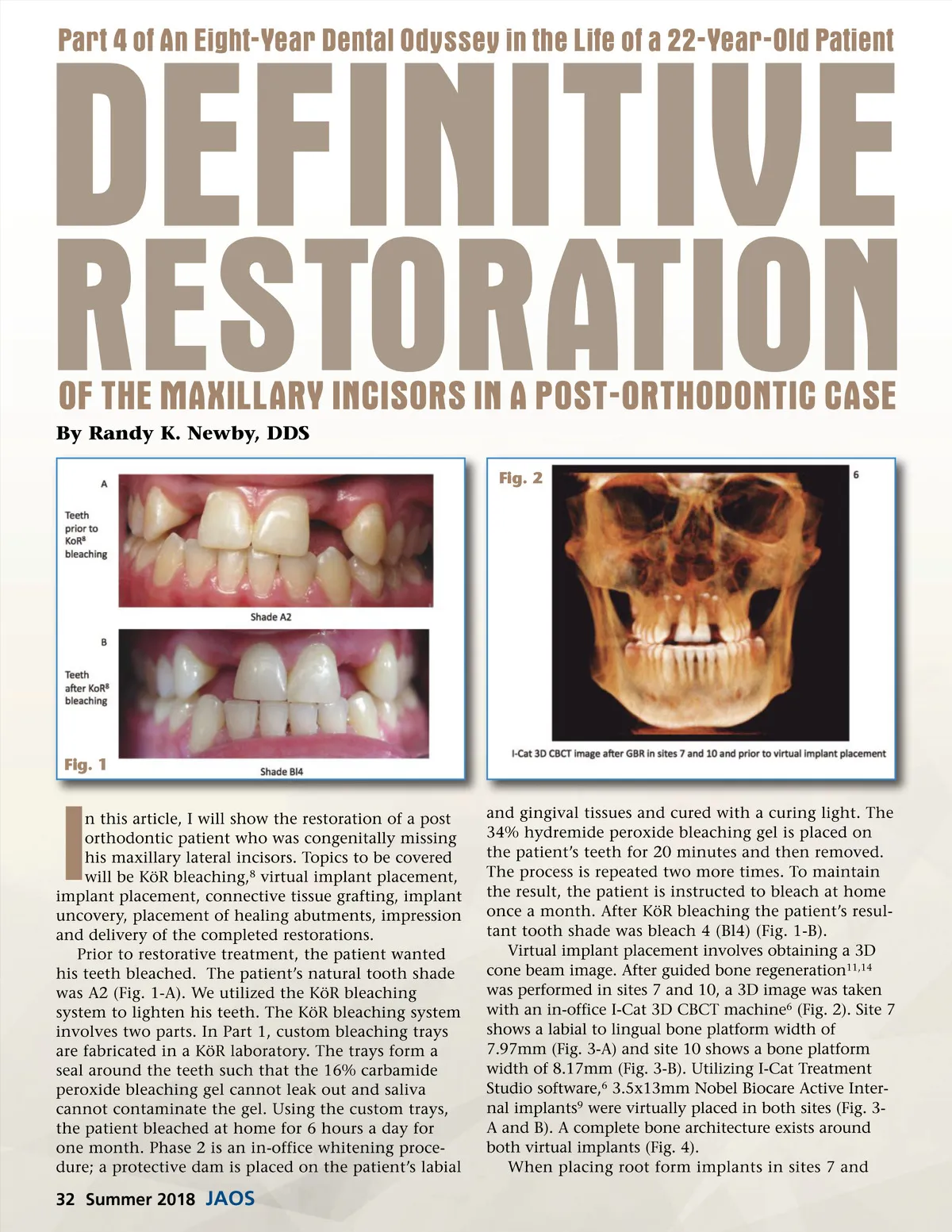
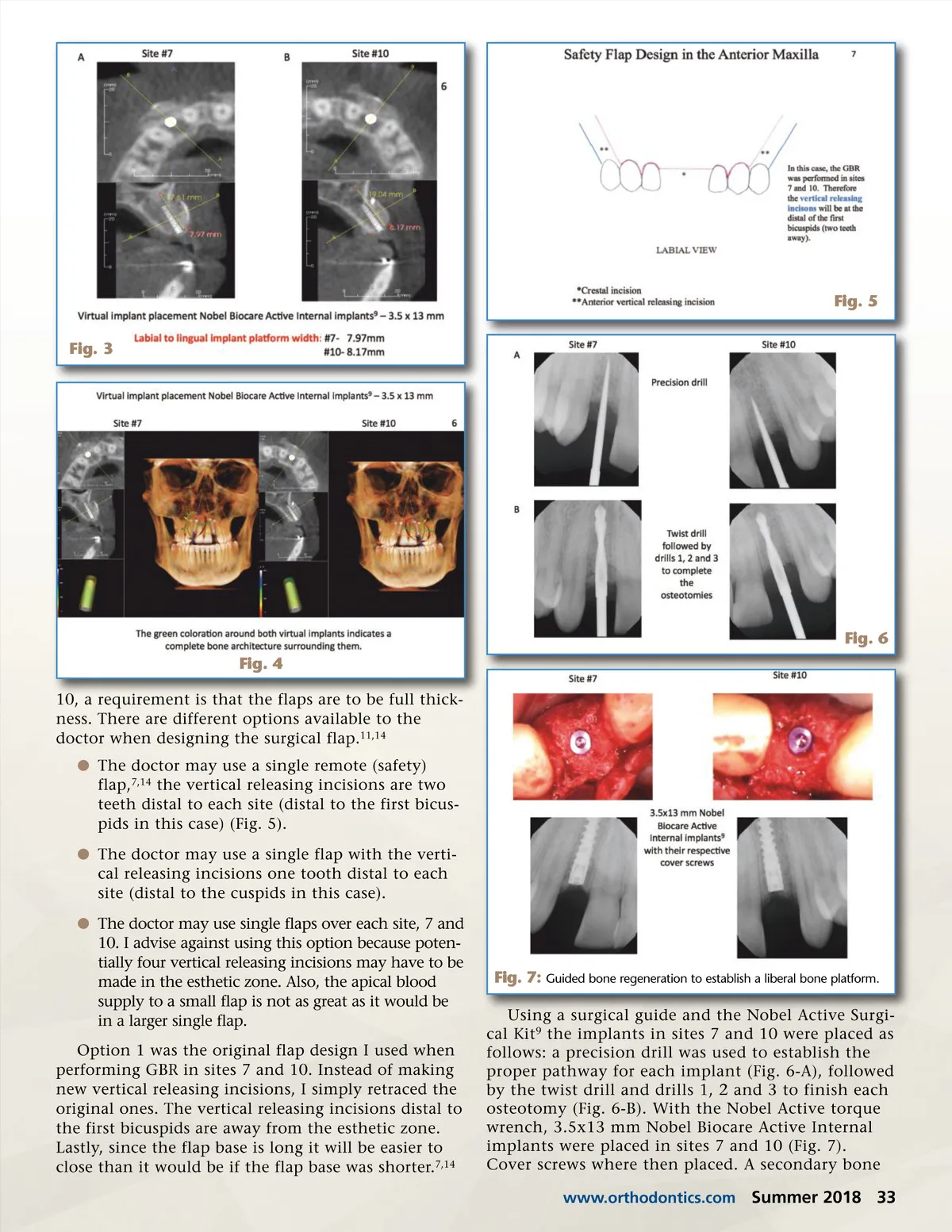
Part 4 of An Eight-Year Dental Odyssey in the Life of a 22-Year-Old Patient DEFINITIVE RESTORATION OF THE MAXILLARY INCISORS IN A POST-ORTHODONTIC CASE By Randy K. Newby, DDS Fig. 2 Fig. 1 n this article, I will show the restoration of a post orthodontic patient who was congenitally missing his maxillary lateral incisors. Topics to be covered will be KöR bleaching, 8 virtual implant placement, implant placement, connective tissue grafting, implant uncovery, placement of healing abutments, impression and delivery of the completed restorations. Prior to restorative treatment, the patient wanted his teeth bleached. The patient’s natural tooth shade was A2 (Fig. 1-A). We utilized the KöR bleaching system to lighten his teeth. The KöR bleaching system involves two parts. In Part 1, custom bleaching trays are fabricated in a KöR laboratory. The trays form a seal around the teeth such that the 16% carbamide peroxide bleaching gel cannot leak out and saliva cannot contaminate the gel. Using the custom trays, the patient bleached at home for 6 hours a day for one month. Phase 2 is an in-office whitening proce-dure; a protective dam is placed on the patient’s labial I and gingival tissues and cured with a curing light. The 34% hydremide peroxide bleaching gel is placed on the patient’s teeth for 20 minutes and then removed. The process is repeated two more times. To maintain the result, the patient is instructed to bleach at home once a month. After KöR bleaching the patient’s resul-tant tooth shade was bleach 4 (Bl4) (Fig. 1-B). Virtual implant placement involves obtaining a 3D cone beam image. After guided bone regeneration 11,14 was performed in sites 7 and 10, a 3D image was taken with an in-office I-Cat 3D CBCT machine 6 (Fig. 2). Site 7 shows a labial to lingual bone platform width of 7.97mm (Fig. 3-A) and site 10 shows a bone platform width of 8.17mm (Fig. 3-B). Utilizing I-Cat Treatment Studio software, 6 3.5x13mm Nobel Biocare Active Inter-nal implants 9 were virtually placed in both sites (Fig. 3-A and B). A complete bone architecture exists around both virtual implants (Fig. 4). When placing root form implants in sites 7 and 32 Summer 2018 JAOS
Journal of the American Orthodontic Society Summer 2018/Buyer's Guide: Page 32