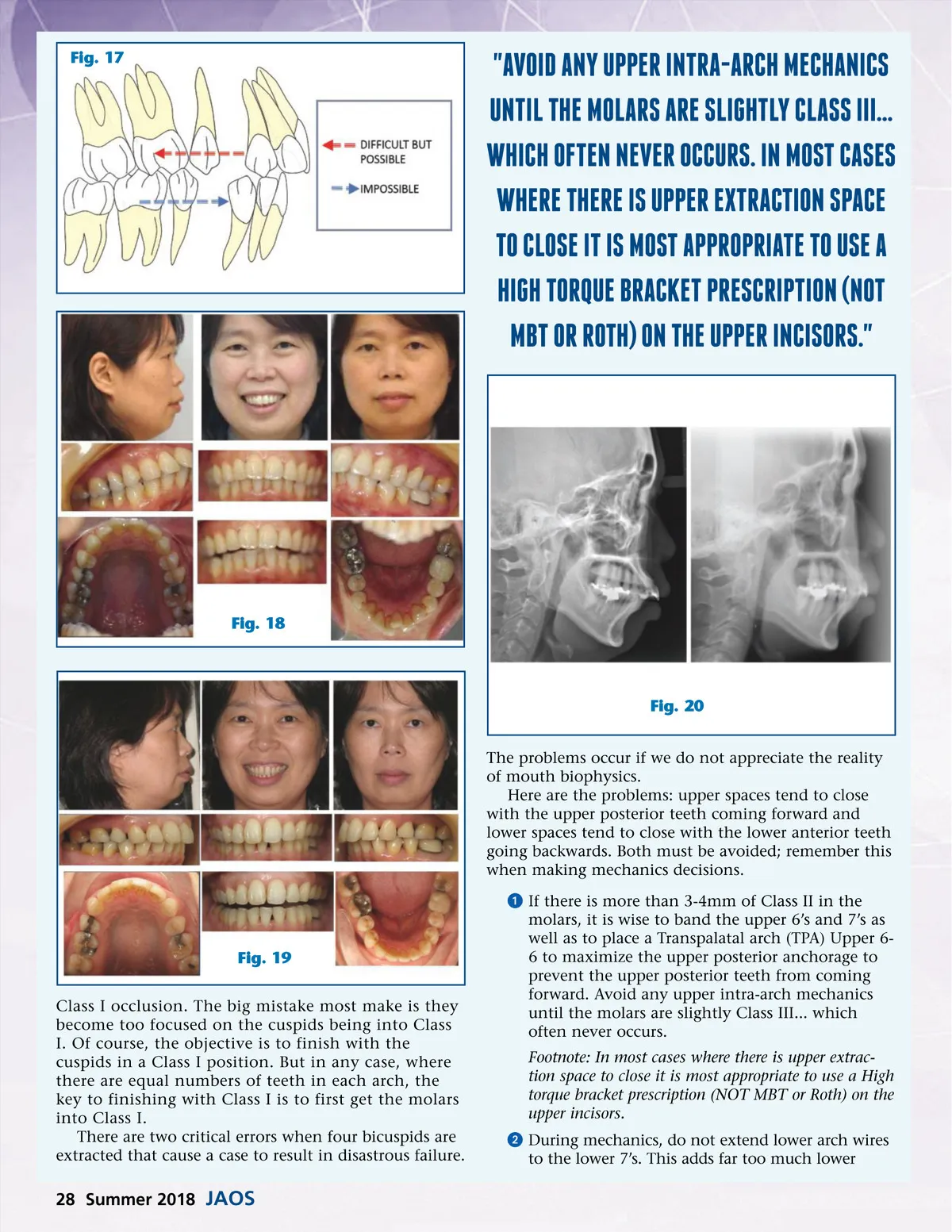
Fig. 17 "avoid any uppeR intRa-aRch mechanics until the molaRs aRe slightly class iii... Which oFten neveR occuRs. in most cases WheRe theRe is uppeR extRaction space to close it is most appRopRiate to use a high toRque BRacKet pRescRiption (not mBt oR Roth) on the uppeR incisoRs." Fig. 18 Fig. 20 The problems occur if we do not appreciate the reality of mouth biophysics. Here are the problems: upper spaces tend to close with the upper posterior teeth coming forward and lower spaces tend to close with the lower anterior teeth going backwards. Both must be avoided; remember this when making mechanics decisions. ᕡ If there is more than 3-4mm of Class II in the molars, it is wise to band the upper 6’s and 7’s as well as to place a Transpalatal arch (TPA) Upper 6-6 to maximize the upper posterior anchorage to prevent the upper posterior teeth from coming forward. Avoid any upper intra-arch mechanics until the molars are slightly Class III... which often never occurs. Footnote: In most cases where there is upper extrac-tion space to close it is most appropriate to use a High torque bracket prescription (NOT MBT or Roth) on the upper incisors. ᕢ During mechanics, do not extend lower arch wires to the lower 7’s. This adds far too much lower Fig. 19 Class I occlusion. The big mistake most make is they become too focused on the cuspids being into Class I. Of course, the objective is to finish with the cuspids in a Class I position. But in any case, where there are equal numbers of teeth in each arch, the key to finishing with Class I is to first get the molars into Class I. There are two critical errors when four bicuspids are extracted that cause a case to result in disastrous failure. 28 Summer 2018 JAOS
Journal of the American Orthodontic Society Summer 2018/Buyer's Guide: Page 28