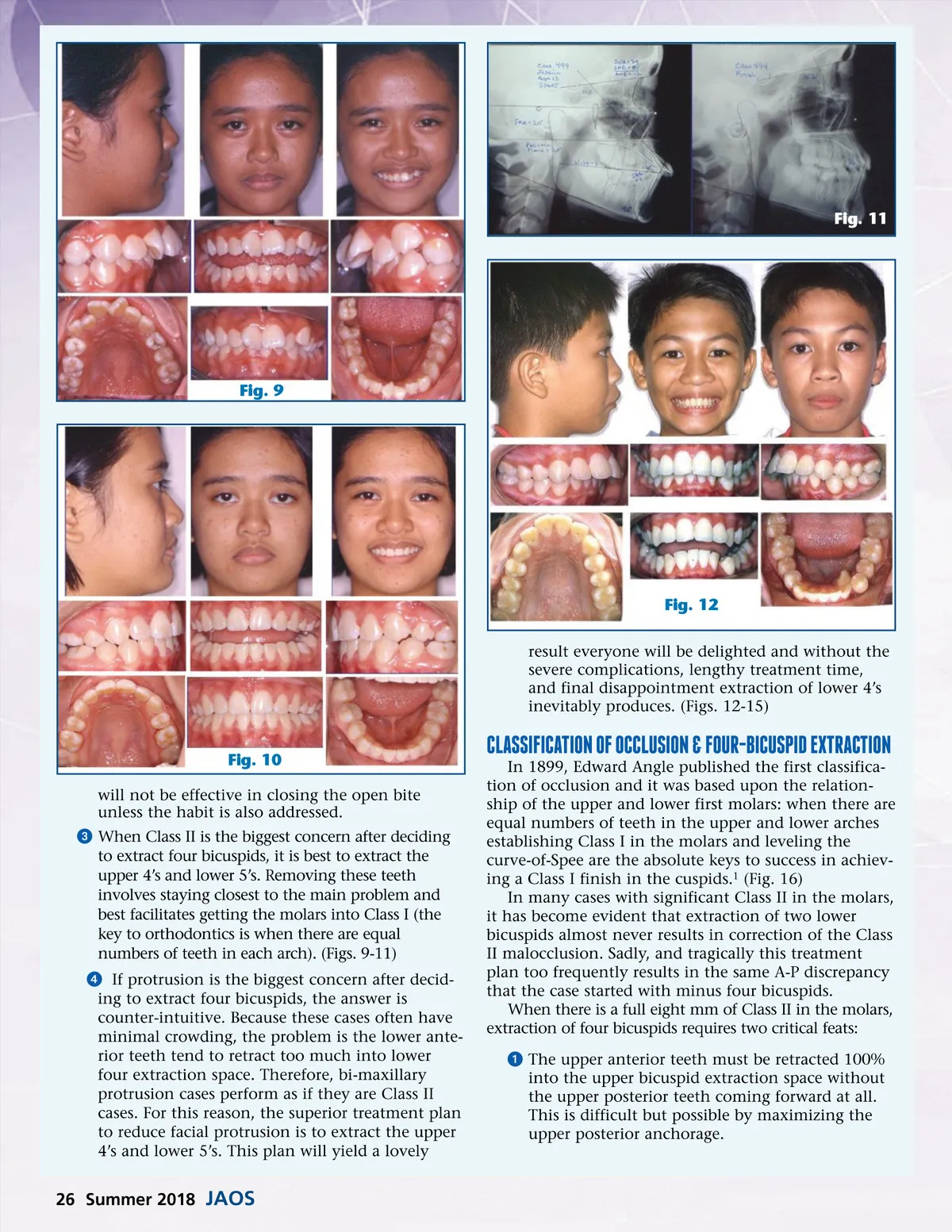
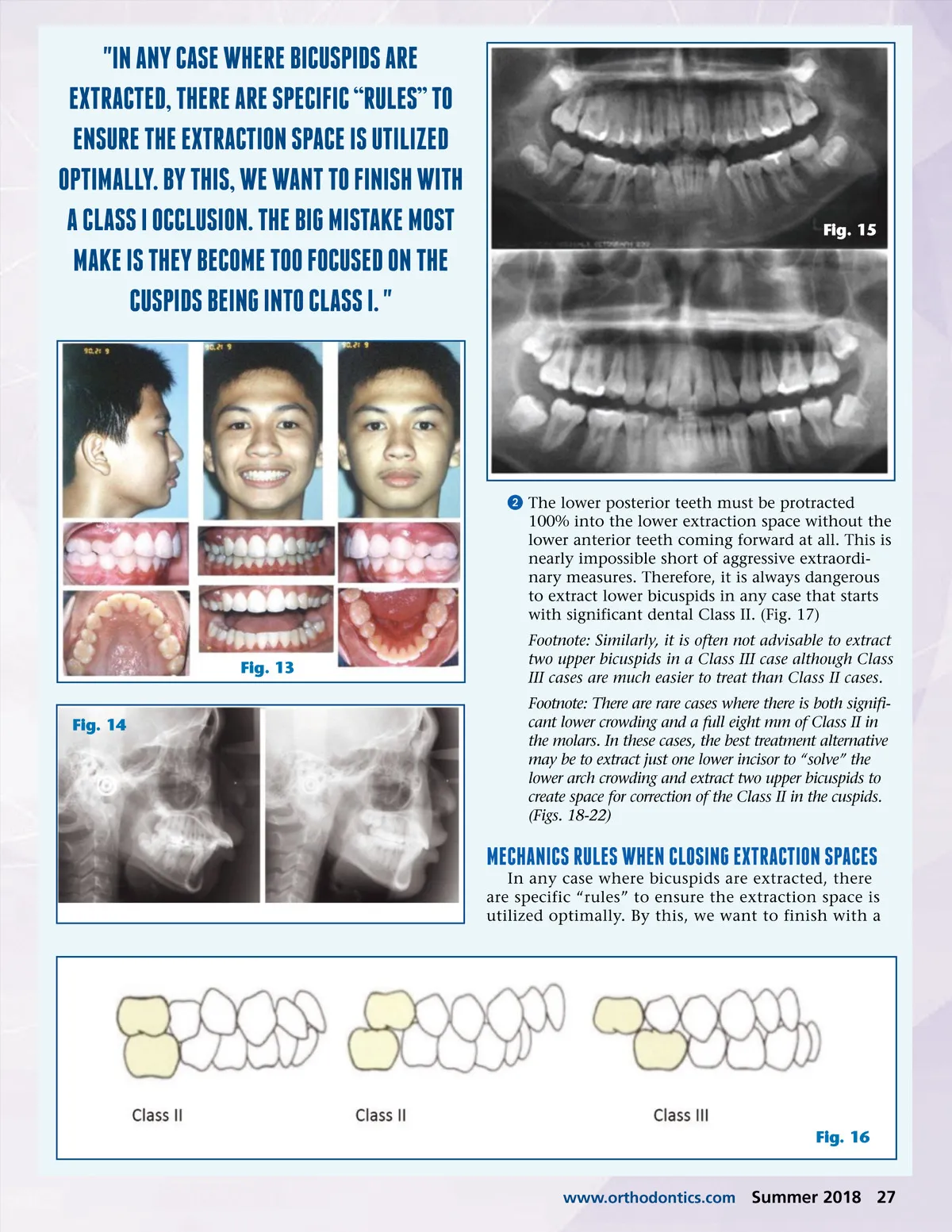
Fig. 11 Fig. 9 Fig. 12 result everyone will be delighted and without the severe complications, lengthy treatment time, and final disappointment extraction of lower 4’s inevitably produces. (Figs. 12-15) Fig. 10 will not be effective in closing the open bite unless the habit is also addressed. ᕣ When Class II is the biggest concern after deciding to extract four bicuspids, it is best to extract the upper 4’s and lower 5’s. Removing these teeth involves staying closest to the main problem and best facilitates getting the molars into Class I (the key to orthodontics is when there are equal numbers of teeth in each arch). (Figs. 9-11) ᕤ If protrusion is the biggest concern after decid-ing to extract four bicuspids, the answer is counter-intuitive. Because these cases often have minimal crowding, the problem is the lower ante-rior teeth tend to retract too much into lower four extraction space. Therefore, bi-maxillary protrusion cases perform as if they are Class II cases. For this reason, the superior treatment plan to reduce facial protrusion is to extract the upper 4’s and lower 5’s. This plan will yield a lovely classiFication oF occlusion & FouR-Bicuspid extRaction In 1899, Edward Angle published the first classifica-tion of occlusion and it was based upon the relation-ship of the upper and lower first molars: when there are equal numbers of teeth in the upper and lower arches establishing Class I in the molars and leveling the curve-of-Spee are the absolute keys to success in achiev-ing a Class I finish in the cuspids. 1 (Fig. 16) In many cases with significant Class II in the molars, it has become evident that extraction of two lower bicuspids almost never results in correction of the Class II malocclusion. Sadly, and tragically this treatment plan too frequently results in the same A-P discrepancy that the case started with minus four bicuspids. When there is a full eight mm of Class II in the molars, extraction of four bicuspids requires two critical feats: ᕡ The upper anterior teeth must be retracted 100% into the upper bicuspid extraction space without the upper posterior teeth coming forward at all. This is difficult but possible by maximizing the upper posterior anchorage. 26 Summer 2018 JAOS
Journal of the American Orthodontic Society Summer 2018/Buyer's Guide: Page 26