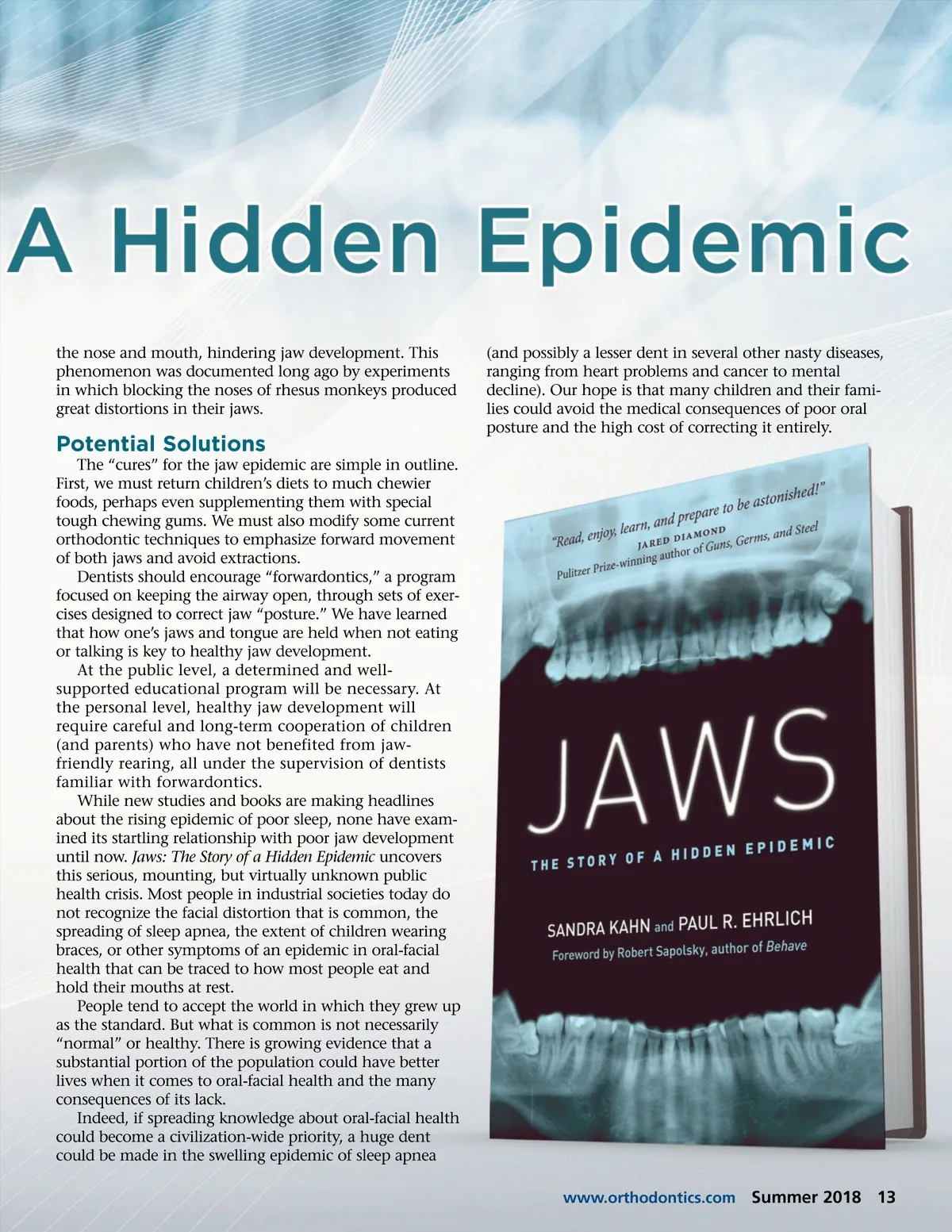
the nose and mouth, hindering jaw development. This phenomenon was documented long ago by experiments in which blocking the noses of rhesus monkeys produced great distortions in their jaws. Potential Solutions The “cures” for the jaw epidemic are simple in outline. First, we must return children’s diets to much chewier foods, perhaps even supplementing them with special tough chewing gums. We must also modify some current orthodontic techniques to emphasize forward movement of both jaws and avoid extractions. Dentists should encourage “forwardontics,” a program focused on keeping the airway open, through sets of exer-cises designed to correct jaw “posture.” We have learned that how one’s jaws and tongue are held when not eating or talking is key to healthy jaw development. At the public level, a determined and well-supported educational program will be necessary. At the personal level, healthy jaw development will require careful and long-term cooperation of children (and parents) who have not benefited from jaw-friendly rearing, all under the supervision of dentists familiar with forwardontics. While new studies and books are making headlines about the rising epidemic of poor sleep, none have exam-ined its startling relationship with poor jaw development until now. Jaws: The Story of a Hidden Epidemic uncovers this serious, mounting, but virtually unknown public health crisis. Most people in industrial societies today do not recognize the facial distortion that is common, the spreading of sleep apnea, the extent of children wearing braces, or other symptoms of an epidemic in oral-facial health that can be traced to how most people eat and hold their mouths at rest. People tend to accept the world in which they grew up as the standard. But what is common is not necessarily “normal” or healthy. There is growing evidence that a substantial portion of the population could have better lives when it comes to oral-facial health and the many consequences of its lack. Indeed, if spreading knowledge about oral-facial health could become a civilization-wide priority, a huge dent could be made in the swelling epidemic of sleep apnea (and possibly a lesser dent in several other nasty diseases, ranging from heart problems and cancer to mental decline). Our hope is that many children and their fami-lies could avoid the medical consequences of poor oral posture and the high cost of correcting it entirely. www.orthodontics.com Summer 2018 13
Journal of the American Orthodontic Society Summer 2018/Buyer's Guide: Page 13