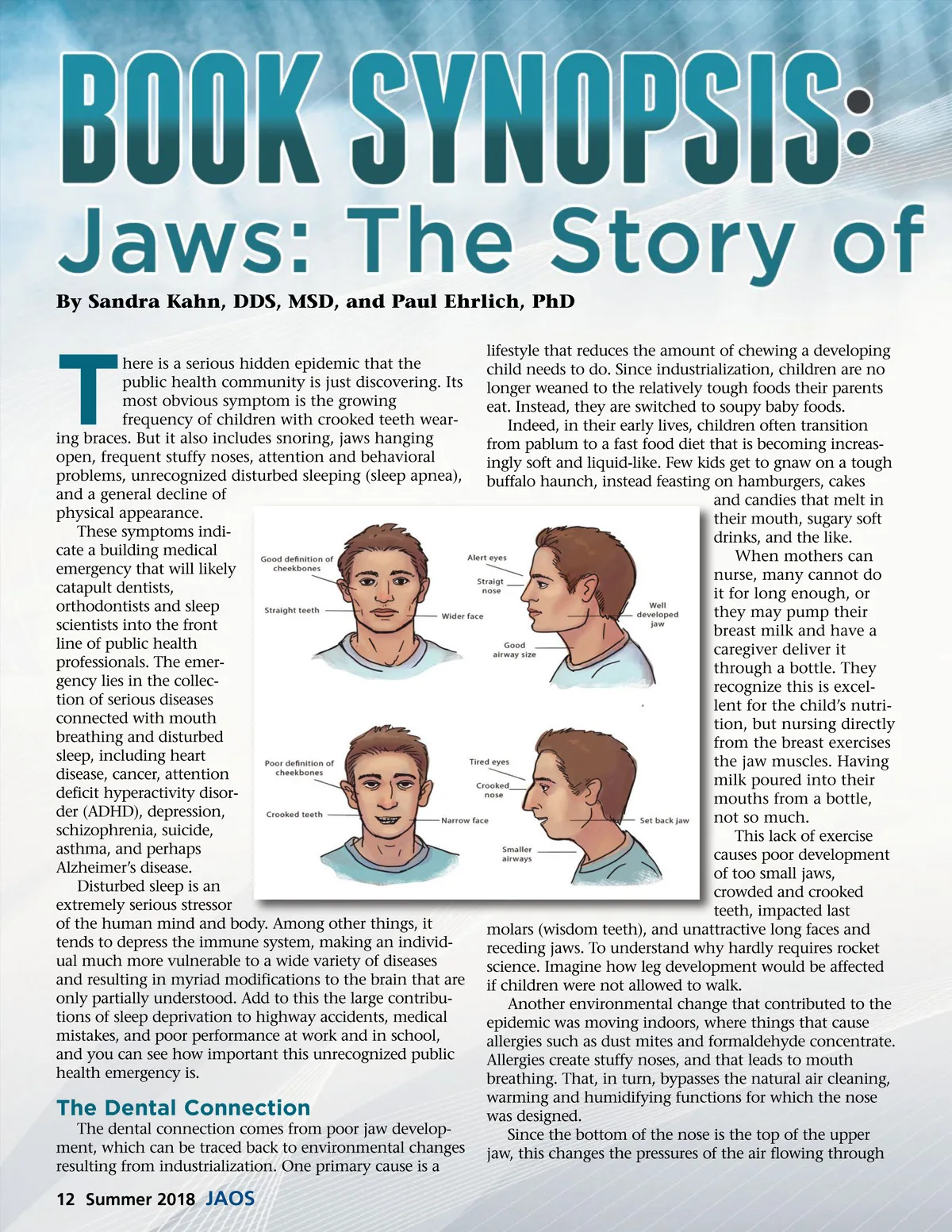
By Sandra Kahn, DDS, MSD, and Paul Ehrlich, PhD here is a serious hidden epidemic that the public health community is just discovering. Its most obvious symptom is the growing frequency of children with crooked teeth wear-ing braces. But it also includes snoring, jaws hanging open, frequent stuffy noses, attention and behavioral problems, unrecognized disturbed sleeping (sleep apnea), and a general decline of physical appearance. These symptoms indi-cate a building medical emergency that will likely catapult dentists, orthodontists and sleep scientists into the front line of public health professionals. The emer-gency lies in the collec-tion of serious diseases connected with mouth breathing and disturbed sleep, including heart disease, cancer, attention deficit hyperactivity disor-der (ADHD), depression, schizophrenia, suicide, asthma, and perhaps Alzheimer’s disease. Disturbed sleep is an extremely serious stressor of the human mind and body. Among other things, it tends to depress the immune system, making an individ-ual much more vulnerable to a wide variety of diseases and resulting in myriad modifications to the brain that are only partially understood. Add to this the large contribu-tions of sleep deprivation to highway accidents, medical mistakes, and poor performance at work and in school, and you can see how important this unrecognized public health emergency is. T The Dental Connection The dental connection comes from poor jaw develop-ment, which can be traced back to environmental changes resulting from industrialization. One primary cause is a lifestyle that reduces the amount of chewing a developing child needs to do. Since industrialization, children are no longer weaned to the relatively tough foods their parents eat. Instead, they are switched to soupy baby foods. Indeed, in their early lives, children often transition from pablum to a fast food diet that is becoming increas-ingly soft and liquid-like. Few kids get to gnaw on a tough buffalo haunch, instead feasting on hamburgers, cakes and candies that melt in their mouth, sugary soft drinks, and the like. When mothers can nurse, many cannot do it for long enough, or they may pump their breast milk and have a caregiver deliver it through a bottle. They recognize this is excel-lent for the child’s nutri-tion, but nursing directly from the breast exercises the jaw muscles. Having milk poured into their mouths from a bottle, not so much. This lack of exercise causes poor development of too small jaws, crowded and crooked teeth, impacted last molars (wisdom teeth), and unattractive long faces and receding jaws. To understand why hardly requires rocket science. Imagine how leg development would be affected if children were not allowed to walk. Another environmental change that contributed to the epidemic was moving indoors, where things that cause allergies such as dust mites and formaldehyde concentrate. Allergies create stuffy noses, and that leads to mouth breathing. That, in turn, bypasses the natural air cleaning, warming and humidifying functions for which the nose was designed. Since the bottom of the nose is the top of the upper jaw, this changes the pressures of the air flowing through 12 Summer 2018 JAOS
Journal of the American Orthodontic Society Summer 2018/Buyer's Guide: Page 12