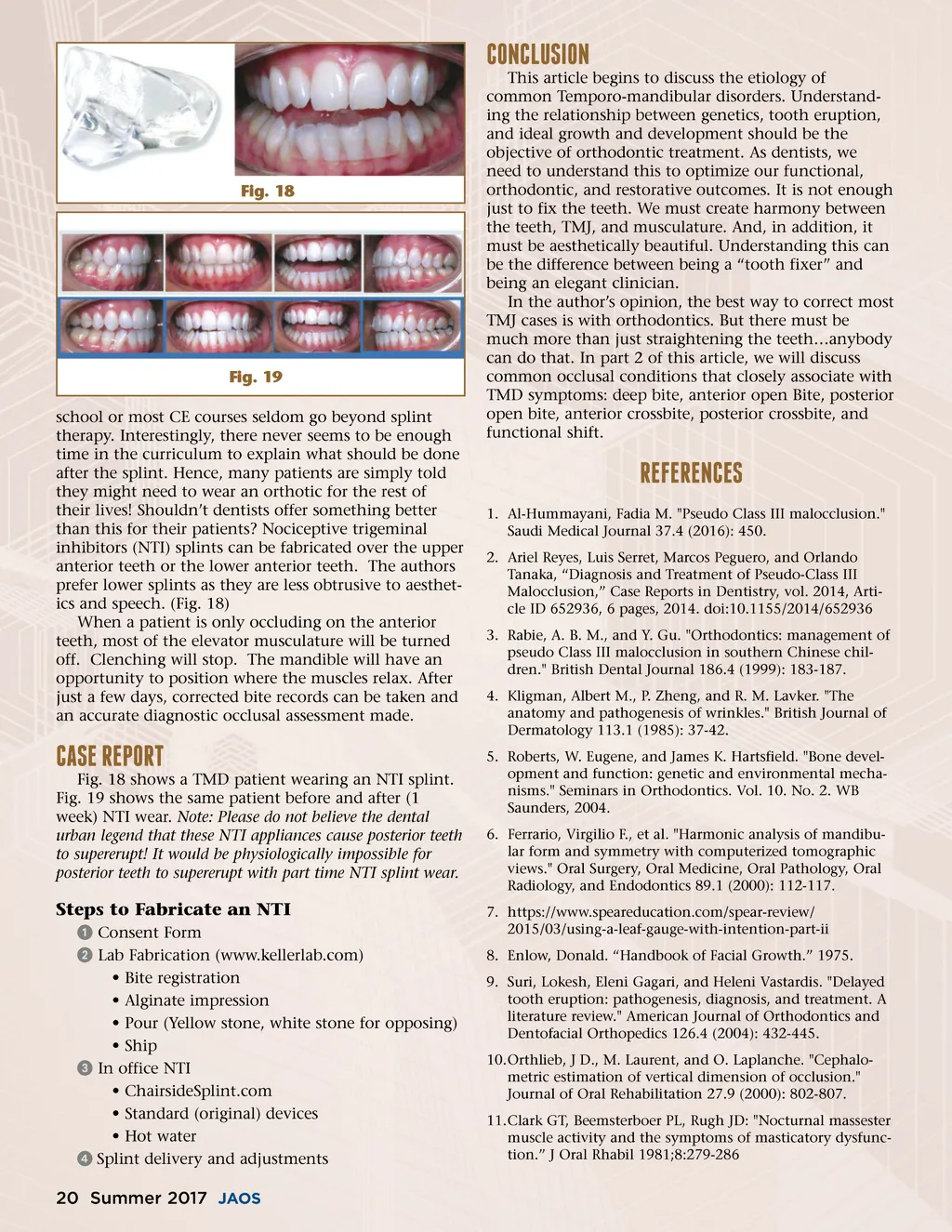
Fig. 18 Fig. 19 school or most CE courses seldom go beyond splint therapy. Interestingly, there never seems to be enough time in the curriculum to explain what should be done after the splint. Hence, many patients are simply told they might need to wear an orthotic for the rest of their lives! Shouldn’t dentists offer something better than this for their patients? Nociceptive trigeminal inhibitors (NTI) splints can be fabricated over the upper anterior teeth or the lower anterior teeth. The authors prefer lower splints as they are less obtrusive to aesthet-ics and speech. (Fig. 18) When a patient is only occluding on the anterior teeth, most of the elevator musculature will be turned off. Clenching will stop. The mandible will have an opportunity to position where the muscles relax. After just a few days, corrected bite records can be taken and an accurate diagnostic occlusal assessment made. This article begins to discuss the etiology of common Temporo-mandibular disorders. Understand-ing the relationship between genetics, tooth eruption, and ideal growth and development should be the objective of orthodontic treatment. As dentists, we need to understand this to optimize our functional, orthodontic, and restorative outcomes. It is not enough just to fix the teeth. We must create harmony between the teeth, TMJ, and musculature. And, in addition, it must be aesthetically beautiful. Understanding this can be the difference between being a “tooth fixer” and being an elegant clinician. In the author’s opinion, the best way to correct most TMJ cases is with orthodontics. But there must be much more than just straightening the teeth…anybody can do that. In part 2 of this article, we will discuss common occlusal conditions that closely associate with TMD symptoms: deep bite, anterior open Bite, posterior open bite, anterior crossbite, posterior crossbite, and functional shift. coNclusioN REfERENcEs 1. Al-Hummayani, Fadia M. "Pseudo Class III malocclusion." Saudi Medical Journal 37.4 (2016): 450. 2. Ariel Reyes, Luis Serret, Marcos Peguero, and Orlando Tanaka, “Diagnosis and Treatment of Pseudo-Class III Malocclusion,” Case Reports in Dentistry, vol. 2014, Arti-cle ID 652936, 6 pages, 2014. doi:10.1155/2014/652936 3. Rabie, A. B. M., and Y. Gu. "Orthodontics: management of pseudo Class III malocclusion in southern Chinese chil-dren." British Dental Journal 186.4 (1999): 183-187. 4. Kligman, Albert M., P. Zheng, and R. M. Lavker. "The anatomy and pathogenesis of wrinkles." British Journal of Dermatology 113.1 (1985): 37-42. 5. Roberts, W. Eugene, and James K. Hartsfield. "Bone devel-opment and function: genetic and environmental mecha-nisms." Seminars in Orthodontics. Vol. 10. No. 2. WB Saunders, 2004. 6. Ferrario, Virgilio F., et al. "Harmonic analysis of mandibu-lar form and symmetry with computerized tomographic views." Oral Surgery, Oral Medicine, Oral Pathology, Oral Radiology, and Endodontics 89.1 (2000): 112-117. 7. https://www.speareducation.com/spear-review/ 2015/03/using-a-leaf-gauge-with-intention-part-ii 8. Enlow, Donald. “Handbook of Facial Growth.” 1975. 9. Suri, Lokesh, Eleni Gagari, and Heleni Vastardis. "Delayed tooth eruption: pathogenesis, diagnosis, and treatment. A literature review." American Journal of Orthodontics and Dentofacial Orthopedics 126.4 (2004): 432-445. 10.Orthlieb, J D., M. Laurent, and O. Laplanche. "Cephalo-metric estimation of vertical dimension of occlusion." Journal of Oral Rehabilitation 27.9 (2000): 802-807. 11.Clark GT, Beemsterboer PL, Rugh JD: "Nocturnal massester muscle activity and the symptoms of masticatory dysfunc-tion.” J Oral Rhabil 1981;8:279-286 Fig. 18 shows a TMD patient wearing an NTI splint. Fig. 19 shows the same patient before and after (1 week) NTI wear. Note: Please do not believe the dental urban legend that these NTI appliances cause posterior teeth to supererupt! It would be physiologically impossible for posterior teeth to supererupt with part time NTI splint wear. cAsE REpoRT Steps to Fabricate an NTI ᕡ Consent Form ᕢ Lab Fabrication (www.kellerlab.com) • Bite registration • Alginate impression • Pour (Yellow stone, white stone for opposing) • Ship ᕣ In office NTI • ChairsideSplint.com • Standard (original) devices • Hot water ᕤ Splint delivery and adjustments 20 Summer 2017 JAOS
Journal of the American Orthodontic Society Summer 2017/Buyer's Guide: Page 20