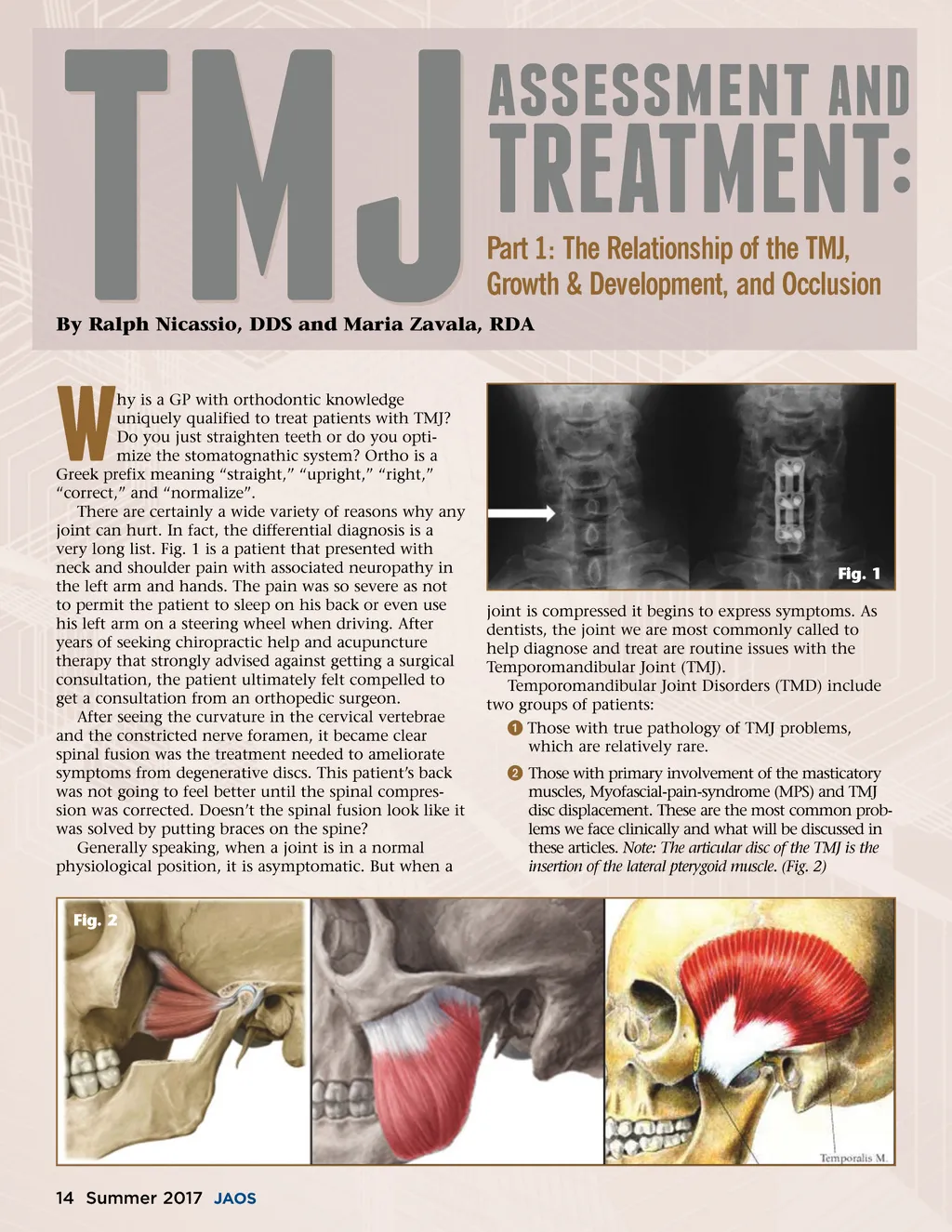
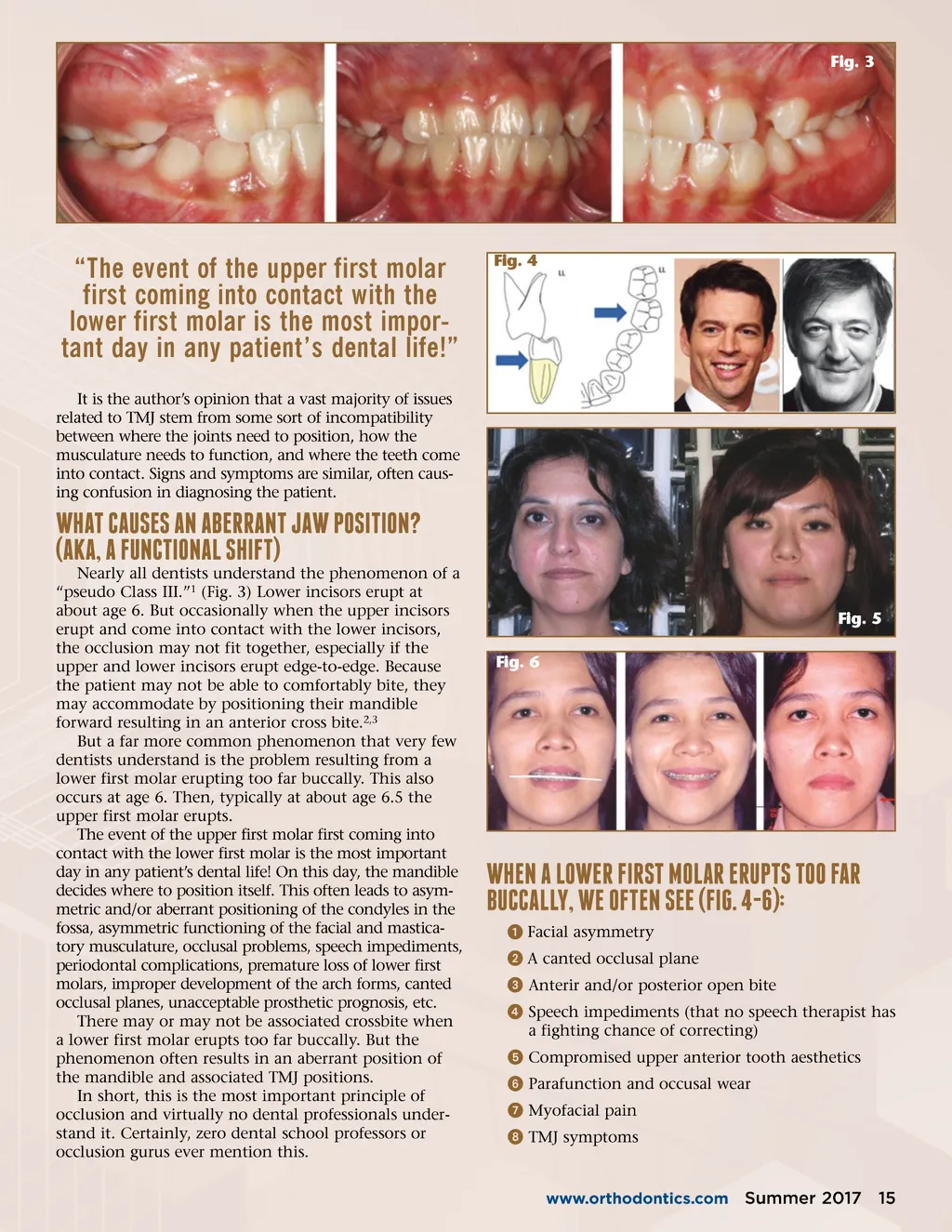
TMJ W hy is a GP with orthodontic knowledge uniquely qualified to treat patients with TMJ? Do you just straighten teeth or do you opti-mize the stomatognathic system? Ortho is a Greek prefix meaning “straight,” “upright,” “right,” “correct,” and “normalize”. There are certainly a wide variety of reasons why any joint can hurt. In fact, the differential diagnosis is a very long list. Fig. 1 is a patient that presented with neck and shoulder pain with associated neuropathy in the left arm and hands. The pain was so severe as not to permit the patient to sleep on his back or even use his left arm on a steering wheel when driving. After years of seeking chiropractic help and acupuncture therapy that strongly advised against getting a surgical consultation, the patient ultimately felt compelled to get a consultation from an orthopedic surgeon. After seeing the curvature in the cervical vertebrae and the constricted nerve foramen, it became clear spinal fusion was the treatment needed to ameliorate symptoms from degenerative discs. This patient’s back was not going to feel better until the spinal compres-sion was corrected. Doesn’t the spinal fusion look like it was solved by putting braces on the spine? Generally speaking, when a joint is in a normal physiological position, it is asymptomatic. But when a Fig. 2 assessment AND Part 1: The Relationship of the TMJ, Growth & Development, and Occlusion TREATMENT: By Ralph Nicassio, DDS and Maria Zavala, RDA Fig. 1 joint is compressed it begins to express symptoms. As dentists, the joint we are most commonly called to help diagnose and treat are routine issues with the Temporomandibular Joint (TMJ). Temporomandibular Joint Disorders (TMD) include two groups of patients: ᕡ Those with true pathology of TMJ problems, which are relatively rare. ᕢ Those with primary involvement of the masticatory muscles, Myofascial-pain-syndrome (MPS) and TMJ disc displacement. These are the most common prob-lems we face clinically and what will be discussed in these articles. Note: The articular disc of the TMJ is the insertion of the lateral pterygoid muscle. (Fig. 2) 14 Summer 2017 JAOS
Journal of the American Orthodontic Society Summer 2017/Buyer's Guide: Page 14