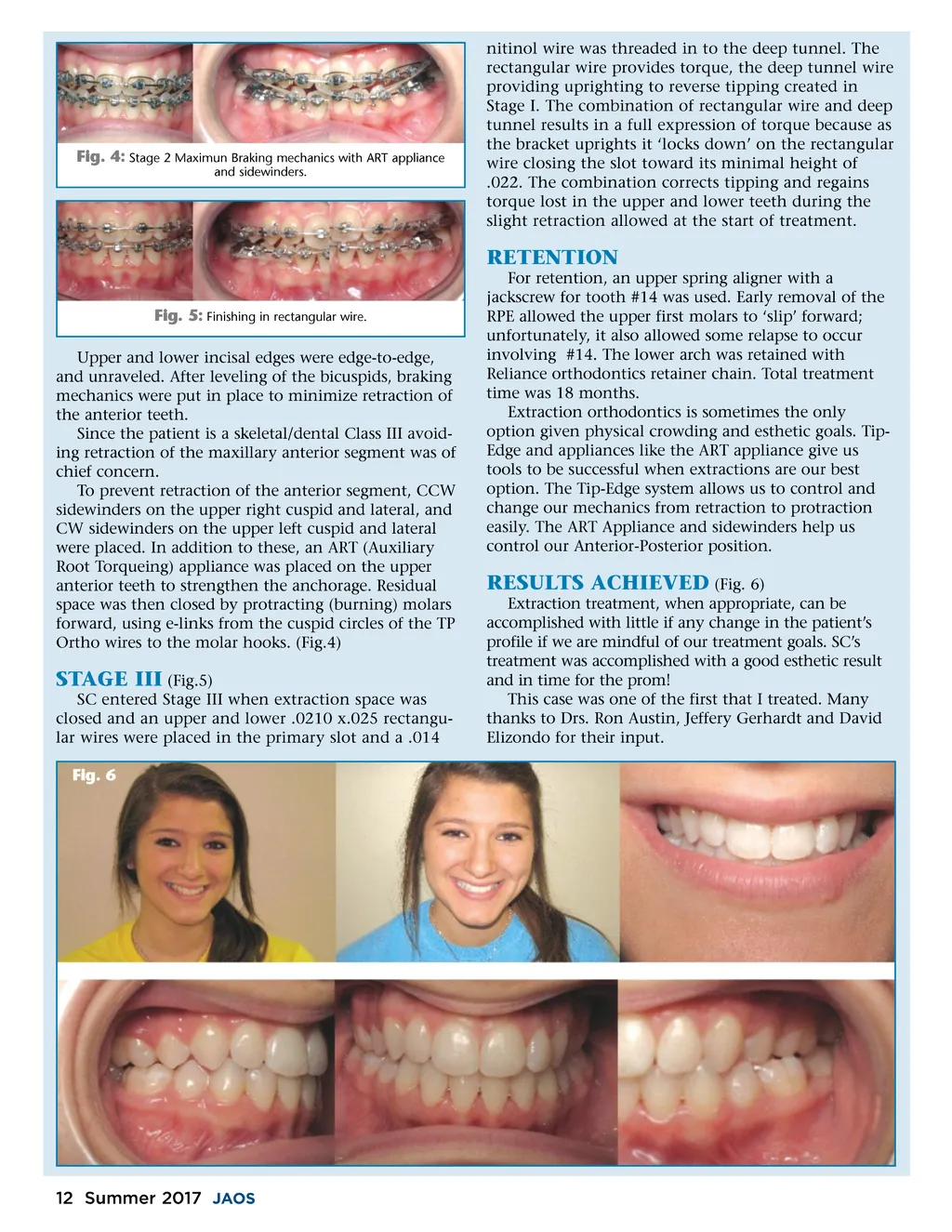
Fig. 4: Stage 2 Maximun Braking mechanics with ART appliance and sidewinders. nitinol wire was threaded in to the deep tunnel. The rectangular wire provides torque, the deep tunnel wire providing uprighting to reverse tipping created in Stage I. The combination of rectangular wire and deep tunnel results in a full expression of torque because as the bracket uprights it ‘locks down’ on the rectangular wire closing the slot toward its minimal height of .022. The combination corrects tipping and regains torque lost in the upper and lower teeth during the slight retraction allowed at the start of treatment. RETENTION Fig. 5: Finishing in rectangular wire. Upper and lower incisal edges were edge-to-edge, and unraveled. After leveling of the bicuspids, braking mechanics were put in place to minimize retraction of the anterior teeth. Since the patient is a skeletal/dental Class III avoid-ing retraction of the maxillary anterior segment was of chief concern. To prevent retraction of the anterior segment, CCW sidewinders on the upper right cuspid and lateral, and CW sidewinders on the upper left cuspid and lateral were placed. In addition to these, an ART (Auxiliary Root Torqueing) appliance was placed on the upper anterior teeth to strengthen the anchorage. Residual space was then closed by protracting (burning) molars forward, using e-links from the cuspid circles of the TP Ortho wires to the molar hooks. (Fig.4) For retention, an upper spring aligner with a jackscrew for tooth #14 was used. Early removal of the RPE allowed the upper first molars to ‘slip’ forward; unfortunately, it also allowed some relapse to occur involving #14. The lower arch was retained with Reliance orthodontics retainer chain. Total treatment time was 18 months. Extraction orthodontics is sometimes the only option given physical crowding and esthetic goals. Tip-Edge and appliances like the ART appliance give us tools to be successful when extractions are our best option. The Tip-Edge system allows us to control and change our mechanics from retraction to protraction easily. The ART Appliance and sidewinders help us control our Anterior-Posterior position. RESULTS ACHIEVED (Fig. 6) Extraction treatment, when appropriate, can be accomplished with little if any change in the patient’s profile if we are mindful of our treatment goals. SC’s treatment was accomplished with a good esthetic result and in time for the prom! This case was one of the first that I treated. Many thanks to Drs. Ron Austin, Jeffery Gerhardt and David Elizondo for their input. STAGE III (Fig.5) SC entered Stage III when extraction space was closed and an upper and lower .0210 x.025 rectangu-lar wires were placed in the primary slot and a .014 Fig. 6 12 Summer 2017 JAOS
Journal of the American Orthodontic Society Summer 2017/Buyer's Guide: Page 12