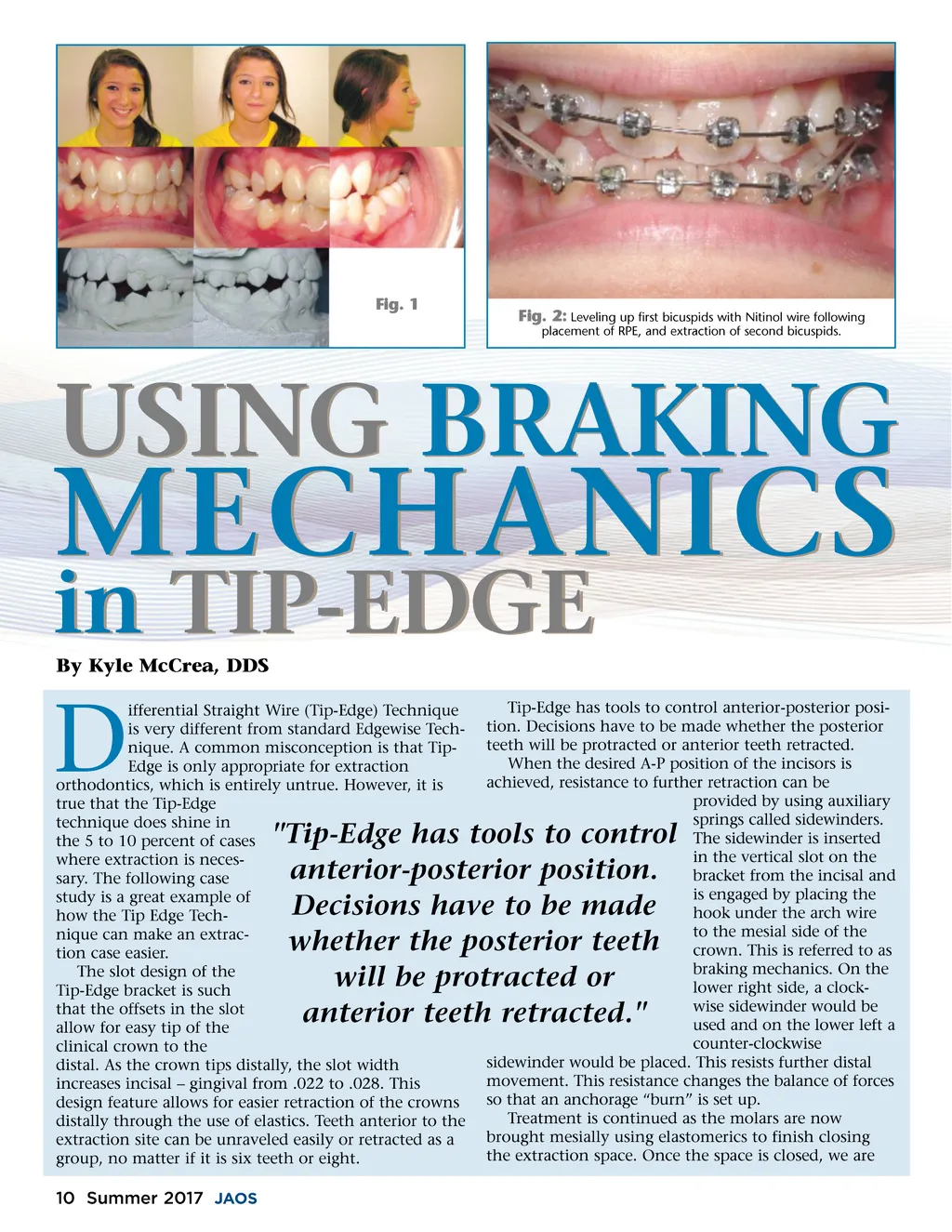
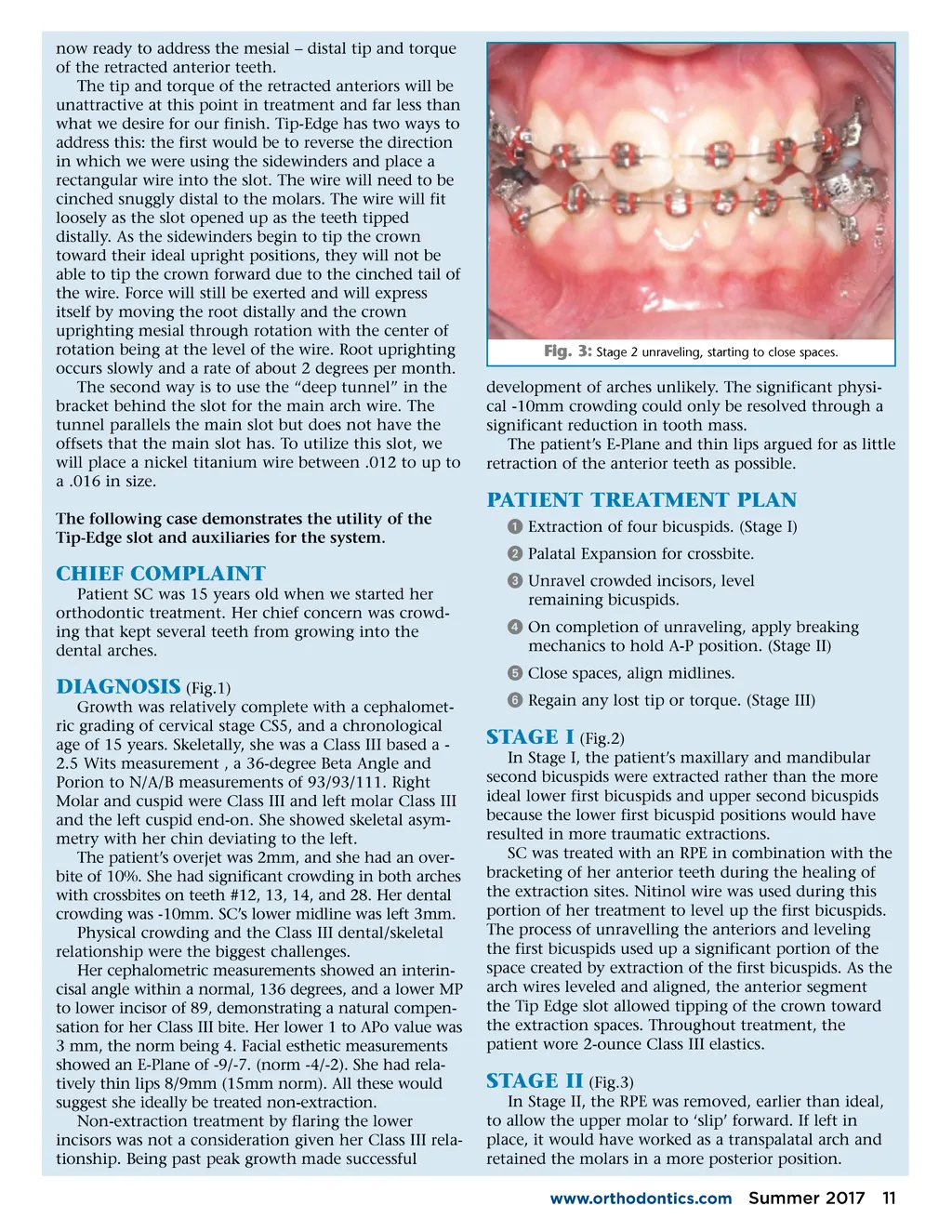
Fig. 1 Fig. 2: Leveling up first bicuspids with Nitinol wire following placement of RPE, and extraction of second bicuspids. MECHANICS in TIP-EDGE By Kyle McCrea, DDS ifferential Straight Wire (Tip-Edge) Technique is very different from standard Edgewise Tech-nique. A common misconception is that Tip-Edge is only appropriate for extraction orthodontics, which is entirely untrue. However, it is true that the Tip-Edge technique does shine in the 5 to 10 percent of cases where extraction is neces-sary. The following case study is a great example of how the Tip Edge Tech-nique can make an extrac-tion case easier. The slot design of the Tip-Edge bracket is such that the offsets in the slot allow for easy tip of the clinical crown to the distal. As the crown tips distally, the slot width increases incisal – gingival from .022 to .028. This design feature allows for easier retraction of the crowns distally through the use of elastics. Teeth anterior to the extraction site can be unraveled easily or retracted as a group, no matter if it is six teeth or eight. USING BRAKING Tip-Edge has tools to control anterior-posterior posi-tion. Decisions have to be made whether the posterior teeth will be protracted or anterior teeth retracted. When the desired A-P position of the incisors is achieved, resistance to further retraction can be provided by using auxiliary springs called sidewinders. The sidewinder is inserted in the vertical slot on the bracket from the incisal and is engaged by placing the hook under the arch wire to the mesial side of the crown. This is referred to as braking mechanics. On the lower right side, a clock-wise sidewinder would be used and on the lower left a counter-clockwise sidewinder would be placed. This resists further distal movement. This resistance changes the balance of forces so that an anchorage “burn” is set up. Treatment is continued as the molars are now brought mesially using elastomerics to finish closing the extraction space. Once the space is closed, we are D "Tip-Edge has tools to control anterior-posterior position. Decisions have to be made whether the posterior teeth will be protracted or anterior teeth retracted." 10 Summer 2017 JAOS
Journal of the American Orthodontic Society Summer 2017/Buyer's Guide: Page 10