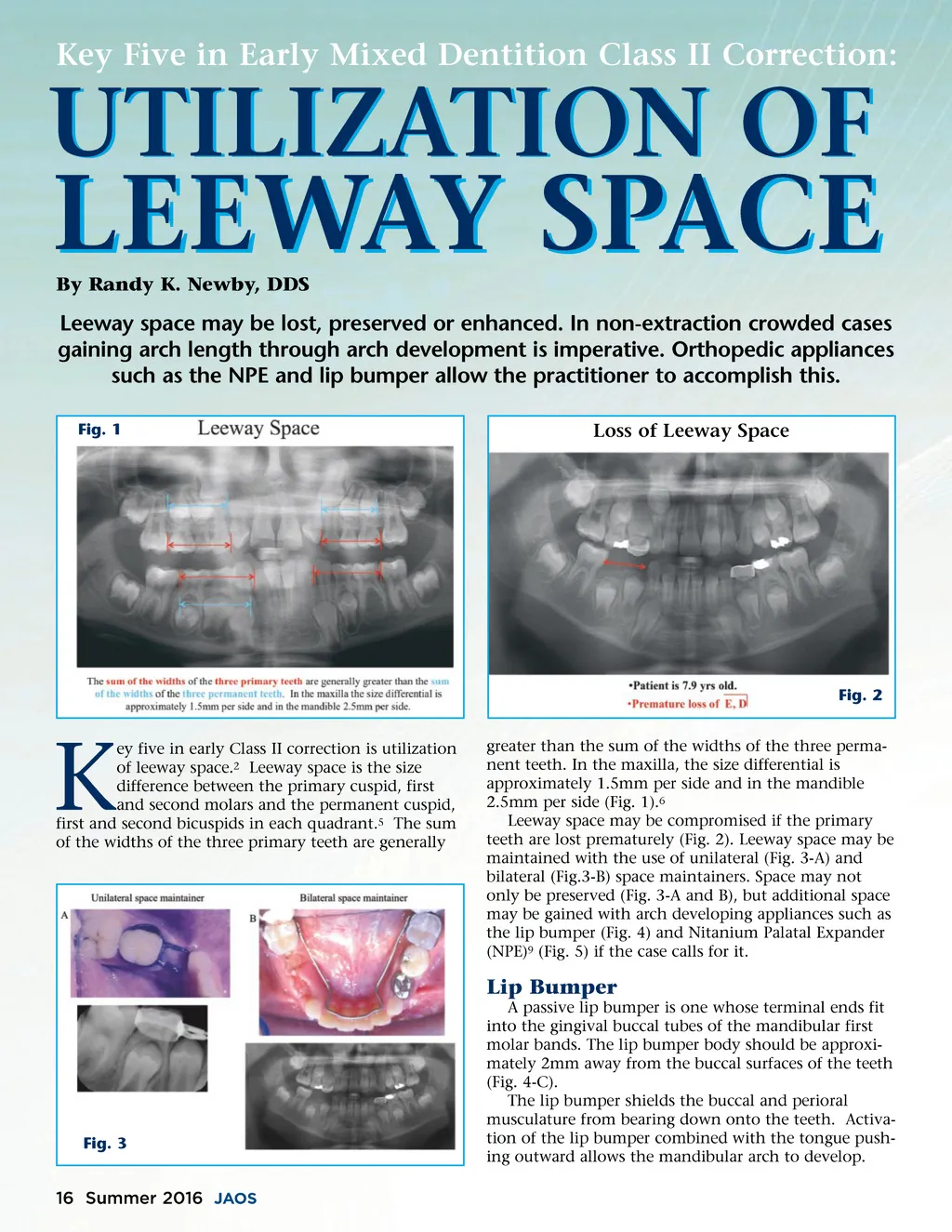
Key Five in Early Mixed Dentition Class II Correction: UTILIZATION OF By Randy K. Newby, DDS Fig. 1 LEEWAY SPACE Leeway space may be lost, preserved or enhanced. In non-extraction crowded cases gaining arch length through arch development is imperative. Orthopedic appliances such as the NPE and lip bumper allow the practitioner to accomplish this. Loss of Leeway Space Fig. 2 K ey five in early Class II correction is utilization of leeway space. 2 Leeway space is the size difference between the primary cuspid, first and second molars and the permanent cuspid, first and second bicuspids in each quadrant. 5 The sum of the widths of the three primary teeth are generally greater than the sum of the widths of the three perma-nent teeth. In the maxilla, the size differential is approximately 1.5mm per side and in the mandible 2.5mm per side (Fig. 1). 6 Leeway space may be compromised if the primary teeth are lost prematurely (Fig. 2). Leeway space may be maintained with the use of unilateral (Fig. 3-A) and bilateral (Fig.3-B) space maintainers. Space may not only be preserved (Fig. 3-A and B), but additional space may be gained with arch developing appliances such as the lip bumper (Fig. 4) and Nitanium Palatal Expander (NPE) 9 (Fig. 5) if the case calls for it. Lip Bumper A passive lip bumper is one whose terminal ends fit into the gingival buccal tubes of the mandibular first molar bands. The lip bumper body should be approxi-mately 2mm away from the buccal surfaces of the teeth (Fig. 4-C). The lip bumper shields the buccal and perioral musculature from bearing down onto the teeth. Activa-tion of the lip bumper combined with the tongue push-ing outward allows the mandibular arch to develop. Fig. 3 16 Summer 2016 JAOS
Journal of the American Orthodontic Society Summer 2016 / Buyer's Guide: Page 16