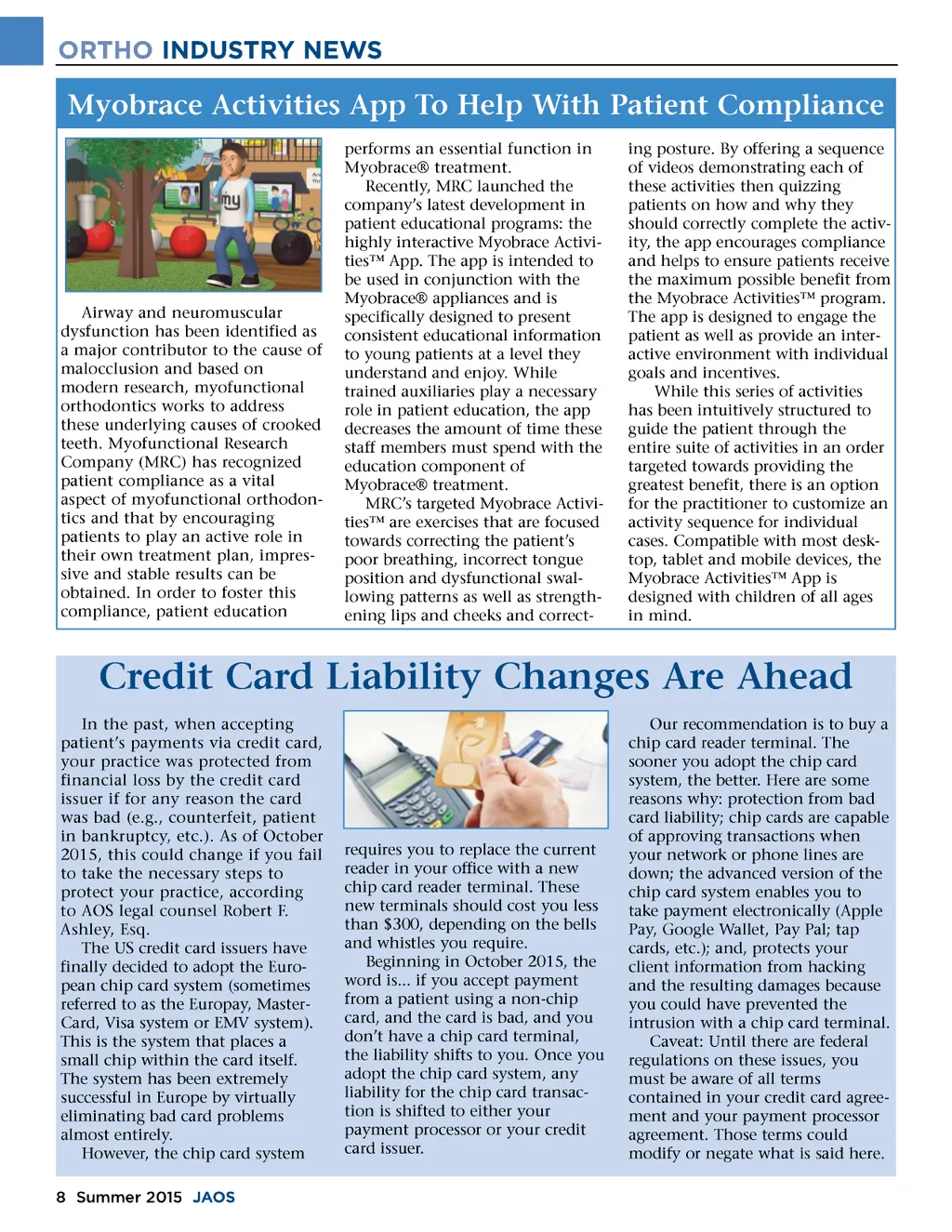
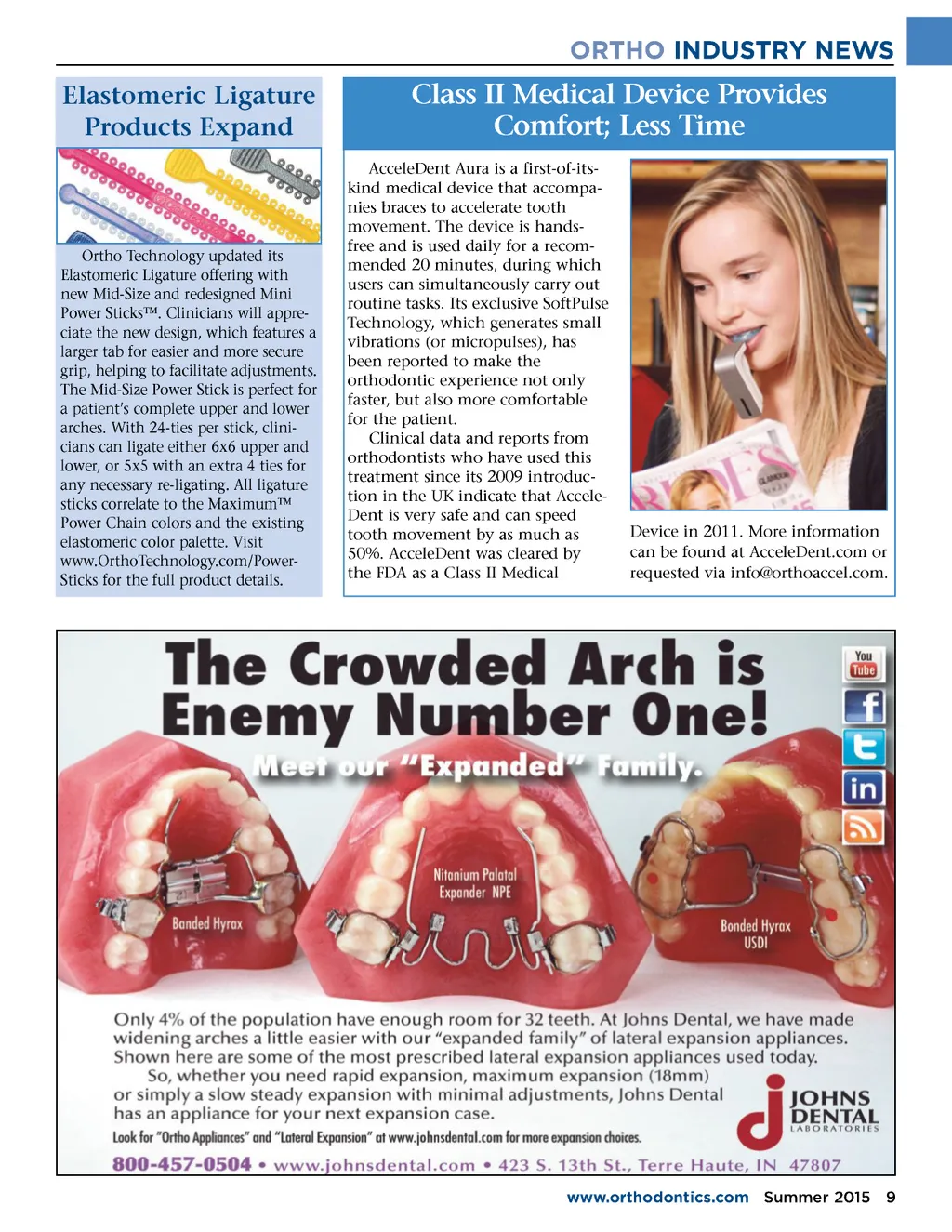
ORTHO INDUSTRY NEWS Myobrace Activities App To Help With Patient Compliance performs an essential function in Myobrace® treatment. Recently, MRC launched the company’s latest development in patient educational programs: the highly interactive Myobrace Activi-ties™ App. The app is intended to be used in conjunction with the Myobrace® appliances and is specifically designed to present consistent educational information to young patients at a level they understand and enjoy. While trained auxiliaries play a necessary role in patient education, the app decreases the amount of time these staff members must spend with the education component of Myobrace® treatment. MRC’s targeted Myobrace Activi-ties™ are exercises that are focused towards correcting the patient’s poor breathing, incorrect tongue position and dysfunctional swal-lowing patterns as well as strength-ening lips and cheeks and correct-ing posture. By offering a sequence of videos demonstrating each of these activities then quizzing patients on how and why they should correctly complete the activ-ity, the app encourages compliance and helps to ensure patients receive the maximum possible benefit from the Myobrace Activities™ program. The app is designed to engage the patient as well as provide an inter-active environment with individual goals and incentives. While this series of activities has been intuitively structured to guide the patient through the entire suite of activities in an order targeted towards providing the greatest benefit, there is an option for the practitioner to customize an activity sequence for individual cases. Compatible with most desk-top, tablet and mobile devices, the Myobrace Activities™ App is designed with children of all ages in mind. Airway and neuromuscular dysfunction has been identified as a major contributor to the cause of malocclusion and based on modern research, myofunctional orthodontics works to address these underlying causes of crooked teeth. Myofunctional Research Company (MRC) has recognized patient compliance as a vital aspect of myofunctional orthodon-tics and that by encouraging patients to play an active role in their own treatment plan, impres-sive and stable results can be obtained. In order to foster this compliance, patient education Credit Card Liability Changes Are Ahead In the past, when accepting patient’s payments via credit card, your practice was protected from financial loss by the credit card issuer if for any reason the card was bad (e.g., counterfeit, patient in bankruptcy, etc.). As of October 2015, this could change if you fail to take the necessary steps to protect your practice, according to AOS legal counsel Robert F. Ashley, Esq. The US credit card issuers have finally decided to adopt the Euro-pean chip card system (sometimes referred to as the Europay, Master-Card, Visa system or EMV system). This is the system that places a small chip within the card itself. The system has been extremely successful in Europe by virtually eliminating bad card problems almost entirely. However, the chip card system 8 Summer 2015 JAOS Our recommendation is to buy a chip card reader terminal. The sooner you adopt the chip card system, the better. Here are some reasons why: protection from bad card liability; chip cards are capable of approving transactions when your network or phone lines are down; the advanced version of the chip card system enables you to take payment electronically (Apple Pay, Google Wallet, Pay Pal; tap cards, etc.); and, protects your client information from hacking and the resulting damages because you could have prevented the intrusion with a chip card terminal. Caveat: Until there are federal regulations on these issues, you must be aware of all terms contained in your credit card agree-ment and your payment processor agreement. Those terms could modify or negate what is said here. requires you to replace the current reader in your office with a new chip card reader terminal. These new terminals should cost you less than $300, depending on the bells and whistles you require. Beginning in October 2015, the word is... if you accept payment from a patient using a non-chip card, and the card is bad, and you don’t have a chip card terminal, the liability shifts to you. Once you adopt the chip card system, any liability for the chip card transac-tion is shifted to either your payment processor or your credit card issuer.
Journal of the American Orthodontic Society Summer 2015-Buyer's Guide: Page 8