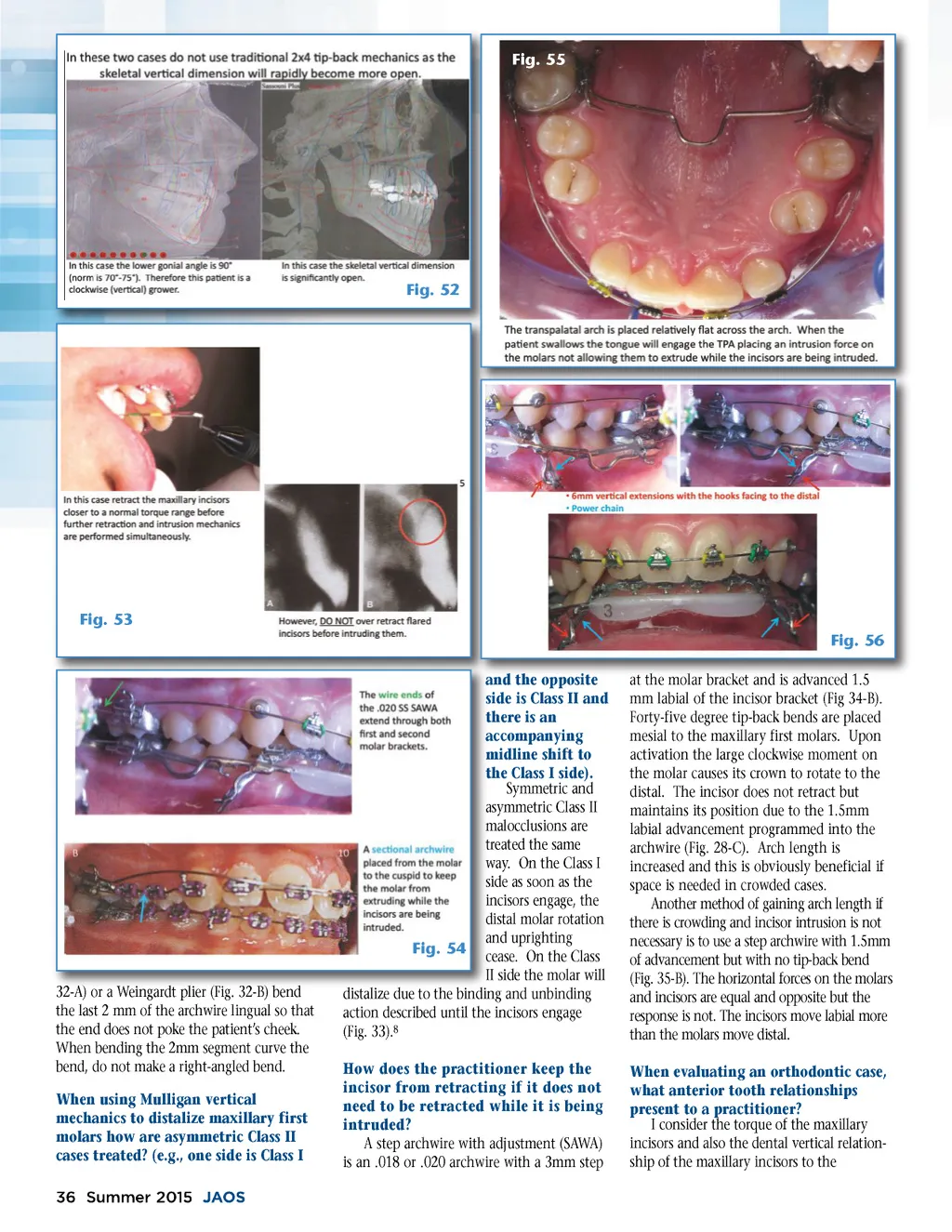
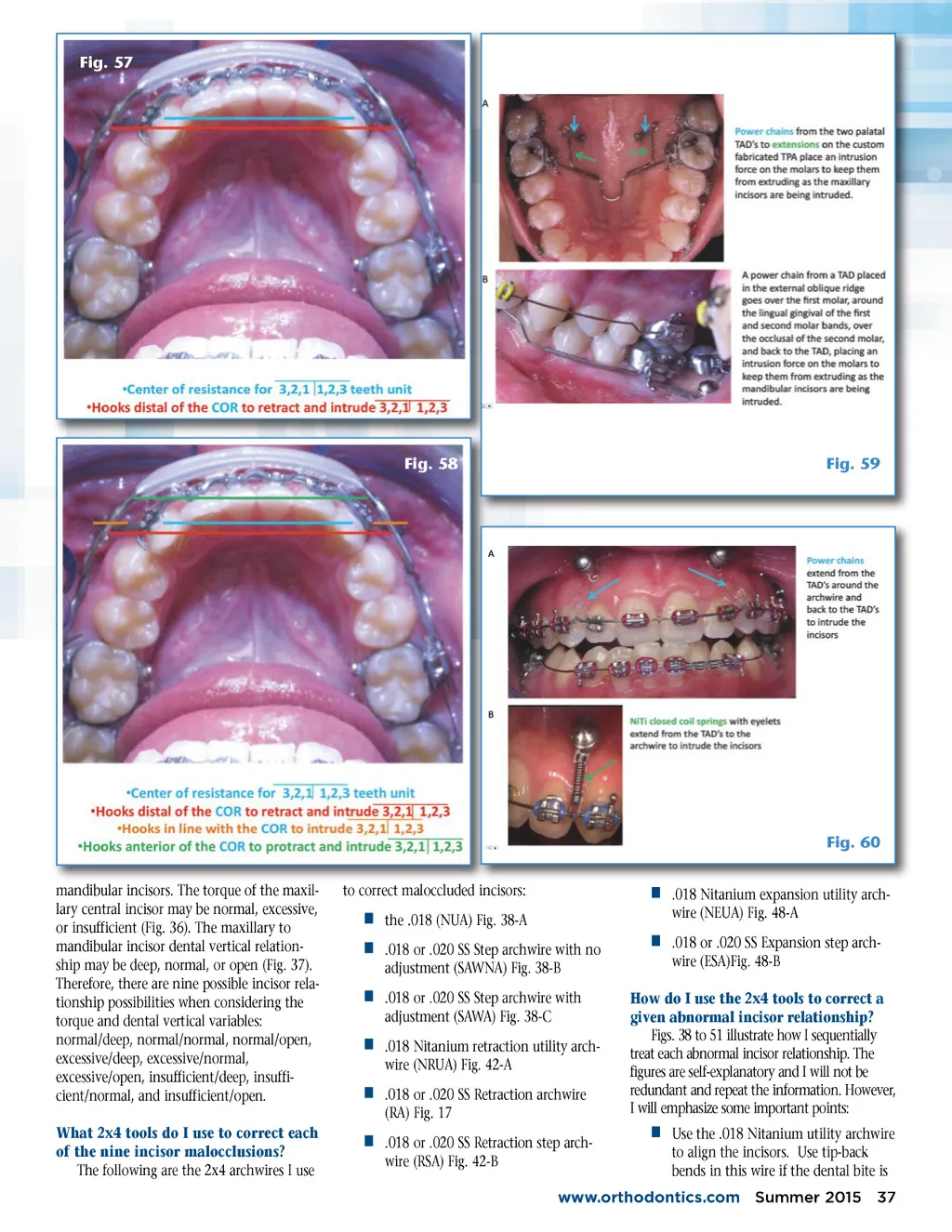
Fig. 57 Fig. 58 Fig. 59 Fig. 60 mandibular incisors. The torque of the maxil-lary central incisor may be normal, excessive, or insufficient (Fig. 36). The maxillary to mandibular incisor dental vertical relation-ship may be deep, normal, or open (Fig. 37). Therefore, there are nine possible incisor rela-tionship possibilities when considering the torque and dental vertical variables: normal/deep, normal/normal, normal/open, excessive/deep, excessive/normal, excessive/open, insufficient/deep, insuffi-cient/normal, and insufficient/open. What 2x4 tools do I use to correct each of the nine incisor malocclusions? The following are the 2x4 archwires I use to correct maloccluded incisors: í the .018 (NUA) Fig. 38-A í .018 or .020 SS Step archwire with no adjustment (SAWNA) Fig. 38-B í .018 or .020 SS Step archwire with adjustment (SAWA) Fig. 38-C í .018 Nitanium retraction utility arch-wire (NRUA) Fig. 42-A í .018 or .020 SS Retraction archwire (RA) Fig. 17 í .018 or .020 SS Retraction step arch-wire (RSA) Fig. 42-B í .018 Nitanium expansion utility arch-wire (NEUA) Fig. 48-A í .018 or .020 SS Expansion step arch-wire (ESA)Fig. 48-B How do I use the 2x4 tools to correct a given abnormal incisor relationship? Figs. 38 to 51 illustrate how I sequentially treat each abnormal incisor relationship. The figures are self-explanatory and I will not be redundant and repeat the information. However, I will emphasize some important points: í Use the .018 Nitanium utility archwire to align the incisors. Use tip-back bends in this wire if the dental bite is www.orthodontics.com Summer 2015 37
Journal of the American Orthodontic Society Summer 2015-Buyer's Guide: Page 37