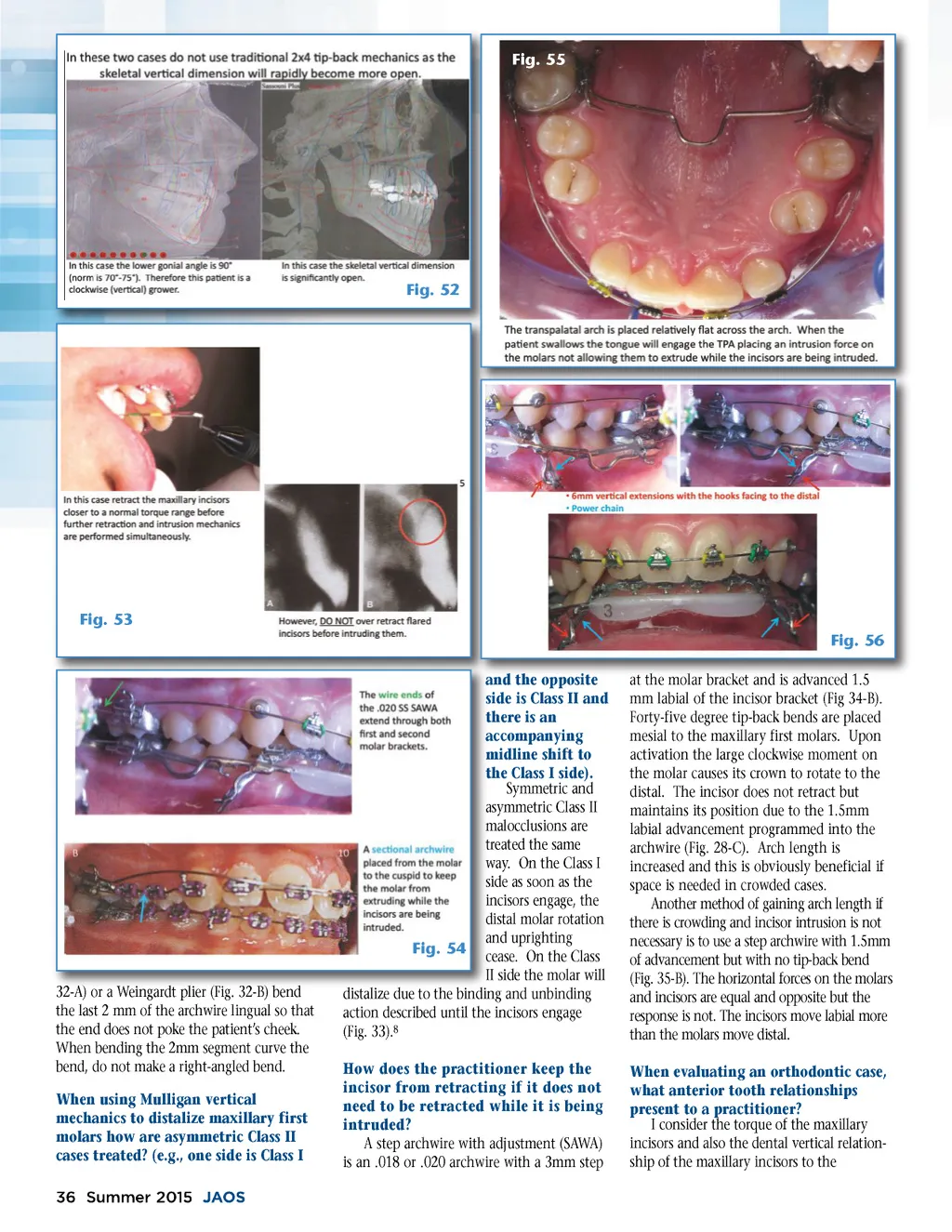
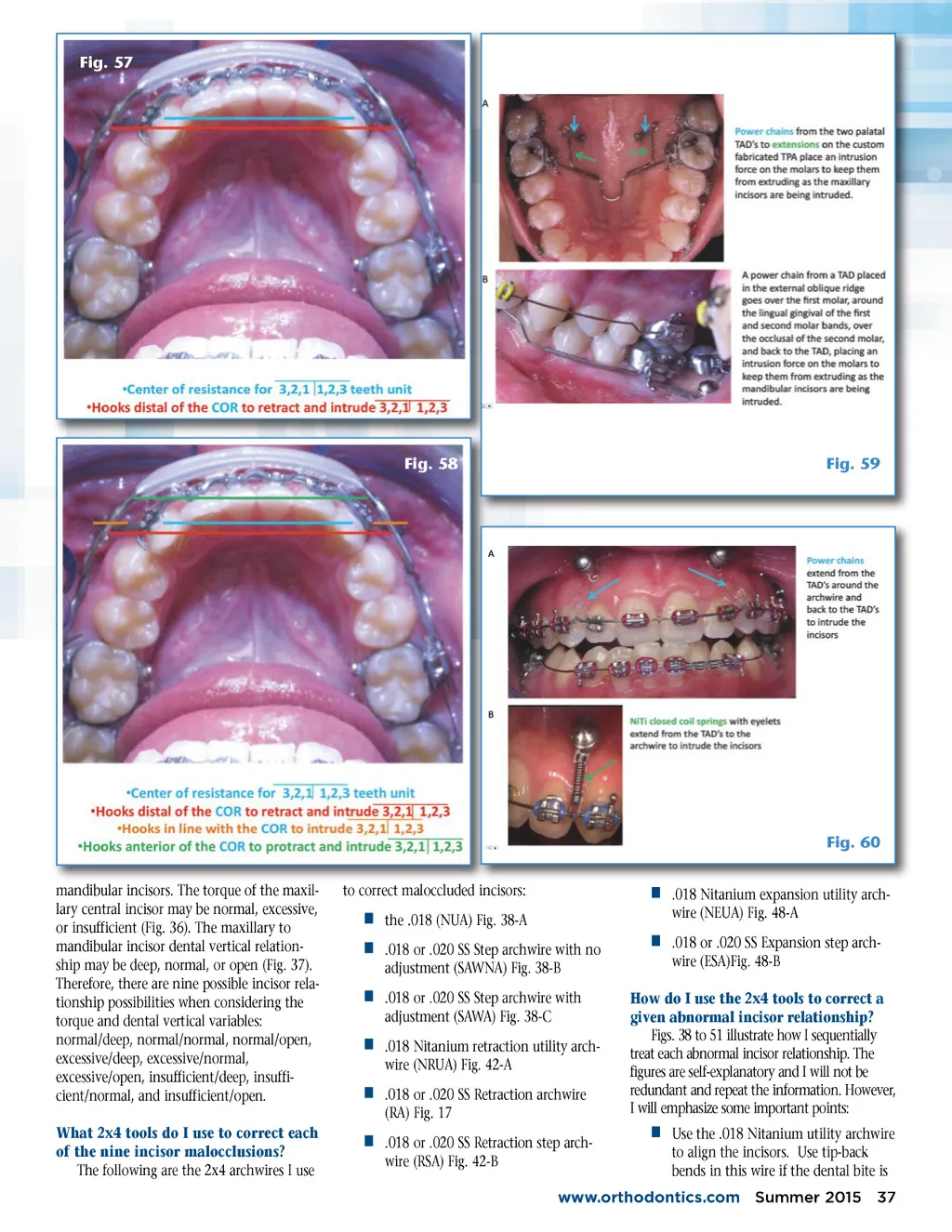
Fig. 55 Fig. 52 Fig. 53 Fig. 56 and the opposite side is Class II and there is an accompanying midline shift to the Class I side). Symmetric and asymmetric Class II malocclusions are treated the same way. On the Class I side as soon as the incisors engage, the distal molar rotation and uprighting Fig. 54 cease. On the Class II side the molar will distalize due to the binding and unbinding action described until the incisors engage (Fig. 33). 8 How does the practitioner keep the incisor from retracting if it does not need to be retracted while it is being intruded? A step archwire with adjustment (SAWA) is an .018 or .020 archwire with a 3mm step at the molar bracket and is advanced 1.5 mm labial of the incisor bracket (Fig 34-B). Forty-five degree tip-back bends are placed mesial to the maxillary first molars. Upon activation the large clockwise moment on the molar causes its crown to rotate to the distal. The incisor does not retract but maintains its position due to the 1.5mm labial advancement programmed into the archwire (Fig. 28-C). Arch length is increased and this is obviously beneficial if space is needed in crowded cases. Another method of gaining arch length if there is crowding and incisor intrusion is not necessary is to use a step archwire with 1.5mm of advancement but with no tip-back bend (Fig. 35-B). The horizontal forces on the molars and incisors are equal and opposite but the response is not. The incisors move labial more than the molars move distal. When evaluating an orthodontic case, what anterior tooth relationships present to a practitioner? I consider the torque of the maxillary incisors and also the dental vertical relation-ship of the maxillary incisors to the 32-A) or a Weingardt plier (Fig. 32-B) bend the last 2 mm of the archwire lingual so that the end does not poke the patient’s cheek. When bending the 2mm segment curve the bend, do not make a right-angled bend. When using Mulligan vertical mechanics to distalize maxillary first molars how are asymmetric Class II cases treated? (e.g., one side is Class I 36 Summer 2015 JAOS
Journal of the American Orthodontic Society Summer 2015-Buyer's Guide: Page 36