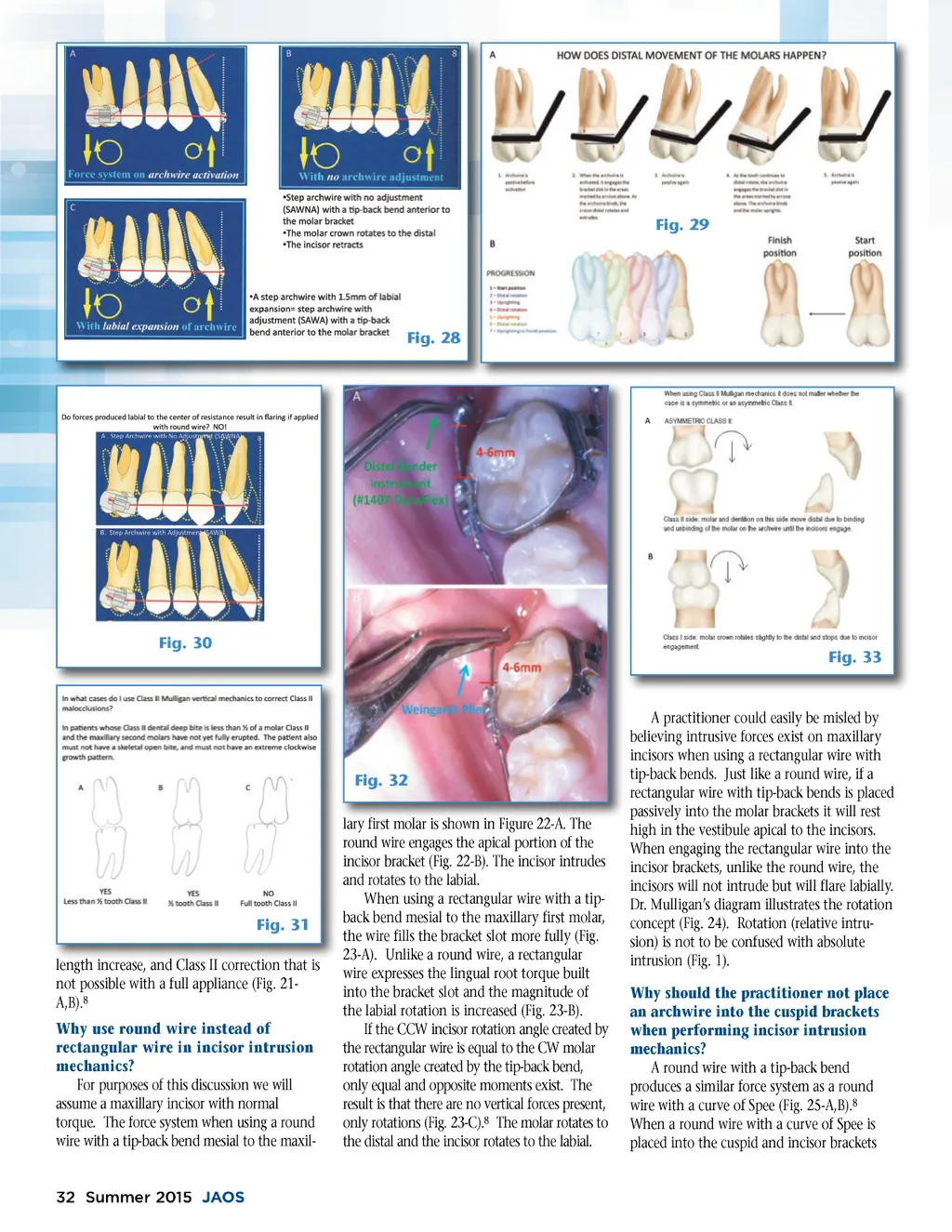
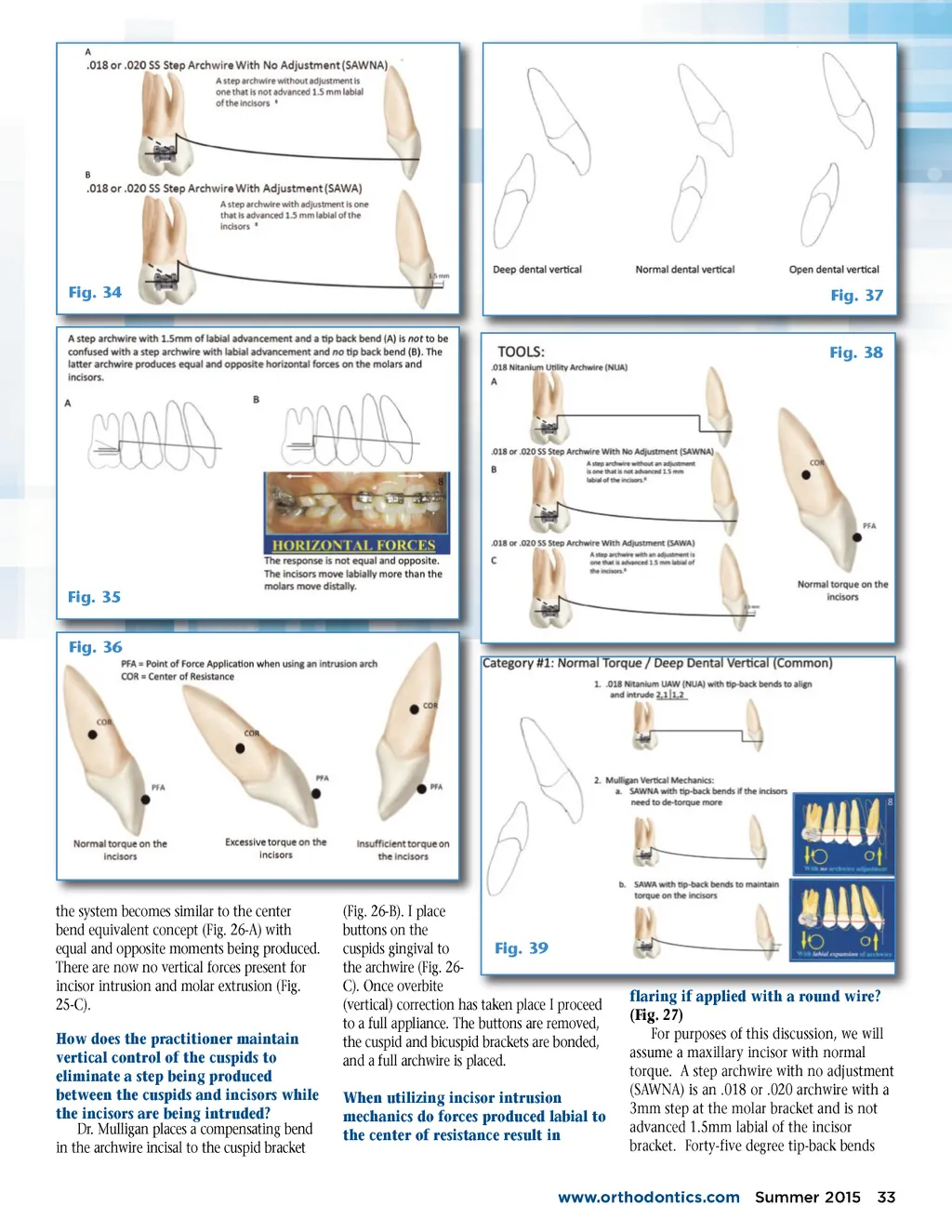
Fig. 29 Fig. 28 Fig. 30 Fig. 33 Fig. 32 lary first molar is shown in Figure 22-A. The round wire engages the apical portion of the incisor bracket (Fig. 22-B). The incisor intrudes and rotates to the labial. When using a rectangular wire with a tip-back bend mesial to the maxillary first molar, the wire fills the bracket slot more fully (Fig. 23-A). Unlike a round wire, a rectangular wire expresses the lingual root torque built into the bracket slot and the magnitude of the labial rotation is increased (Fig. 23-B). If the CCW incisor rotation angle created by the rectangular wire is equal to the CW molar rotation angle created by the tip-back bend, only equal and opposite moments exist. The result is that there are no vertical forces present, only rotations (Fig. 23-C). 8 The molar rotates to the distal and the incisor rotates to the labial. Fig. 31 length increase, and Class II correction that is not possible with a full appliance (Fig. 21-A,B). 8 Why use round wire instead of rectangular wire in incisor intrusion mechanics? For purposes of this discussion we will assume a maxillary incisor with normal torque. The force system when using a round wire with a tip-back bend mesial to the maxil-A practitioner could easily be misled by believing intrusive forces exist on maxillary incisors when using a rectangular wire with tip-back bends. Just like a round wire, if a rectangular wire with tip-back bends is placed passively into the molar brackets it will rest high in the vestibule apical to the incisors. When engaging the rectangular wire into the incisor brackets, unlike the round wire, the incisors will not intrude but will flare labially. Dr. Mulligan’s diagram illustrates the rotation concept (Fig. 24). Rotation (relative intru-sion) is not to be confused with absolute intrusion (Fig. 1). Why should the practitioner not place an archwire into the cuspid brackets when performing incisor intrusion mechanics? A round wire with a tip-back bend produces a similar force system as a round wire with a curve of Spee (Fig. 25-A,B). 8 When a round wire with a curve of Spee is placed into the cuspid and incisor brackets 32 Summer 2015 JAOS
Journal of the American Orthodontic Society Summer 2015-Buyer's Guide: Page 32