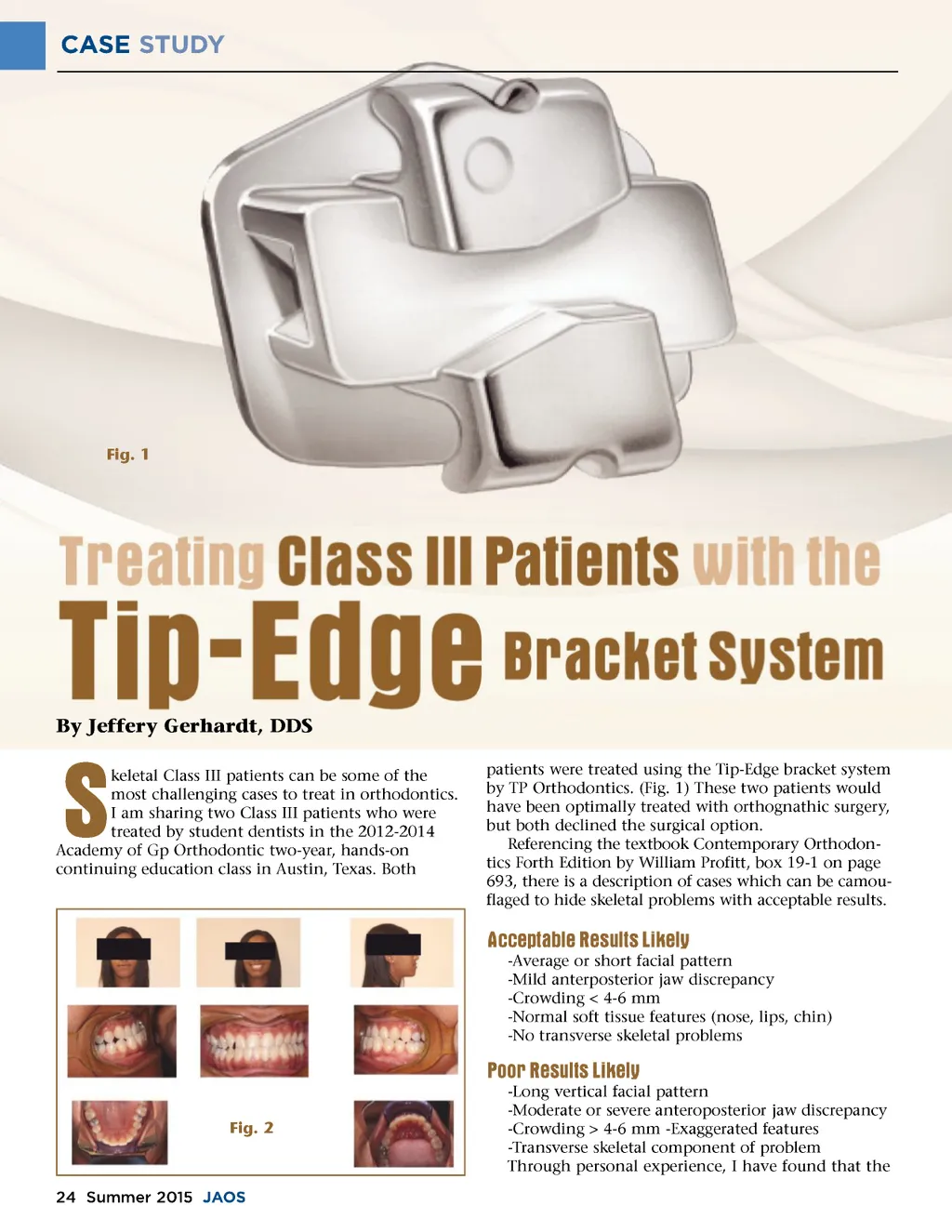
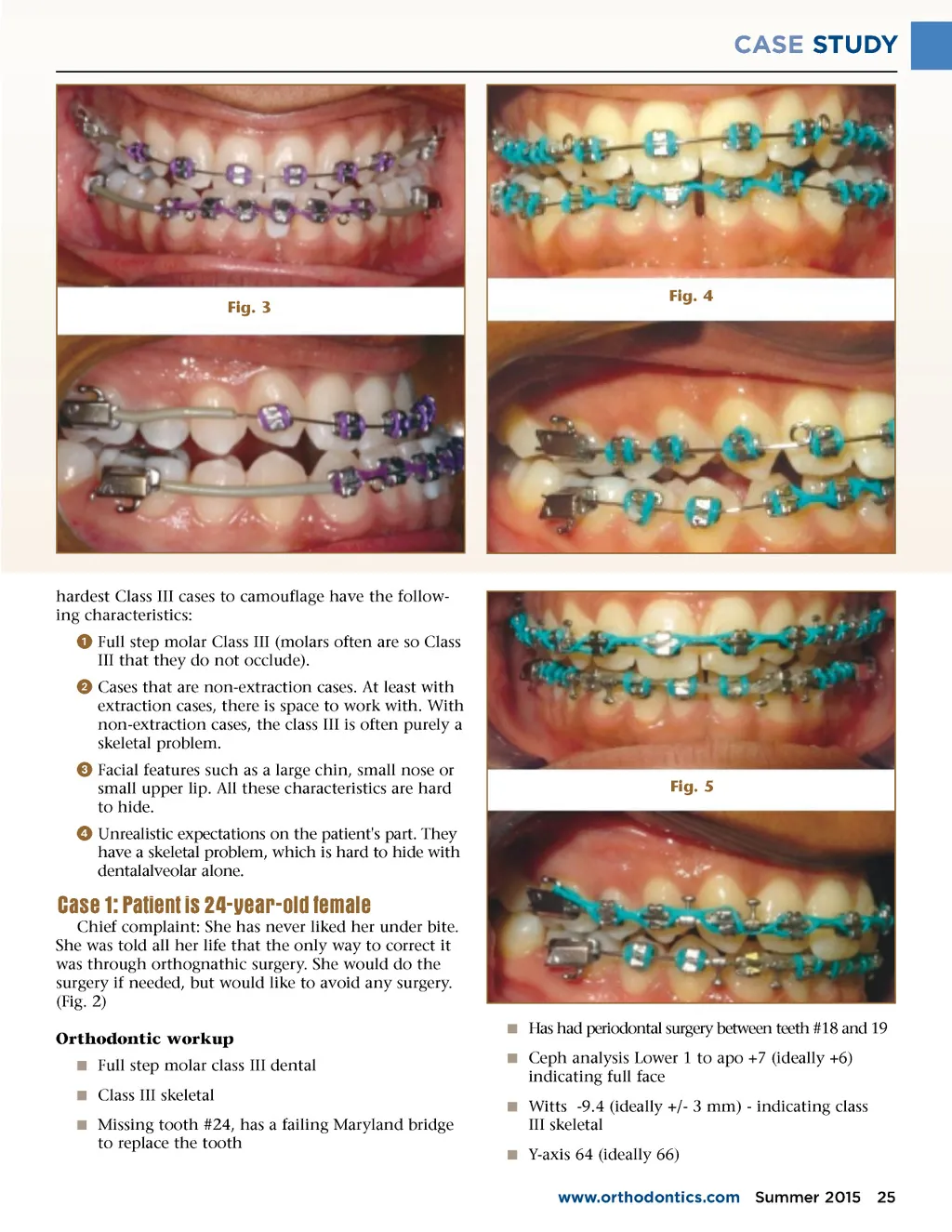
CASE STUDY Fig. 3 Fig. 4 hardest Class III cases to camouflage have the follow-ing characteristics: ᕡ Full step molar Class III (molars often are so Class III that they do not occlude). ᕢ Cases that are non-extraction cases. At least with extraction cases, there is space to work with. With non-extraction cases, the class III is often purely a skeletal problem. ᕣ Facial features such as a large chin, small nose or small upper lip. All these characteristics are hard to hide. ᕤ Unrealistic expectations on the patient's part. They have a skeletal problem, which is hard to hide with dentalalveolar alone. Fig. 5 Case 1: Patient is 24-year-old female Chief complaint: She has never liked her under bite. She was told all her life that the only way to correct it was through orthognathic surgery. She would do the surgery if needed, but would like to avoid any surgery. (Fig. 2) Orthodontic workup Full step molar class III dental Class III skeletal Missing tooth #24, has a failing Maryland bridge to replace the tooth Has had periodontal surgery between teeth #18 and 19 Ceph analysis Lower 1 to apo +7 (ideally +6) indicating full face Witts -9.4 (ideally +/-3 mm) -indicating class III skeletal Y-axis 64 (ideally 66) www.orthodontics.com Summer 2015 25
Journal of the American Orthodontic Society Summer 2015-Buyer's Guide: Page 25