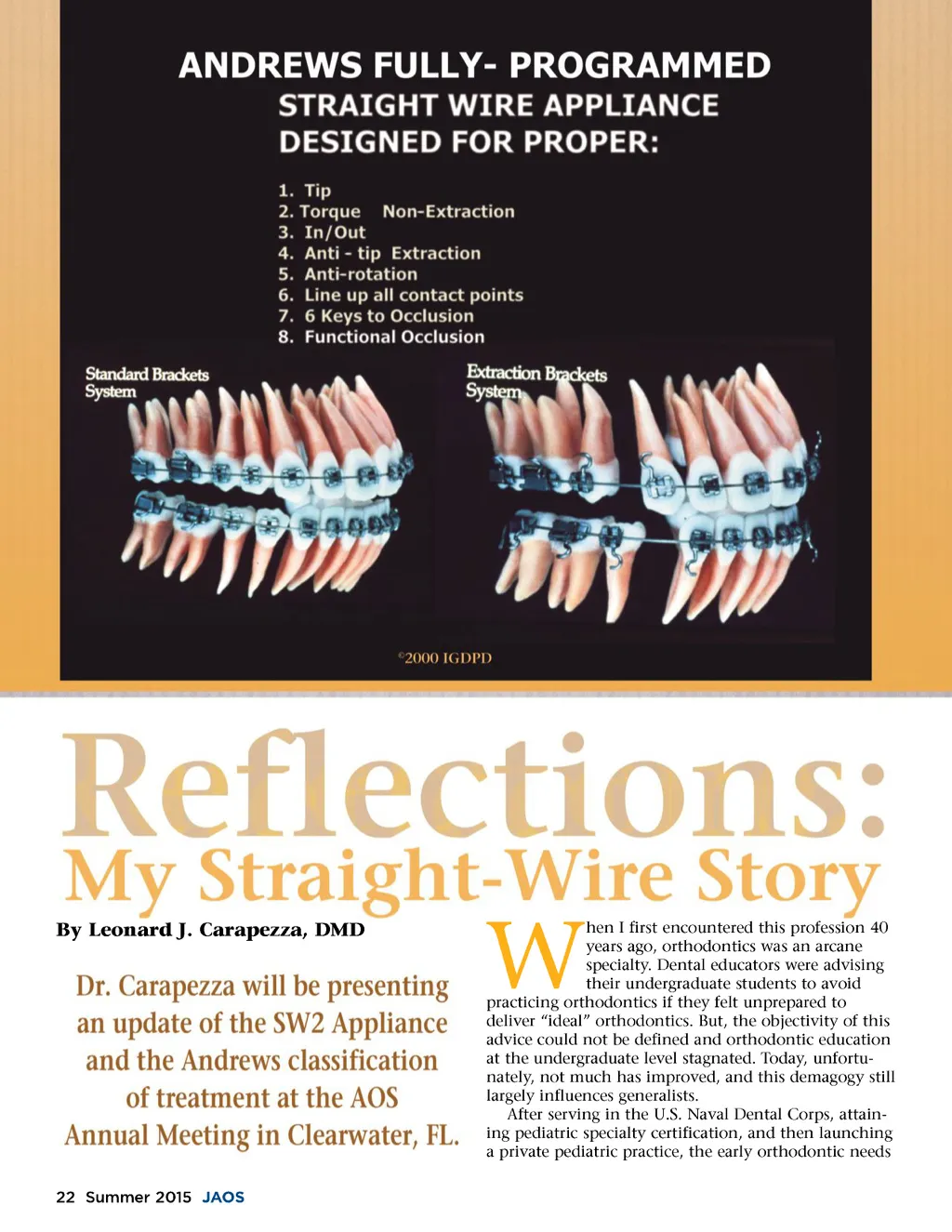
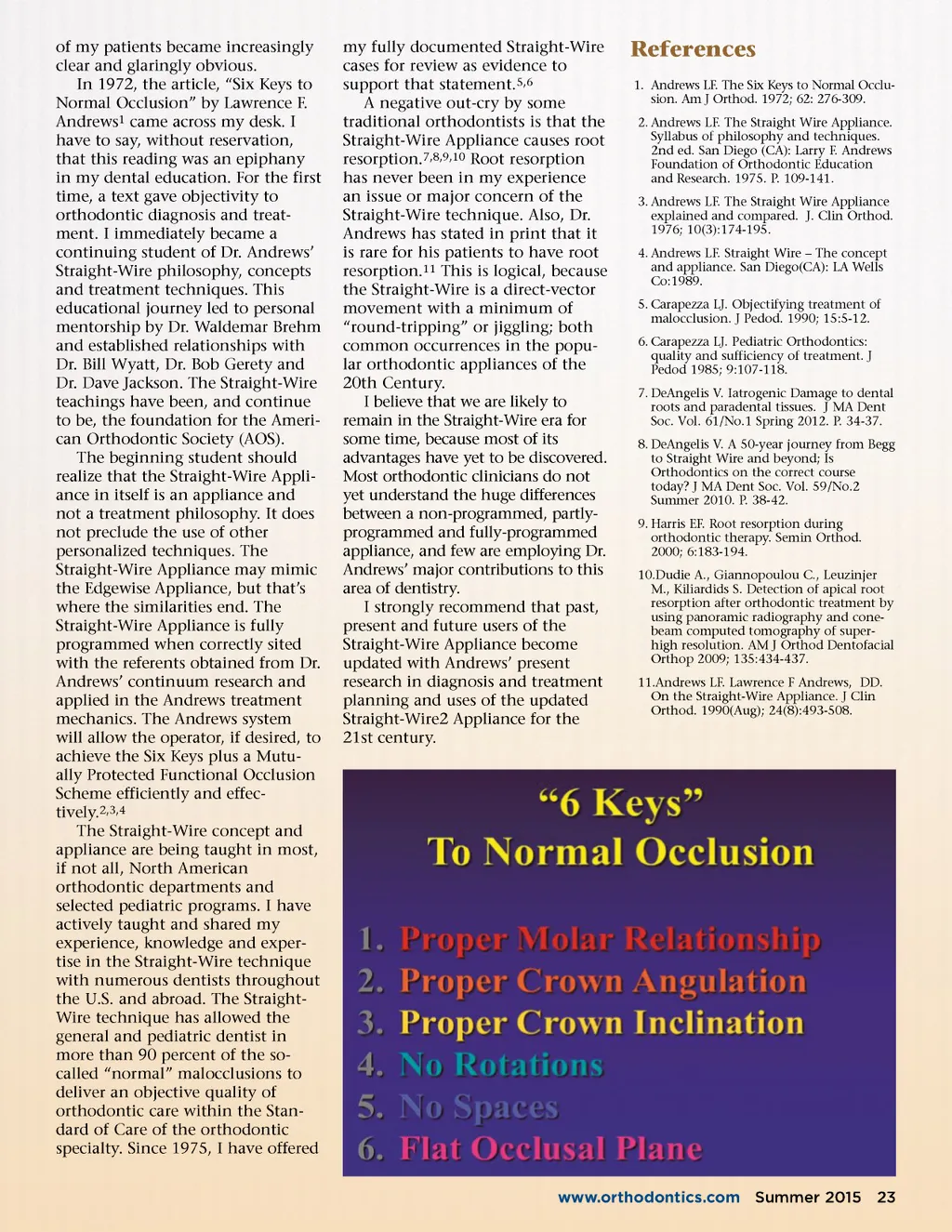
of my patients became increasingly clear and glaringly obvious. In 1972, the article, “Six Keys to Normal Occlusion” by Lawrence F. Andrews 1 came across my desk. I have to say, without reservation, that this reading was an epiphany in my dental education. For the first time, a text gave objectivity to orthodontic diagnosis and treat-ment. I immediately became a continuing student of Dr. Andrews’ Straight-Wire philosophy, concepts and treatment techniques. This educational journey led to personal mentorship by Dr. Waldemar Brehm and established relationships with Dr. Bill Wyatt, Dr. Bob Gerety and Dr. Dave Jackson. The Straight-Wire teachings have been, and continue to be, the foundation for the Ameri-can Orthodontic Society (AOS). The beginning student should realize that the Straight-Wire Appli-ance in itself is an appliance and not a treatment philosophy. It does not preclude the use of other personalized techniques. The Straight-Wire Appliance may mimic the Edgewise Appliance, but that’s where the similarities end. The Straight-Wire Appliance is fully programmed when correctly sited with the referents obtained from Dr. Andrews’ continuum research and applied in the Andrews treatment mechanics. The Andrews system will allow the operator, if desired, to achieve the Six Keys plus a Mutu-ally Protected Functional Occlusion Scheme efficiently and effec-tively. 2,3,4 The Straight-Wire concept and appliance are being taught in most, if not all, North American orthodontic departments and selected pediatric programs. I have actively taught and shared my experience, knowledge and exper-tise in the Straight-Wire technique with numerous dentists throughout the U.S. and abroad. The Straight-Wire technique has allowed the general and pediatric dentist in more than 90 percent of the so-called “normal” malocclusions to deliver an objective quality of orthodontic care within the Stan-dard of Care of the orthodontic specialty. Since 1975, I have offered my fully documented Straight-Wire cases for review as evidence to support that statement. 5,6 A negative out-cry by some traditional orthodontists is that the Straight-Wire Appliance causes root resorption. 7,8,9,10 Root resorption has never been in my experience an issue or major concern of the Straight-Wire technique. Also, Dr. Andrews has stated in print that it is rare for his patients to have root resorption. 11 This is logical, because the Straight-Wire is a direct-vector movement with a minimum of “round-tripping” or jiggling; both common occurrences in the popu-lar orthodontic appliances of the 20th Century. I believe that we are likely to remain in the Straight-Wire era for some time, because most of its advantages have yet to be discovered. Most orthodontic clinicians do not yet understand the huge differences between a non-programmed, partly-programmed and fully-programmed appliance, and few are employing Dr. Andrews’ major contributions to this area of dentistry. I strongly recommend that past, present and future users of the Straight-Wire Appliance become updated with Andrews’ present research in diagnosis and treatment planning and uses of the updated Straight-Wire2 Appliance for the 21st century. References 1. Andrews LF. The Six Keys to Normal Occlu-sion. Am J Orthod. 1972; 62: 276-309. 2. Andrews LF. The Straight Wire Appliance. Syllabus of philosophy and techniques. 2nd ed. San Diego (CA): Larry F. Andrews Foundation of Orthodontic Education and Research. 1975. P. 109-141. 3. Andrews LF. The Straight Wire Appliance explained and compared. J. Clin Orthod. 1976; 10(3):174-195. 4. Andrews LF. Straight Wire – The concept and appliance. San Diego(CA): LA Wells Co:1989. 5. Carapezza LJ. Objectifying treatment of malocclusion. J Pedod. 1990; 15:5-12. 6. Carapezza LJ. Pediatric Orthodontics: quality and sufficiency of treatment. J Pedod 1985; 9:107-118. 7. DeAngelis V. Iatrogenic Damage to dental roots and paradental tissues. J MA Dent Soc. Vol. 61/No.1 Spring 2012. P. 34-37. 8. DeAngelis V. A 50-year journey from Begg to Straight Wire and beyond; Is Orthodontics on the correct course today? J MA Dent Soc. Vol. 59/No.2 Summer 2010. P. 38-42. 9. Harris EF. Root resorption during orthodontic therapy. Semin Orthod. 2000; 6:183-194. 10.Dudie A., Giannopoulou C., Leuzinjer M., Kiliardids S. Detection of apical root resorption after orthodontic treatment by using panoramic radiography and cone-beam computed tomography of super-high resolution. AM J Orthod Dentofacial Orthop 2009; 135:434-437. 11.Andrews LF. Lawrence F Andrews, DD. On the Straight-Wire Appliance. J Clin Orthod. 1990(Aug); 24(8):493-508. www.orthodontics.com Summer 2015 23
Journal of the American Orthodontic Society Summer 2015-Buyer's Guide: Page 23