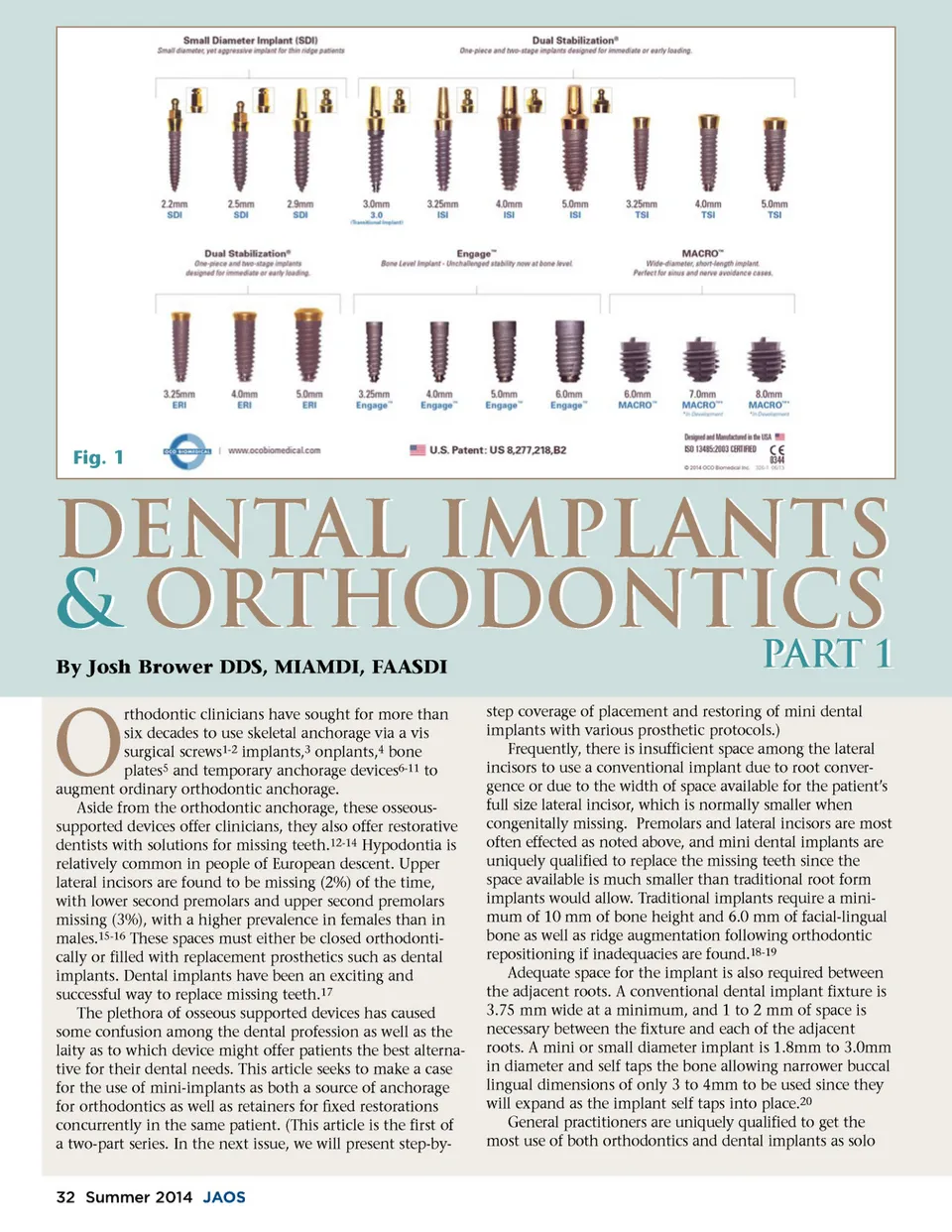
Fig. 1 dental implants & orthodontics By Josh Brower DDS, MIAMDI, FAASDI PART 1 step coverage of placement and restoring of mini dental implants with various prosthetic protocols.) Frequently, there is insufficient space among the lateral incisors to use a conventional implant due to root conver-gence or due to the width of space available for the patient’s full size lateral incisor, which is normally smaller when congenitally missing. Premolars and lateral incisors are most often effected as noted above, and mini dental implants are uniquely qualified to replace the missing teeth since the space available is much smaller than traditional root form implants would allow. Traditional implants require a mini-mum of 10 mm of bone height and 6.0 mm of facial-lingual bone as well as ridge augmentation following orthodontic repositioning if inadequacies are found. 18-19 Adequate space for the implant is also required between the adjacent roots. A conventional dental implant fixture is 3.75 mm wide at a minimum, and 1 to 2 mm of space is necessary between the fixture and each of the adjacent roots. A mini or small diameter implant is 1.8mm to 3.0mm in diameter and self taps the bone allowing narrower buccal lingual dimensions of only 3 to 4mm to be used since they will expand as the implant self taps into place. 20 General practitioners are uniquely qualified to get the most use of both orthodontics and dental implants as solo O rthodontic clinicians have sought for more than six decades to use skeletal anchorage via a vis surgical screws 1-2 implants, 3 onplants, 4 bone plates 5 and temporary anchorage devices 6-11 to augment ordinary orthodontic anchorage. Aside from the orthodontic anchorage, these osseous-supported devices offer clinicians, they also offer restorative dentists with solutions for missing teeth. 12-14 Hypodontia is relatively common in people of European descent. Upper lateral incisors are found to be missing (2%) of the time, with lower second premolars and upper second premolars missing (3%), with a higher prevalence in females than in males. 15-16 These spaces must either be closed orthodonti-cally or filled with replacement prosthetics such as dental implants. Dental implants have been an exciting and successful way to replace missing teeth. 17 The plethora of osseous supported devices has caused some confusion among the dental profession as well as the laity as to which device might offer patients the best alterna-tive for their dental needs. This article seeks to make a case for the use of mini-implants as both a source of anchorage for orthodontics as well as retainers for fixed restorations concurrently in the same patient. (This article is the first of a two-part series. In the next issue, we will present step-by-32 Summer 2014 JAOS
Journal of the American Orthodontic Society Summer 2014 / Buyer's Guide: Page 32