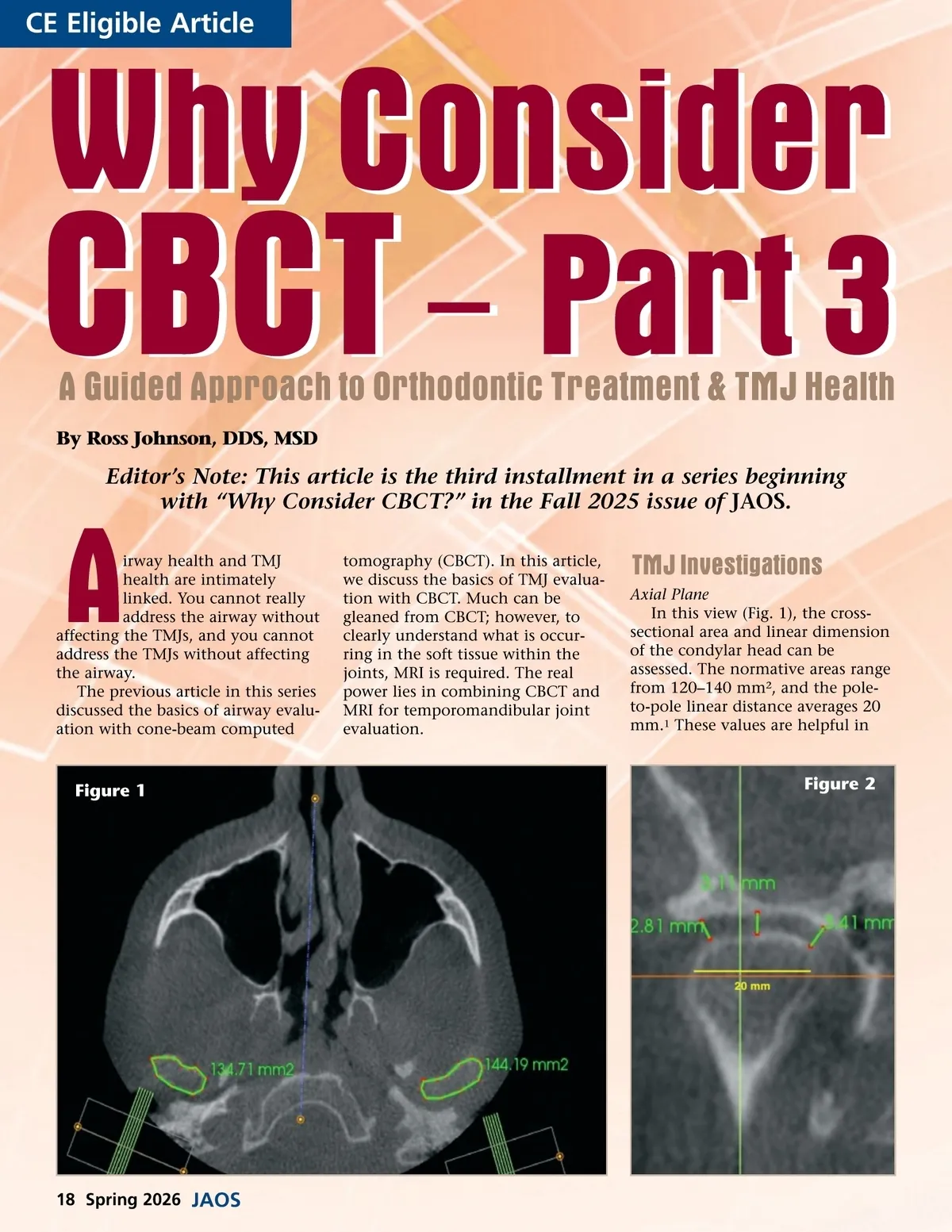
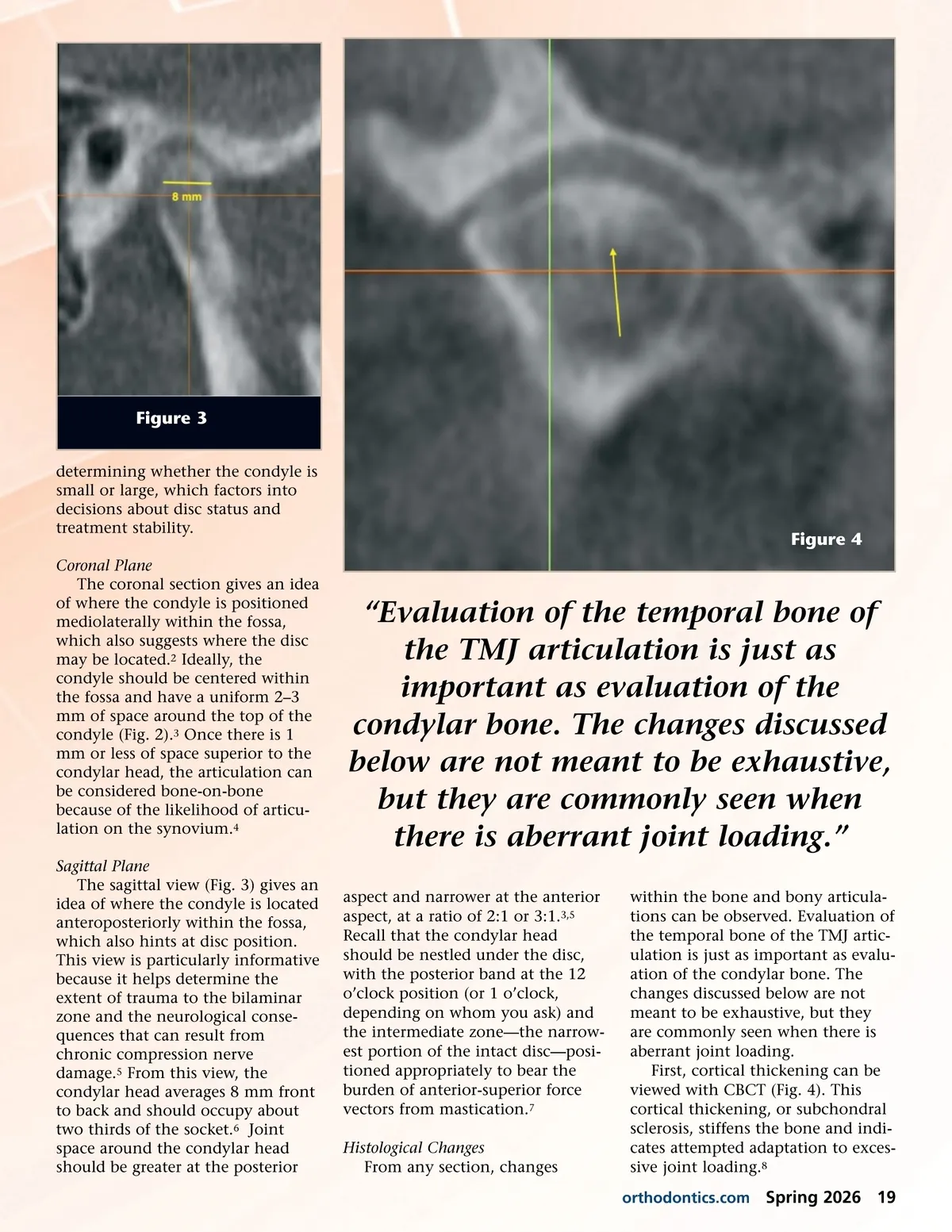
CE Eligible Article Why Consider CBCT – Part 3 A Guided Approach to Orthodontic Treatment & TMJ Health By Ross Johnson, DDS, MSD Editor’s Note: This article is the third installment in a series beginning with “Why Consider CBCT?” in the Fall 2025 issue of JAOS . A irway health and TMJ health are intimately linked. You cannot really address the airway without affecting the TMJs, and you cannot address the TMJs without affecting the airway. The previous article in this series discussed the basics of airway evalu-ation with cone-beam computed tomography (CBCT). In this article, we discuss the basics of TMJ evalua-tion with CBCT. Much can be gleaned from CBCT; however, to clearly understand what is occur-ring in the soft tissue within the joints, MRI is required. The real power lies in combining CBCT and MRI for temporomandibular joint evaluation. TMJ Investigations Axial Plane In this view (Fig. 1), the cross-sectional area and linear dimension of the condylar head can be assessed. The normative areas range from 120–140 mm², and the pole-to-pole linear distance averages 20 mm. 1 These values are helpful in Figure 1 Figure 2 18 Spring 2026 JAOS
Journal of the American Orthodontic Society Spring 2026: Page 18