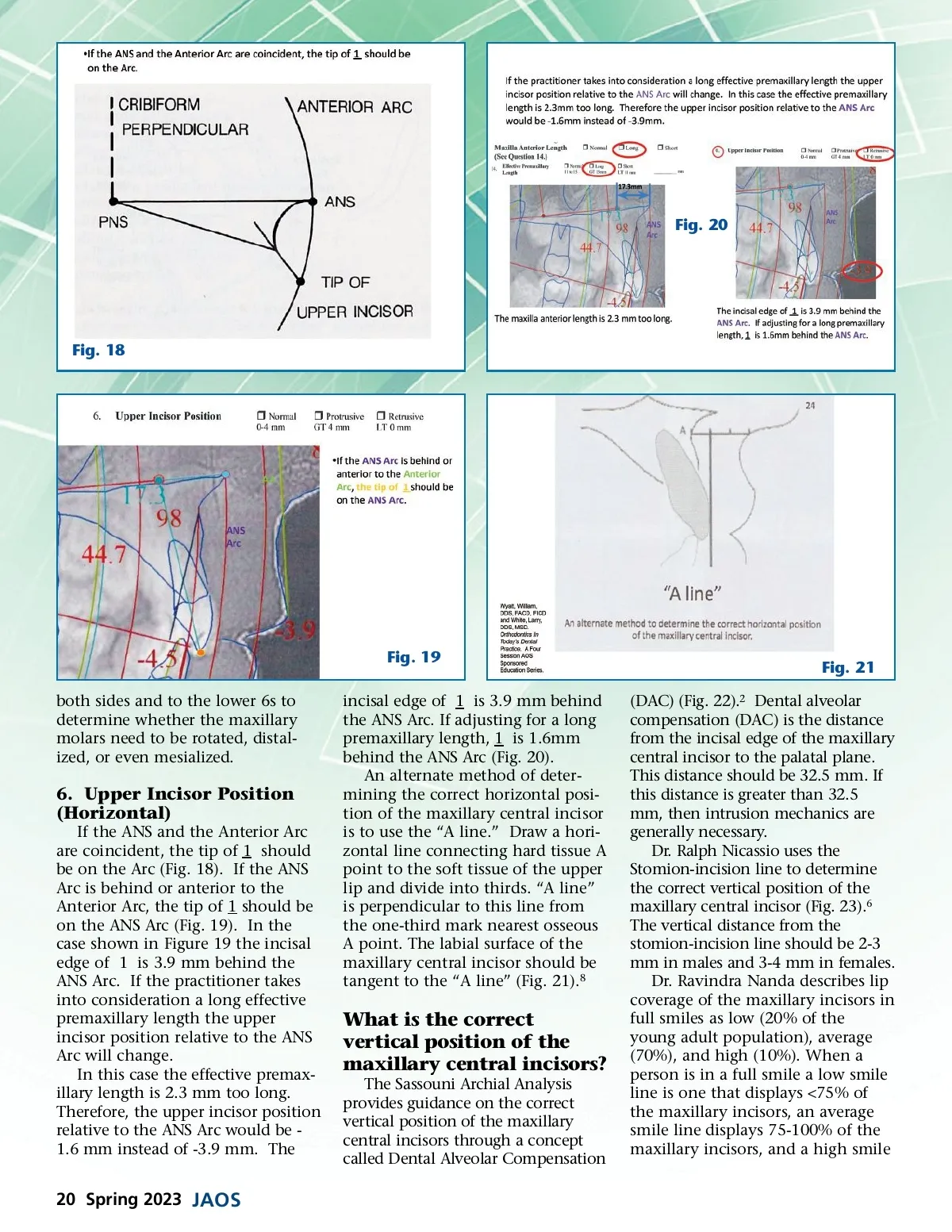
Fig. 20 Fig. 18 Fig. 19 both sides and to the lower 6s to determine whether the maxillary molars need to be rotated, distal-ized, or even mesialized. incisal edge of 1 is 3.9 mm behind the ANS Arc. If adjusting for a long premaxillary length, 1 is 1.6mm behind the ANS Arc (Fig. 20). An alternate method of deter-mining the correct horizontal posi-tion of the maxillary central incisor is to use the “A line.” Draw a hori-zontal line connecting hard tissue A point to the soft tissue of the upper lip and divide into thirds. “A line” is perpendicular to this line from the one-third mark nearest osseous A point. The labial surface of the maxillary central incisor should be tangent to the “A line” (Fig. 21). 8 Fig. 21 (DAC) (Fig. 22). 2 Dental alveolar compensation (DAC) is the distance from the incisal edge of the maxillary central incisor to the palatal plane. This distance should be 32.5 mm. If this distance is greater than 32.5 mm, then intrusion mechanics are generally necessary. Dr. Ralph Nicassio uses the Stomion-incision line to determine the correct vertical position of the maxillary central incisor (Fig. 23). 6 The vertical distance from the stomion-incision line should be 2-3 mm in males and 3-4 mm in females. Dr. Ravindra Nanda describes lip coverage of the maxillary incisors in full smiles as low (20% of the young adult population), average (70%), and high (10%). When a person is in a full smile a low smile line is one that displays <75% of the maxillary incisors, an average smile line displays 75-100% of the maxillary incisors, and a high smile 6. Upper Incisor Position (Horizontal) If the ANS and the Anterior Arc are coincident, the tip of 1 should be on the Arc (Fig. 18). If the ANS Arc is behind or anterior to the Anterior Arc, the tip of 1 should be on the ANS Arc (Fig. 19). In the case shown in Figure 19 the incisal edge of 1 is 3.9 mm behind the ANS Arc. If the practitioner takes into consideration a long effective premaxillary length the upper incisor position relative to the ANS Arc will change. In this case the effective premax-illary length is 2.3 mm too long. Therefore, the upper incisor position relative to the ANS Arc would be -1.6 mm instead of -3.9 mm. The What is the correct vertical position of the maxillary central incisors? The Sassouni Archial Analysis provides guidance on the correct vertical position of the maxillary central incisors through a concept called Dental Alveolar Compensation 20 Spring 2023 JAOS
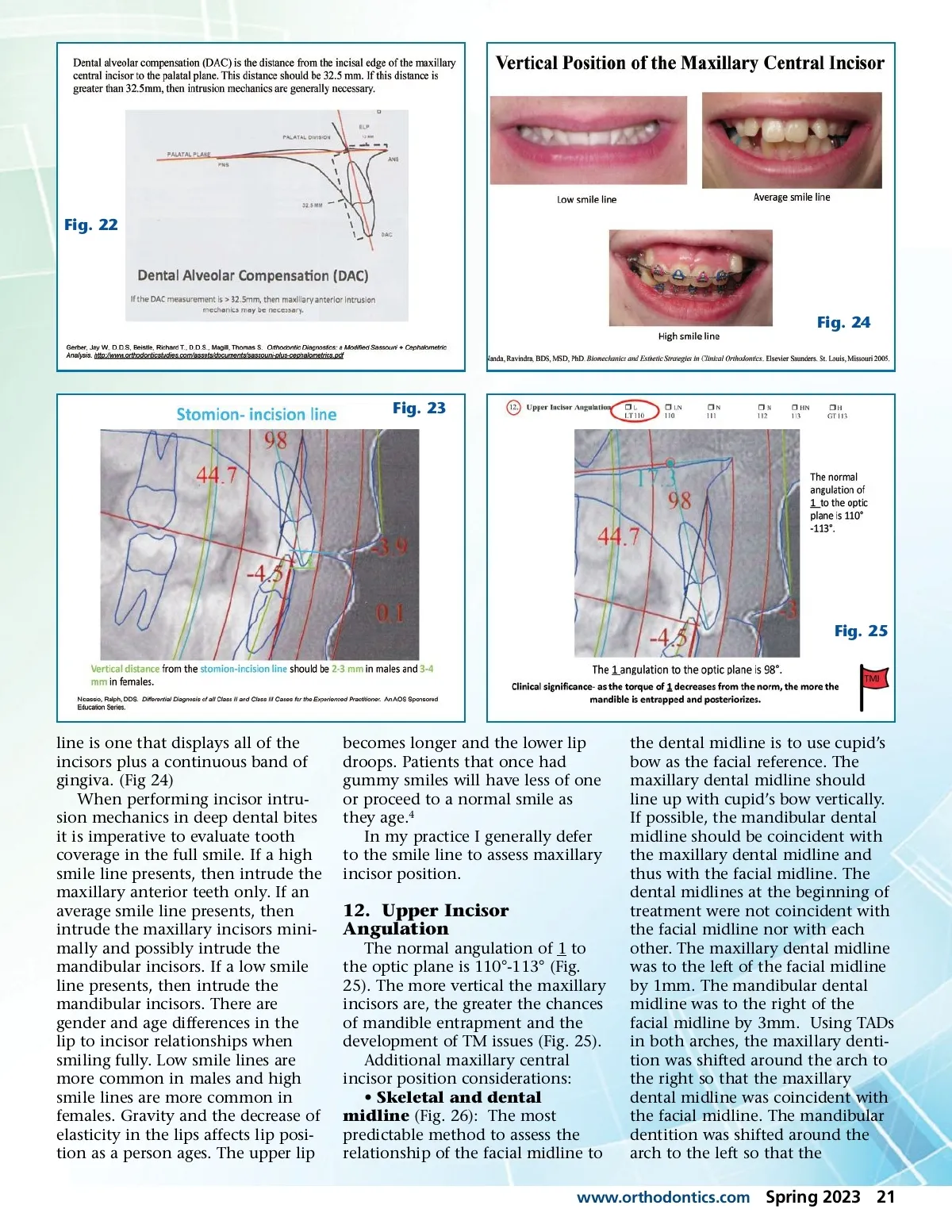
Journal of the American Orthodontic Society Spring 2023: Page 20