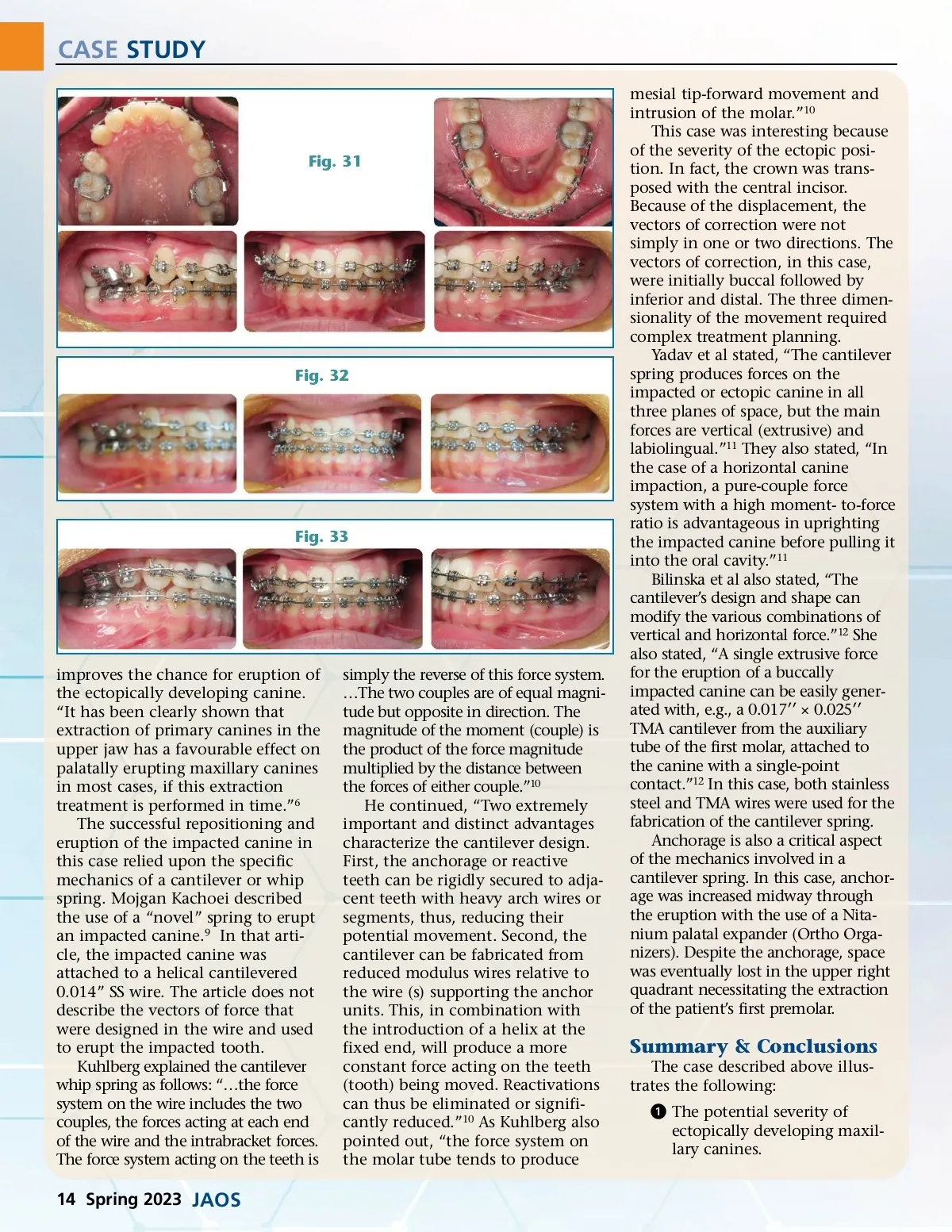
CASE STUDY mesial tip-forward movement and intrusion of the molar.” 10 This case was interesting because of the severity of the ectopic posi-tion. In fact, the crown was trans-posed with the central incisor. Because of the displacement, the vectors of correction were not simply in one or two directions. The vectors of correction, in this case, were initially buccal followed by inferior and distal. The three dimen-sionality of the movement required complex treatment planning. Yadav et al stated, “The cantilever spring produces forces on the impacted or ectopic canine in all three planes of space, but the main forces are vertical (extrusive) and labiolingual.” 11 They also stated, “In the case of a horizontal canine impaction, a pure-couple force system with a high moment-to-force ratio is advantageous in uprighting the impacted canine before pulling it into the oral cavity.” 11 Bilinska et al also stated, “The cantilever’s design and shape can modify the various combinations of vertical and horizontal force.” 12 She also stated, “A single extrusive force for the eruption of a buccally impacted canine can be easily gener-ated with, e.g., a 0.017 ′′ × 0.025 ′′ TMA cantilever from the auxiliary tube of the first molar, attached to the canine with a single-point contact.” 12 In this case, both stainless steel and TMA wires were used for the fabrication of the cantilever spring. Anchorage is also a critical aspect of the mechanics involved in a cantilever spring. In this case, anchor-age was increased midway through the eruption with the use of a Nita-nium palatal expander (Ortho Orga-nizers). Despite the anchorage, space was eventually lost in the upper right quadrant necessitating the extraction of the patient’s first premolar. Fig. 31 Fig. 32 Fig. 33 improves the chance for eruption of the ectopically developing canine. “It has been clearly shown that extraction of primary canines in the upper jaw has a favourable effect on palatally erupting maxillary canines in most cases, if this extraction treatment is performed in time.” 6 The successful repositioning and eruption of the impacted canine in this case relied upon the specific mechanics of a cantilever or whip spring. Mojgan Kachoei described the use of a “novel” spring to erupt an impacted canine. 9 In that arti-cle, the impacted canine was attached to a helical cantilevered 0.014” SS wire. The article does not describe the vectors of force that were designed in the wire and used to erupt the impacted tooth. Kuhlberg explained the cantilever whip spring as follows: “…the force system on the wire includes the two couples, the forces acting at each end of the wire and the intrabracket forces. The force system acting on the teeth is simply the reverse of this force system. …The two couples are of equal magni-tude but opposite in direction. The magnitude of the moment (couple) is the product of the force magnitude multiplied by the distance between the forces of either couple.” 10 He continued, “Two extremely important and distinct advantages characterize the cantilever design. First, the anchorage or reactive teeth can be rigidly secured to adja-cent teeth with heavy arch wires or segments, thus, reducing their potential movement. Second, the cantilever can be fabricated from reduced modulus wires relative to the wire (s) supporting the anchor units. This, in combination with the introduction of a helix at the fixed end, will produce a more constant force acting on the teeth (tooth) being moved. Reactivations can thus be eliminated or signifi-cantly reduced.” 10 As Kuhlberg also pointed out, “the force system on the molar tube tends to produce Summary & Conclusions The case described above illus-trates the following: ᕡ The potential severity of ectopically developing maxil-lary canines. 14 Spring 2023 JAOS
Journal of the American Orthodontic Society Spring 2023: Page 14