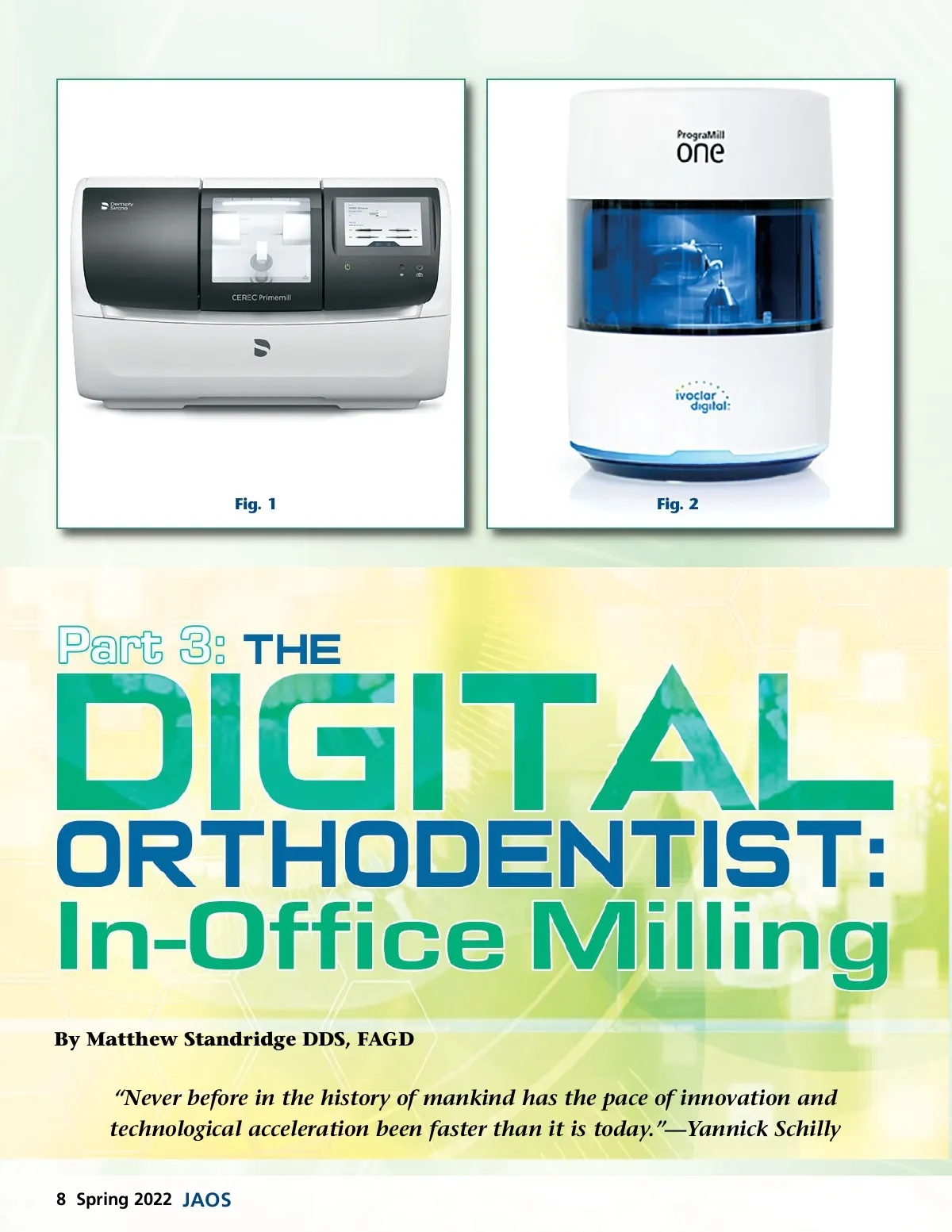
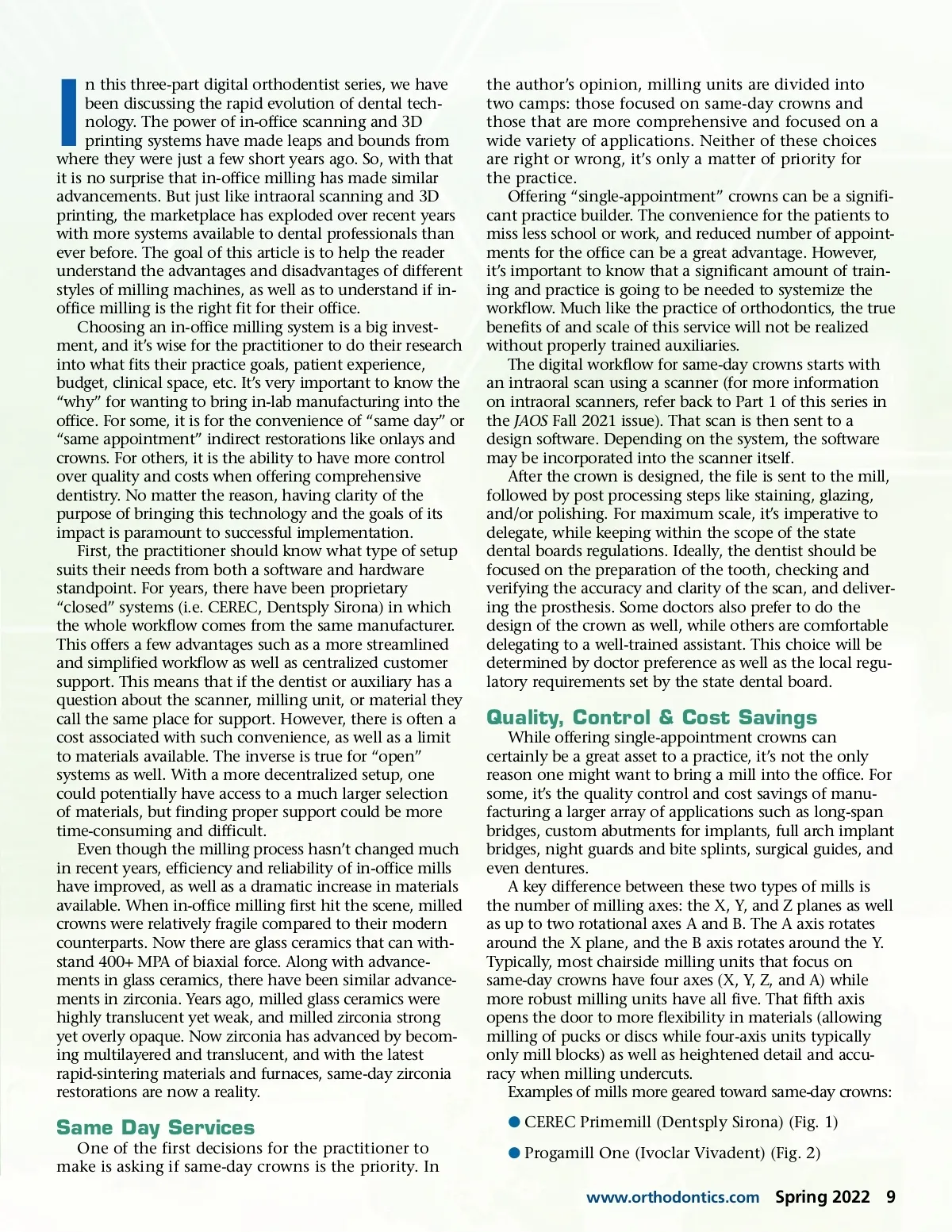
I n this three-part digital orthodentist series, we have been discussing the rapid evolution of dental tech-nology. The power of in-office scanning and 3D printing systems have made leaps and bounds from where they were just a few short years ago. So, with that it is no surprise that in-office milling has made similar advancements. But just like intraoral scanning and 3D printing, the marketplace has exploded over recent years with more systems available to dental professionals than ever before. The goal of this article is to help the reader understand the advantages and disadvantages of different styles of milling machines, as well as to understand if in-office milling is the right fit for their office. Choosing an in-office milling system is a big invest-ment, and it’s wise for the practitioner to do their research into what fits their practice goals, patient experience, budget, clinical space, etc. It’s very important to know the “why” for wanting to bring in-lab manufacturing into the office. For some, it is for the convenience of “same day” or “same appointment” indirect restorations like onlays and crowns. For others, it is the ability to have more control over quality and costs when offering comprehensive dentistry. No matter the reason, having clarity of the purpose of bringing this technology and the goals of its impact is paramount to successful implementation. First, the practitioner should know what type of setup suits their needs from both a software and hardware standpoint. For years, there have been proprietary “closed” systems (i.e. CEREC, Dentsply Sirona) in which the whole workflow comes from the same manufacturer. This offers a few advantages such as a more streamlined and simplified workflow as well as centralized customer support. This means that if the dentist or auxiliary has a question about the scanner, milling unit, or material they call the same place for support. However, there is often a cost associated with such convenience, as well as a limit to materials available. The inverse is true for “open” systems as well. With a more decentralized setup, one could potentially have access to a much larger selection of materials, but finding proper support could be more time-consuming and difficult. Even though the milling process hasn’t changed much in recent years, efficiency and reliability of in-office mills have improved, as well as a dramatic increase in materials available. When in-office milling first hit the scene, milled crowns were relatively fragile compared to their modern counterparts. Now there are glass ceramics that can with-stand 400+ MPA of biaxial force. Along with advance-ments in glass ceramics, there have been similar advance-ments in zirconia. Years ago, milled glass ceramics were highly translucent yet weak, and milled zirconia strong yet overly opaque. Now zirconia has advanced by becom-ing multilayered and translucent, and with the latest rapid-sintering materials and furnaces, same-day zirconia restorations are now a reality. the author’s opinion, milling units are divided into two camps: those focused on same-day crowns and those that are more comprehensive and focused on a wide variety of applications. Neither of these choices are right or wrong, it’s only a matter of priority for the practice. Offering “single-appointment” crowns can be a signifi-cant practice builder. The convenience for the patients to miss less school or work, and reduced number of appoint-ments for the office can be a great advantage. However, it’s important to know that a significant amount of train-ing and practice is going to be needed to systemize the workflow. Much like the practice of orthodontics, the true benefits of and scale of this service will not be realized without properly trained auxiliaries. The digital workflow for same-day crowns starts with an intraoral scan using a scanner (for more information on intraoral scanners, refer back to Part 1 of this series in the JAOS Fall 2021 issue). That scan is then sent to a design software. Depending on the system, the software may be incorporated into the scanner itself. After the crown is designed, the file is sent to the mill, followed by post processing steps like staining, glazing, and/or polishing. For maximum scale, it’s imperative to delegate, while keeping within the scope of the state dental boards regulations. Ideally, the dentist should be focused on the preparation of the tooth, checking and verifying the accuracy and clarity of the scan, and deliver-ing the prosthesis. Some doctors also prefer to do the design of the crown as well, while others are comfortable delegating to a well-trained assistant. This choice will be determined by doctor preference as well as the local regu-latory requirements set by the state dental board. Quality, Control & Cost Savings While offering single-appointment crowns can certainly be a great asset to a practice, it’s not the only reason one might want to bring a mill into the office. For some, it’s the quality control and cost savings of manu-facturing a larger array of applications such as long-span bridges, custom abutments for implants, full arch implant bridges, night guards and bite splints, surgical guides, and even dentures. A key difference between these two types of mills is the number of milling axes: the X, Y, and Z planes as well as up to two rotational axes A and B. The A axis rotates around the X plane, and the B axis rotates around the Y. Typically, most chairside milling units that focus on same-day crowns have four axes (X, Y, Z, and A) while more robust milling units have all five. That fifth axis opens the door to more flexibility in materials (allowing milling of pucks or discs while four-axis units typically only mill blocks) as well as heightened detail and accu-racy when milling undercuts. Examples of mills more geared toward same-day crowns: b CEREC Primemill (Dentsply Sirona) (Fig. 1) b Progamill One (Ivoclar Vivadent) (Fig. 2) www.orthodontics.com Same Day Services One of the first decisions for the practitioner to make is asking if same-day crowns is the priority. In Spring 2022 9
Journal of the American Orthodontic Society Spring 2022: Page 9