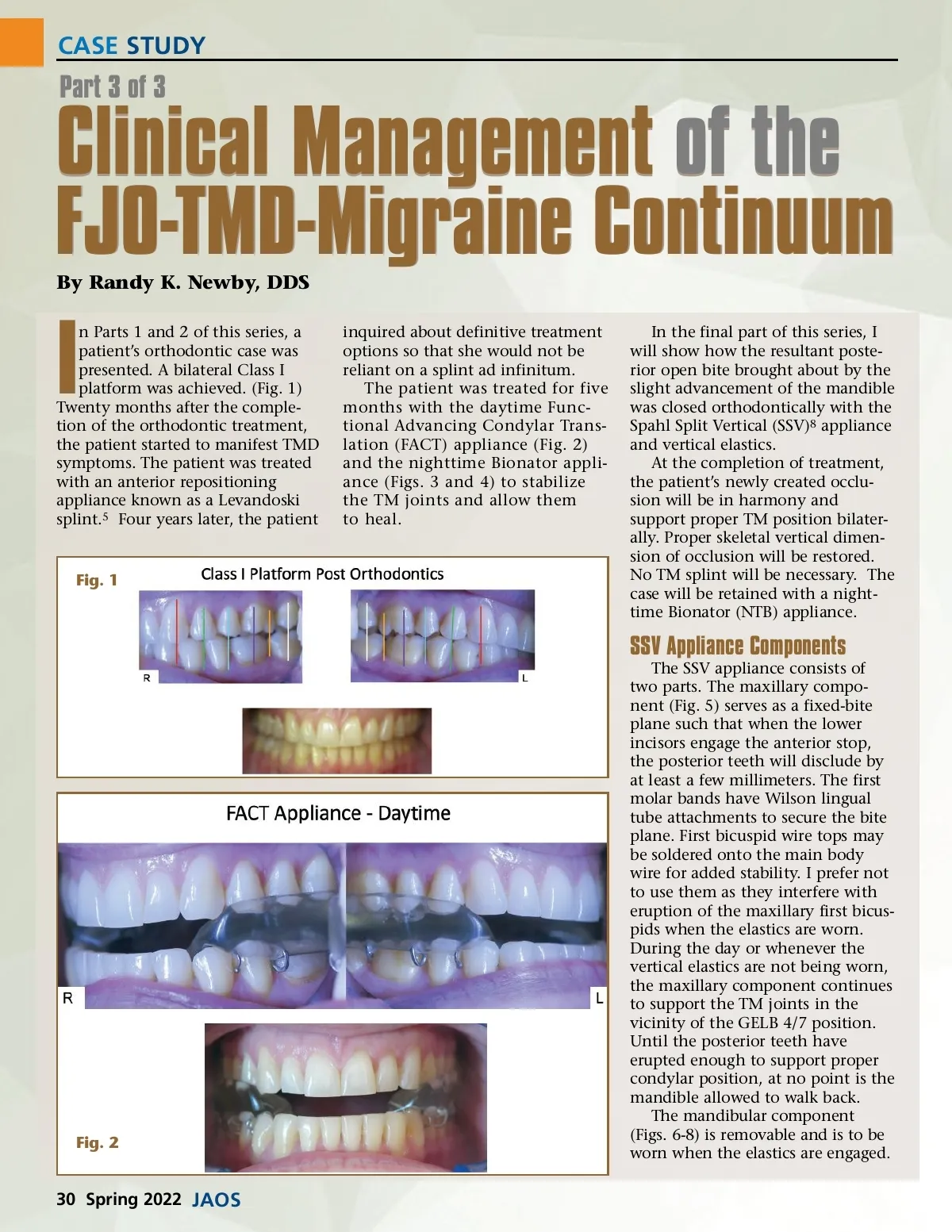
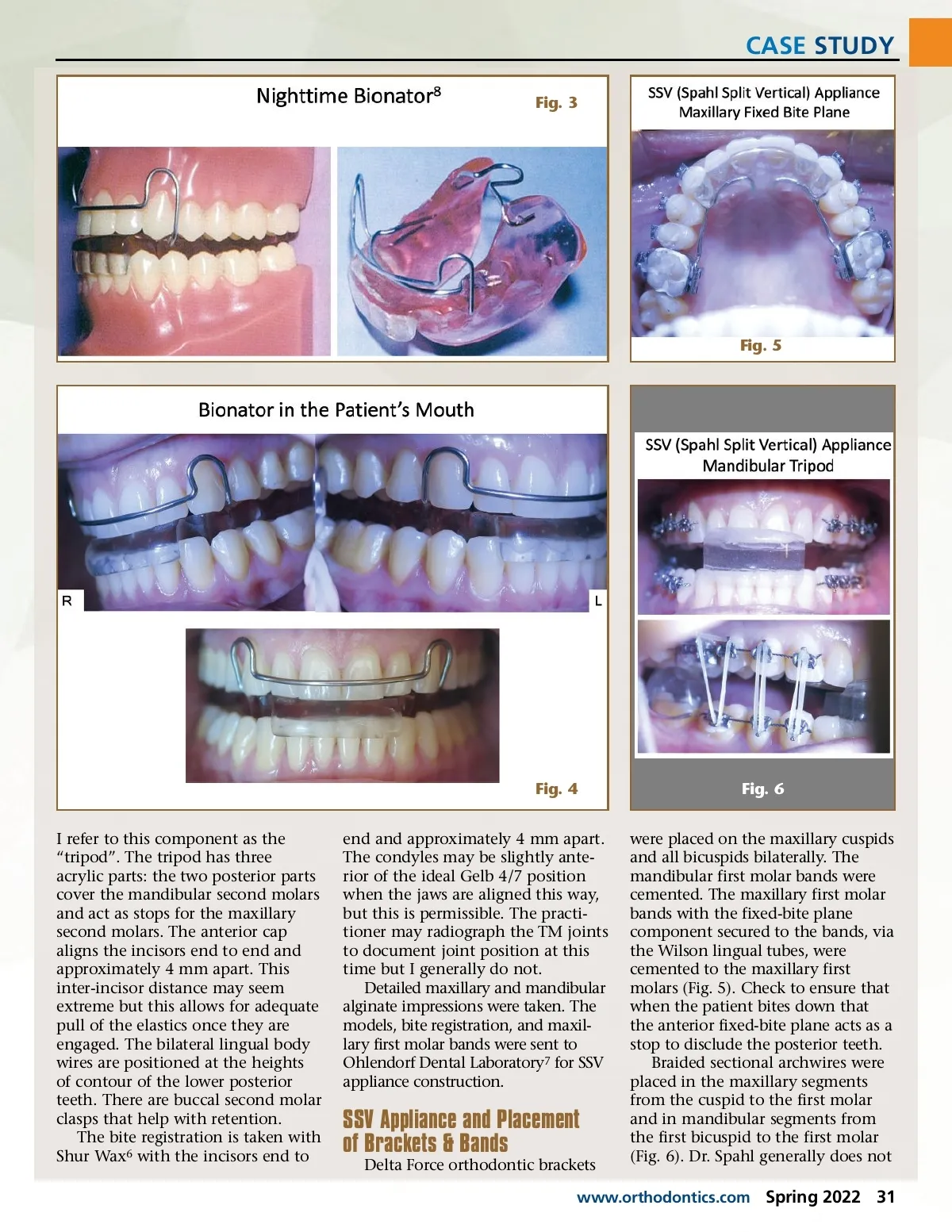
CASE STUDY Part 3 of 3 Clinical Management of the FJO-TMD-Migraine Continuum By Randy K. Newby, DDS I n Parts 1 and 2 of this series, a patient’s orthodontic case was presented. A bilateral Class I platform was achieved. (Fig. 1) Twenty months after the comple-tion of the orthodontic treatment, the patient started to manifest TMD symptoms. The patient was treated with an anterior repositioning appliance known as a Levandoski splint. 5 Four years later, the patient inquired about definitive treatment options so that she would not be reliant on a splint ad infinitum. The patient was treated for five months with the daytime Func-tional Advancing Condylar Trans-lation (FACT) appliance (Fig. 2) and the nighttime Bionator appli-ance (Figs. 3 and 4) to stabilize the TM joints and allow them to heal. Fig. 1 In the final part of this series, I will show how the resultant poste-rior open bite brought about by the slight advancement of the mandible was closed orthodontically with the Spahl Split Vertical (SSV) 8 appliance and vertical elastics. At the completion of treatment, the patient’s newly created occlu-sion will be in harmony and support proper TM position bilater-ally. Proper skeletal vertical dimen-sion of occlusion will be restored. No TM splint will be necessary. The case will be retained with a night-time Bionator (NTB) appliance. SSV Appliance Components The SSV appliance consists of two parts. The maxillary compo-nent (Fig. 5) serves as a fixed-bite plane such that when the lower incisors engage the anterior stop, the posterior teeth will disclude by at least a few millimeters. The first molar bands have Wilson lingual tube attachments to secure the bite plane. First bicuspid wire tops may be soldered onto the main body wire for added stability. I prefer not to use them as they interfere with eruption of the maxillary first bicus-pids when the elastics are worn. During the day or whenever the vertical elastics are not being worn, the maxillary component continues to support the TM joints in the vicinity of the GELB 4/7 position. Until the posterior teeth have erupted enough to support proper condylar position, at no point is the mandible allowed to walk back. The mandibular component (Figs. 6-8) is removable and is to be worn when the elastics are engaged. Fig. 2 30 Spring 2022 JAOS
Journal of the American Orthodontic Society Spring 2022: Page 30