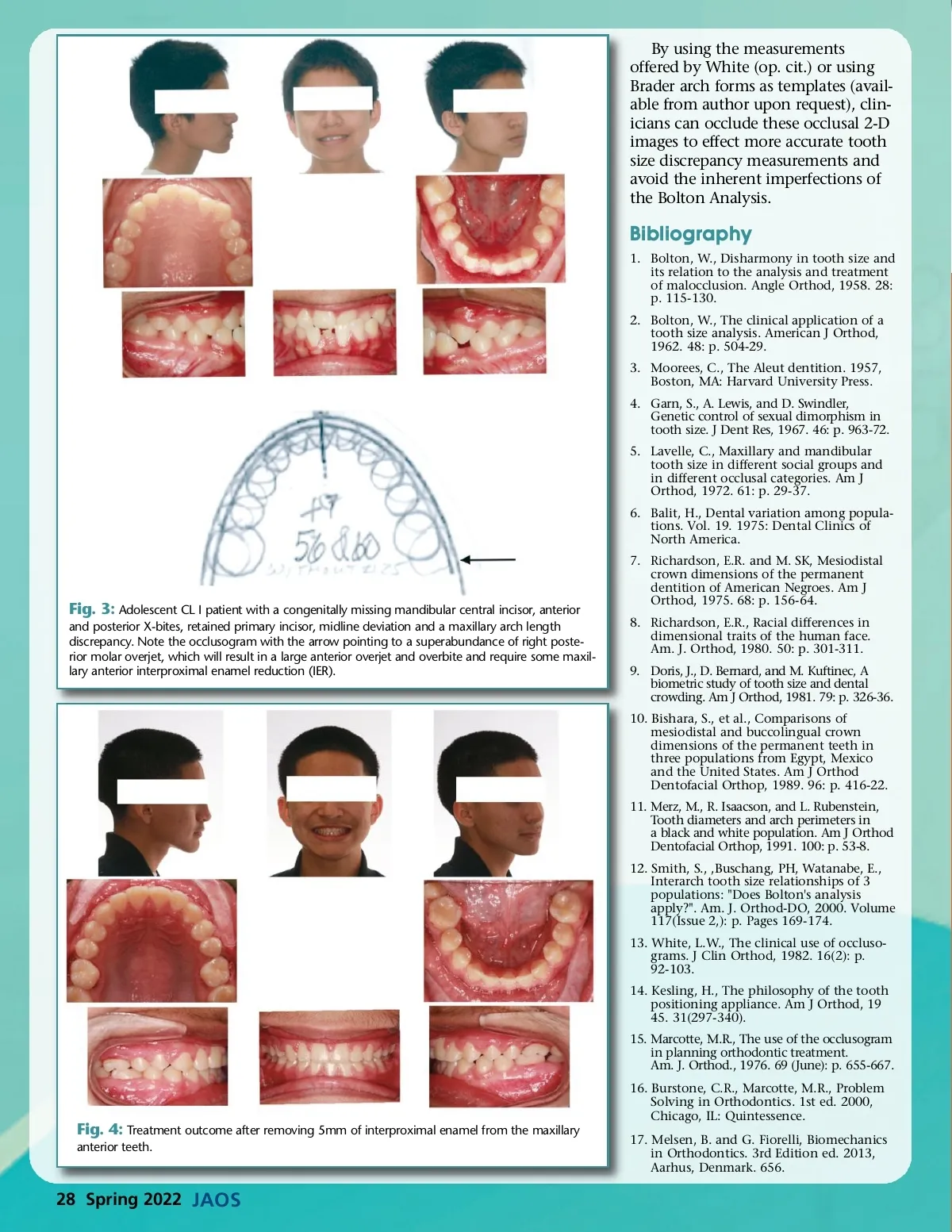
By using the measurements offered by White (op. cit.) or using Brader arch forms as templates (avail-able from author upon request), clin-icians can occlude these occlusal 2-D images to effect more accurate tooth size discrepancy measurements and avoid the inherent imperfections of the Bolton Analysis. Bibliography 1. Bolton, W., Disharmony in tooth size and its relation to the analysis and treatment of malocclusion. Angle Orthod, 1958. 28: p. 115-130. 2. Bolton, W., The clinical application of a tooth size analysis. American J Orthod, 1962. 48: p. 504-29. 3. Moorees, C., The Aleut dentition. 1957, Boston, MA: Harvard University Press. 4. Garn, S., A. Lewis, and D. Swindler, Genetic control of sexual dimorphism in tooth size. J Dent Res, 1967. 46: p. 963-72. 5. Lavelle, C., Maxillary and mandibular tooth size in different social groups and in different occlusal categories. Am J Orthod, 1972. 61: p. 29-37. 6. Balit, H., Dental variation among popula-tions. Vol. 19. 1975: Dental Clinics of North America. 7. Richardson, E.R. and M. SK, Mesiodistal crown dimensions of the permanent dentition of American Negroes. Am J Orthod, 1975. 68: p. 156-64. 8. Richardson, E.R., Racial differences in dimensional traits of the human face. Am. J. Orthod, 1980. 50: p. 301-311. 9. Doris, J., D. Bernard, and M. Kuftinec, A biometric study of tooth size and dental crowding. Am J Orthod, 1981. 79: p. 326-36. 10. Bishara, S., et al., Comparisons of mesiodistal and buccolingual crown dimensions of the permanent teeth in three populations from Egypt, Mexico and the United States. Am J Orthod Dentofacial Orthop, 1989. 96: p. 416-22. 11. Merz, M., R. Isaacson, and L. Rubenstein, Tooth diameters and arch perimeters in a black and white population. Am J Orthod Dentofacial Orthop, 1991. 100: p. 53-8. 12. Smith, S., ,Buschang, PH, Watanabe, E., Interarch tooth size relationships of 3 populations: "Does Bolton's analysis apply?". Am. J. Orthod-DO, 2000. Volume 117(Issue 2,): p. Pages 169-174. 13. White, L.W., The clinical use of occluso-grams. J Clin Orthod, 1982. 16(2): p. 92-103. 14. Kesling, H., The philosophy of the tooth positioning appliance. Am J Orthod, 19 45. 31(297-340). 15. Marcotte, M.R., The use of the occlusogram in planning orthodontic treatment. Am. J. Orthod., 1976. 69 (June): p. 655-667. 16. Burstone, C.R., Marcotte, M.R., Problem Solving in Orthodontics. 1st ed. 2000, Chicago, IL: Quintessence. 17. Melsen, B. and G. Fiorelli, Biomechanics in Orthodontics. 3rd Edition ed. 2013, Aarhus, Denmark. 656. Fig. 3: Adolescent CL I patient with a congenitally missing mandibular central incisor, anterior and posterior X-bites, retained primary incisor, midline deviation and a maxillary arch length discrepancy. Note the occlusogram with the arrow pointing to a superabundance of right poste-rior molar overjet, which will result in a large anterior overjet and overbite and require some maxil-lary anterior interproximal enamel reduction (IER). Fig. 4: Treatment outcome after removing 5mm of interproximal enamel from the maxillary anterior teeth. 28 Spring 2022 JAOS
Journal of the American Orthodontic Society Spring 2022: Page 28