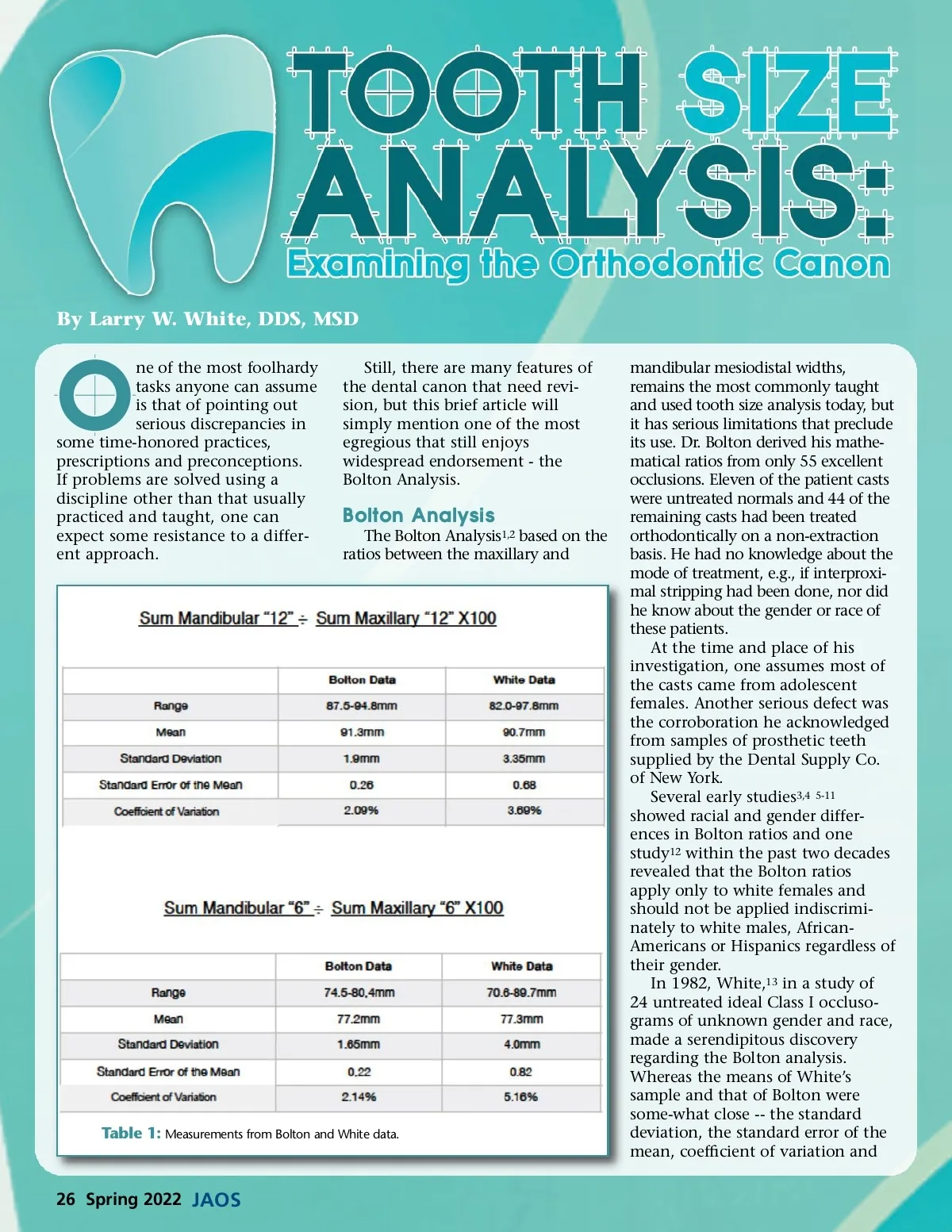
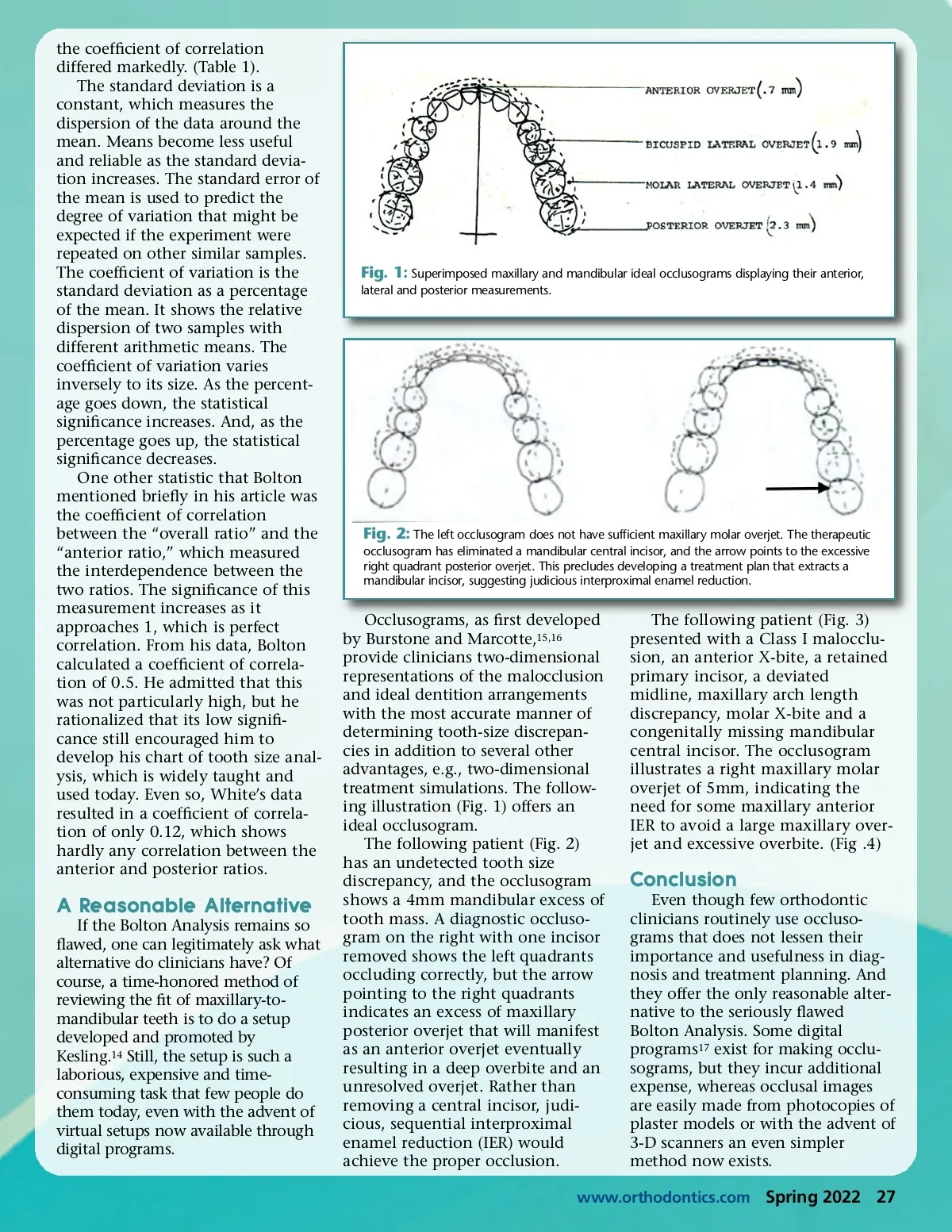
By Larry W. White, DDS, MSD O ne of the most foolhardy tasks anyone can assume is that of pointing out serious discrepancies in some time-honored practices, prescriptions and preconceptions. If problems are solved using a discipline other than that usually practiced and taught, one can expect some resistance to a differ-ent approach. Still, there are many features of the dental canon that need revi-sion, but this brief article will simply mention one of the most egregious that still enjoys widespread endorsement -the Bolton Analysis. Bolton Analysis The Bolton Analysis 1,2 based on the ratios between the maxillary and Table 1: Measurements from Bolton and White data. mandibular mesiodistal widths, remains the most commonly taught and used tooth size analysis today, but it has serious limitations that preclude its use. Dr. Bolton derived his mathe-matical ratios from only 55 excellent occlusions. Eleven of the patient casts were untreated normals and 44 of the remaining casts had been treated orthodontically on a non-extraction basis. He had no knowledge about the mode of treatment, e.g., if interproxi-mal stripping had been done, nor did he know about the gender or race of these patients. At the time and place of his investigation, one assumes most of the casts came from adolescent females. Another serious defect was the corroboration he acknowledged from samples of prosthetic teeth supplied by the Dental Supply Co. of New York. Several early studies 3,4 5-11 showed racial and gender differ-ences in Bolton ratios and one study 12 within the past two decades revealed that the Bolton ratios apply only to white females and should not be applied indiscrimi-nately to white males, African-Americans or Hispanics regardless of their gender. In 1982, White, 13 in a study of 24 untreated ideal Class I occluso-grams of unknown gender and race, made a serendipitous discovery regarding the Bolton analysis. Whereas the means of White’s sample and that of Bolton were some-what close --the standard deviation, the standard error of the mean, coefficient of variation and 26 Spring 2022 JAOS
Journal of the American Orthodontic Society Spring 2022: Page 26