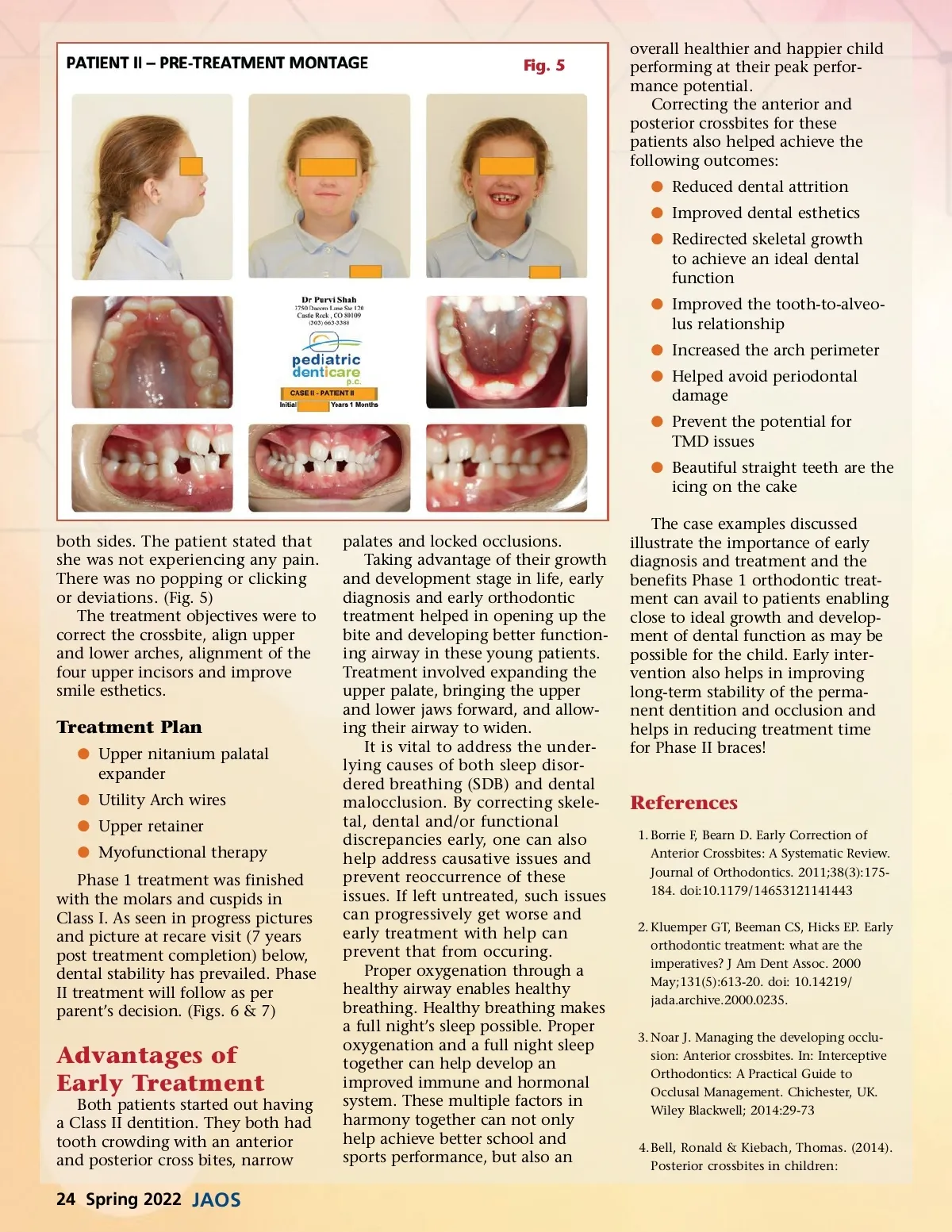
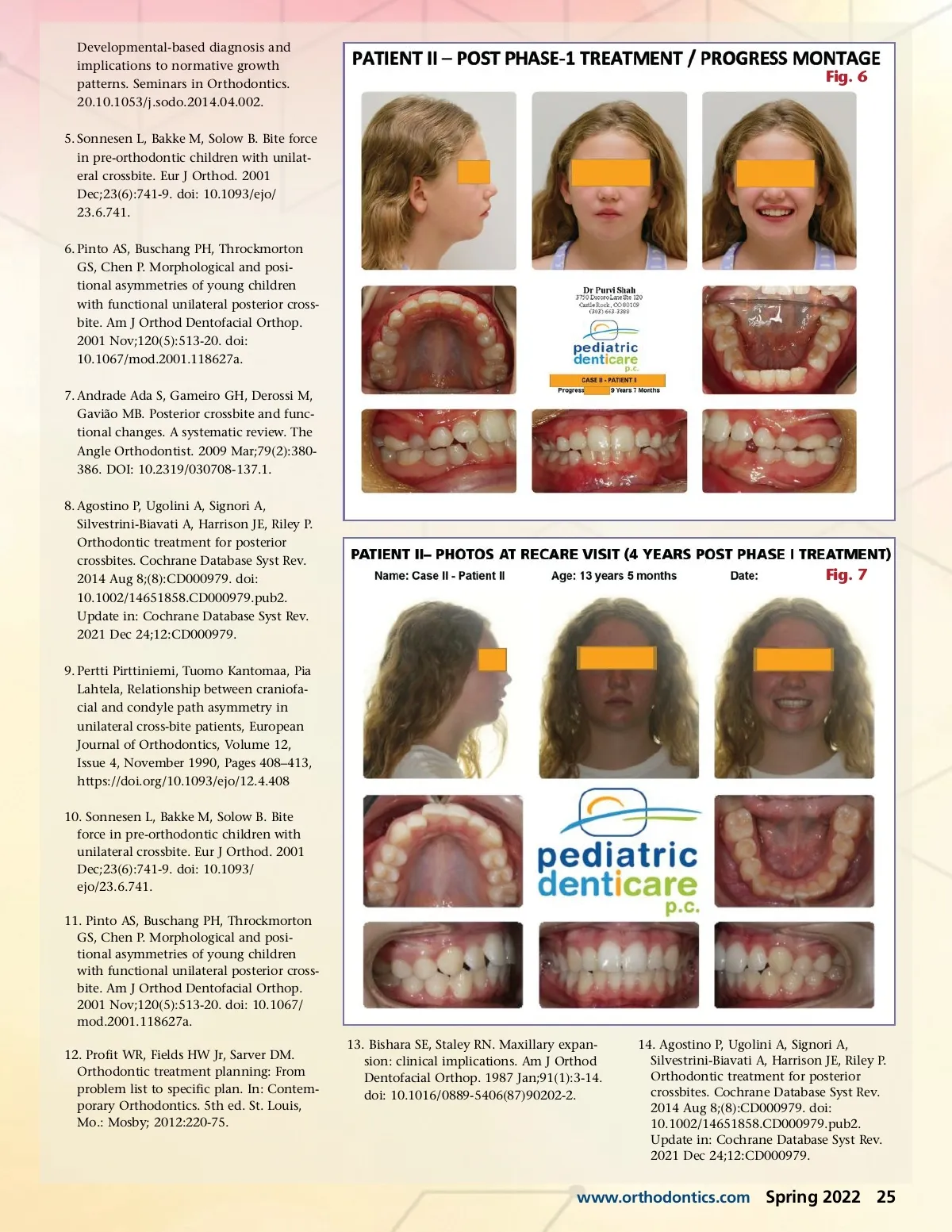
Fig. 5 overall healthier and happier child performing at their peak perfor-mance potential. Correcting the anterior and posterior crossbites for these patients also helped achieve the following outcomes: b Reduced dental attrition b Improved dental esthetics b Redirected skeletal growth to achieve an ideal dental function b Improved the tooth-to-alveo-lus relationship b Increased the arch perimeter b Helped avoid periodontal damage b Prevent the potential for TMD issues b Beautiful straight teeth are the icing on the cake The case examples discussed illustrate the importance of early diagnosis and treatment and the benefits Phase 1 orthodontic treat-ment can avail to patients enabling close to ideal growth and develop-ment of dental function as may be possible for the child. Early inter-vention also helps in improving long-term stability of the perma-nent dentition and occlusion and helps in reducing treatment time for Phase II braces! both sides. The patient stated that she was not experiencing any pain. There was no popping or clicking or deviations. (Fig. 5) The treatment objectives were to correct the crossbite, align upper and lower arches, alignment of the four upper incisors and improve smile esthetics. Treatment Plan b Upper nitanium palatal expander b Utility Arch wires b Upper retainer b Myofunctional therapy Phase 1 treatment was finished with the molars and cuspids in Class I. As seen in progress pictures and picture at recare visit (7 years post treatment completion) below, dental stability has prevailed. Phase II treatment will follow as per parent’s decision. (Figs. 6 & 7) Advantages of Early Treatment Both patients started out having a Class II dentition. They both had tooth crowding with an anterior and posterior cross bites, narrow palates and locked occlusions. Taking advantage of their growth and development stage in life, early diagnosis and early orthodontic treatment helped in opening up the bite and developing better function-ing airway in these young patients. Treatment involved expanding the upper palate, bringing the upper and lower jaws forward, and allow-ing their airway to widen. It is vital to address the under-lying causes of both sleep disor-dered breathing (SDB) and dental malocclusion. By correcting skele-tal, dental and/or functional discrepancies early, one can also help address causative issues and prevent reoccurrence of these issues. If left untreated, such issues can progressively get worse and early treatment with help can prevent that from occuring. Proper oxygenation through a healthy airway enables healthy breathing. Healthy breathing makes a full night’s sleep possible. Proper oxygenation and a full night sleep together can help develop an improved immune and hormonal system. These multiple factors in harmony together can not only help achieve better school and sports performance, but also an References 1. Borrie F, Bearn D. Early Correction of Anterior Crossbites: A Systematic Review. Journal of Orthodontics. 2011;38(3):175-184. doi:10.1179/14653121141443 2. Kluemper GT, Beeman CS, Hicks EP. Early orthodontic treatment: what are the imperatives? J Am Dent Assoc. 2000 May;131(5):613-20. doi: 10.14219/ jada.archive.2000.0235. 3. Noar J. Managing the developing occlu-sion: Anterior crossbites. In: Interceptive Orthodontics: A Practical Guide to Occlusal Management. Chichester, UK. Wiley Blackwell; 2014:29-73 4. Bell, Ronald & Kiebach, Thomas. (2014). Posterior crossbites in children: 24 Spring 2022 JAOS
Journal of the American Orthodontic Society Spring 2022: Page 24